RankRizz

Degrees of freedom, equipartition of energy and internal energy — JEE Main Previous Year Questions

Degrees of freedom, equipartition of energy and internal energy has been asked 22 times in JEE Main, in 12 different years between 2006 and 2026, and in all of the last five exam years (2022–2026), 10 questions in all. That is 12% of Kinetic Theory of Gases. Last asked in JEE Main 06 Apr 2026, Shift 2. 20 are multiple choice and 2 numerical-value; 10 easy and 9 medium by our difficulty labels. All of them are below, newest first, free to read.

Questions

22

Years asked

12

Since

2006

Of the chapter

12%

When JEE Main asked it

Questions on Degrees of freedom, equipartition of energy and internal energy in every year it was asked, newest first.

JEE Main questions on Degrees of freedom, equipartition of energy and internal energy by year, 2006–2026
YearRelative frequencyQuestions
20261
20251
20244
20232
20222
20213
20202
20193
20171
20111
20091
20061
Total22

Every Degrees of freedom, equipartition of energy and internal energy question

1–20 OF 22 · NEWEST FIRST

JEE MAIN 2026 · 06 APR S2Degrees of freedom, equipartition of energy and internal energy

If 2 mole of an ideal monoatomic gas at temperature TT, is mixed with 6 mole of another ideal monoatomic gas at temperature 2T2T then the temperature of mixture is :

  1. A

    52T\dfrac{5}{2}T

  2. B

    54T\dfrac{5}{4}T

  3. C

    72T\dfrac{7}{2}T

  4. D

    74T\dfrac{7}{4}T

JEE MAIN 2025 · 02 APR S2Degrees of freedom, equipartition of energy and internal energy

The internal energy of air in a 4 m×4 m×3 m4\,\text{m} \times 4\,\text{m} \times 3\,\text{m} sized room at 1 atmospheric pressure will be _________ ×106\times 10^6 J.
(Consider air as diatomic molecule)

JEE MAIN 2024 · 06 APR S2Degrees of freedom, equipartition of energy and internal energy

Energy of 10 non rigid diatomic molecules at temperature TT is :

  1. A

    70KBT70 K_B T

  2. B

    35KBT35 K_B T

  3. C

    72RT\frac{7}{2} RT

  4. D

    35RT35 RT

JEE MAIN 2024 · 04 APR S2Degrees of freedom, equipartition of energy and internal energy

The translational degrees of freedom (ft)(f_t) and rotational degrees of freedom (fr)(f_r) of CH4CH_4 molecule are:

  1. A

    ft=2f_t = 2 and fr=2f_r = 2

  2. B

    ft=3f_t = 3 and fr=3f_r = 3

  3. C

    ft=3f_t = 3 and fr=2f_r = 2

  4. D

    ft=2f_t = 2 and fr=3f_r = 3

JEE MAIN 2024 · 31 JAN S2Degrees of freedom, equipartition of energy and internal energy

A gas mixture consists of 8 moles of argon and 6 moles of oxygen at temperature TT. Neglecting all vibrational modes, the total internal energy of the system is

  1. A

    29RT29RT

  2. B

    20RT20RT

  3. C

    27RT27RT

  4. D

    21RT21RT

JEE MAIN 2024 · 27 JAN S2Degrees of freedom, equipartition of energy and internal energy

The total kinetic energy of 1 mole of oxygen at 27°C is :
[Use universal gas constant (R) = 8.31 J mol−1^{-1} K−1^{-1}]

  1. A

    6845.5 J

  2. B

    5942.0 J

  3. C

    6232.5 J

  4. D

    5670.5 J

JEE MAIN 2023 · 10 APR S1Degrees of freedom, equipartition of energy and internal energy

Match List I with List II:

List IList II
(A)3 Translational degrees of freedom(I)Monoatomic gases
(B)3 Translational, 2 rotational degrees of freedom(II)Polyatomic gases
(C)3 Translational, 2 rotational and 1 vibrational degrees of freedom(III)Rigid diatomic gases
(D)3 Translational, 3 rotational and more than one vibrational degrees of freedom(IV)Nonrigid diatomic gases


Choose the correct answer from the options below:

  1. A

    A-I, B-III, C-IV, D-II

  2. B

    A-IV, B-III, C-II, D-I

  3. C

    A-IV, B-II, C-I, D-III

  4. D

    A-I, B-IV, C-III, D-II

JEE MAIN 2023 · 10 APR S2Degrees of freedom, equipartition of energy and internal energy

A gas mixture consists of 2 moles of oxygen and 4 moles of neon at temperature TT. Neglecting all vibrational modes, the total internal energy of the system will be:

  1. A

    11RT

  2. B

    8RT

  3. C

    4RT

  4. D

    16RT

JEE MAIN 2022 · 27 JUL S2Degrees of freedom, equipartition of energy and internal energy

Which statements are correct about degrees of freedom?
A. A molecule with nn degrees of freedom has n2{n^{2}} different ways of storing energy.
B. Each degree of freedom is associated with 12RT\frac{1}{2}RT average energy per mole.
C. A monoatomic gas molecule has 1 rotational degree of freedom whereas diatomic molecule has 2 rotational degrees of freedom.
D. CH4CH_4 has a total of 6 degrees of freedom.
Choose the correct answer from the options given below:

  1. A

    B and C only

  2. B

    B and D only

  3. C

    A and B only

  4. D

    C and D only

JEE MAIN 2022 · 28 JUN S1Degrees of freedom, equipartition of energy and internal energy

The total internal energy of two mole monoatomic ideal gas at temperature T=300T = 300 K will be ______ J. (Given R=8.31R = 8.31 J mol−1^{-1} K−1^{-1})

JEE MAIN 2021 · 17 MAR S1Degrees of freedom, equipartition of energy and internal energy

Two ideal polyatomic gases at temperatures T1T_1 and T2T_2 are mixed so that there is no loss of energy. If F1F_1 and F2F_2, m1m_1 and m2m_2, n1n_1 and n2n_2 be the degrees of freedom, masses, number of molecules of the first and second gas respectively, the temperature of mixture of these two gases is:

  1. A

    n1T1+n2T2n1+n2\frac{n_1 T_1 + n_2 T_2}{n_1 + n_2}

  2. B

    n1F1T1+n2F2T2n1F1+n2F2\frac{n_1 F_1 T_1 + n_2 F_2 T_2}{n_1 F_1 + n_2 F_2}

  3. C

    n1F1T1+n2F2T2F1+F2\frac{n_1 F_1 T_1 + n_2 F_2 T_2}{F_1 + F_2}

  4. D

    n1F1T1+n2F2T2n1+n2\frac{n_1 F_1 T_1 + n_2 F_2 T_2}{n_1 + n_2}

JEE MAIN 2021 · 26 FEB S2Degrees of freedom, equipartition of energy and internal energy

The internal energy (U), pressure (P) and volume (V) of an ideal gas are related as U=3PV+4U = 3PV + 4. The gas is

  1. A

    either monoatomic or diatomic

  2. B

    polyatomic only

  3. C

    monoatomic only

  4. D

    diatomic only

JEE MAIN 2021 · 25 FEB S2Degrees of freedom, equipartition of energy and internal energy

Given below are two statements:
Statement I: In a diatomic molecule, the rotational energy at a given temperature obeys Maxwell's distribution.
Statement II: In a diatomic molecule, the rotational energy at a given temperature equals the translational kinetic energy for each molecule.
In the light of the above statements, choose the correct answer from the options given below:

  1. A

    Statement I is false but Statement II is true.

  2. B

    Statement I is true but Statement II is false.

  3. C

    Both Statement I and Statement II are true.

  4. D

    Both Statement I and Statement II are false.

JEE MAIN 2020 · 03 SEP S1Degrees of freedom, equipartition of energy and internal energy

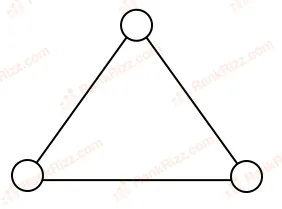
Consider a gas of triatomic molecules. The molecules are assumed to be triangular and made of massless rigid rods whose vertices are occupied by atoms. The internal energy of a mole of the gas at temperature T is:

Figure for JEE Main 2020 Physics question on Degrees of freedom, equipartition of energy and internal energy
  1. A

    52RT\frac{5}{2}RT

  2. B

    32RT\frac{3}{2}RT

  3. C

    92RT\frac{9}{2}RT

  4. D

    3RT3RT

JEE MAIN 2020 · 02 SEP S1Degrees of freedom, equipartition of energy and internal energy

A gas mixture consists of 3 moles of oxygen and 5 moles of argon at temperature T. Assuming the gases to be ideal and the oxygen bond to be rigid, the total internal energy (in units of RT) of the mixture is:

  1. A

    15

  2. B

    13

  3. C

    20

  4. D

    11

JEE MAIN 2019 · 09 APR S1Degrees of freedom, equipartition of energy and internal energy

An HCl molecule has rotational, translational and vibrational motions. If the rms velocity of HCl molecules in its gaseous phase is vˉ\bar{v}, m is its mass and kB_B is Boltzmann's constant, then its temperature will be:

  1. A

    mvˉ25kB\frac{m\bar{v}^2}{5k_B}

  2. B

    mvˉ26kB\frac{m\bar{v}^2}{6k_B}

  3. C

    mvˉ23kB\frac{m\bar{v}^2}{3k_B}

  4. D

    mvˉ27kB\frac{m\bar{v}^2}{7k_B}

JEE MAIN 2019 · 12 JAN S1Degrees of freedom, equipartition of energy and internal energy

An ideal gas occupies a volume of 2m32 m^3 at a pressure of 3×10⁶Pa3 \times 10^6 Pa. The energy of the gas is:

  1. A

    108J10^8 J

  2. B

    9×10⁶J9 \times 10^6 J

  3. C

    3×10²J3 \times 10^2 J

  4. D

    6×10⁴J6 \times 10^4 J

JEE MAIN 2019 · 11 JAN S1Degrees of freedom, equipartition of energy and internal energy

A gas mixture consists of 3 moles of oxygen and 5 moles of argon at temperature T. Considering only translational and rotational modes, the total internal energy of the system is

  1. A

    15RT

  2. B

    12RT

  3. C

    4RT

  4. D

    20RT

JEE MAIN 2017 · 09 APR ONLINEDegrees of freedom, equipartition of energy and internal energy

NN moles of diatomic gas in a cylinder is at a temperature TT. Heat is supplied to the cylinder such that the temperature remains constant but nn moles of the diatomic gas get converted into monoatomic gas. The change in the total kinetic energy of the gas is

  1. A

    0

  2. B

    52nRT\frac{5}{2}nRT

  3. C

    32nRT\frac{3}{2}nRT

  4. D

    12nRT\frac{1}{2}nRT

JEE MAIN 2011Degrees of freedom, equipartition of energy and internal energy

Three perfect gases at absolute temperatures T1,T2T_1, T_2 and T3T_3 are mixed. The masses of molecules are m1,m2m_1, m_2 and m3m_3 and the number of molecules are n1,n2n_1, n_2 and n3n_3 respectively. Assuming no loss of energy, the final temperature of the mixture is:

  1. A

    n1T1+n2T2+n3T3n1+n2+n3\dfrac{n_1 T_1 + n_2 T_2 + n_3 T_3}{n_1 + n_2 + n_3}

  2. B

    n1T12+n2T22+n3T32n1T1+n2T2+n3T3\dfrac{n_1 T_1^2 + n_2 T_2^2 + n_3 T_3^2}{n_1 T_1 + n_2 T_2 + n_3 T_3}

  3. C

    n12T12+n22T22+n32T32n1T1+n2T2+n3T3\dfrac{n_1^2 T_1^2 + n_2^2 T_2^2 + n_3^2 T_3^2}{n_1 T_1 + n_2 T_2 + n_3 T_3}

  4. D

    (T1+T2+T3)3\dfrac{(T_1 + T_2 + T_3)}{3}

Degrees of freedom, equipartition of energy and internal energy: common questions

How many Degrees of freedom, equipartition of energy and internal energy questions have come in JEE Main?
Degrees of freedom, equipartition of energy and internal energy has been asked 22 times in JEE Main, in 12 different years between 2006 and 2026. It came up in all of the last five exam years (2022–2026), 10 questions in all.
Is Degrees of freedom, equipartition of energy and internal energy important for JEE Main?
It is part of Kinetic Theory of Gases: 22 of the chapter's 191 JEE Main questions (12%). It came up in all of the last five exam years (2022–2026), 10 questions in all.
When was Degrees of freedom, equipartition of energy and internal energy last asked in JEE Main?
Most recently in JEE Main 06 Apr 2026, Shift 2. Questions on this page are newest first, so the latest ones are at the top.
What kind of Degrees of freedom, equipartition of energy and internal energy questions does JEE Main ask?
20 are multiple choice and 2 numerical-value; 10 easy and 9 medium by our difficulty labels. Each question shows its answer key and worked solution where we have them.