RankRizz

Kinetic Theory of Gases — JEE Advanced Previous Year Questions

Kinetic Theory of Gases has been asked in 11 of the 20 JEE Advanced years from 2007 to 2026: 15 questions in all. It was not set in any of the 2 2026 papers. Across the last 20 papers it carried 1.7% of Physics questions. By type: 11 single-correct, 3 multiple-correct and 1 numerical. Of the 15 with a difficulty tag, 33% are easy, 53% medium and 13% hard. Most asked: Ideal gas equation and gas laws (11, 73%) and Degrees of freedom, equipartition of energy and internal energy (4, 27%).

DATA UPDATED

Questions

15

Distinct ideas

2

Share of marks

1.7%

Difficulty

EASY

Kinetic Theory of Gases weightage, year by year

The share of each year’s Physics questions that came from Kinetic Theory of Gases, counted from the 19 papers we hold for the last 10 years, and paper by paper inside a year.

Falling: 0.0% of Physics questions in 2024–2026, down from 2.6% in 2017–2023. Its heaviest year was 2023, at 5.9%. Not asked at all in 2018, 2019, 2022, 2024, 2025, 2026.

Kinetic Theory of Gases questions per year, per paper, and as a share of Physics questions
YEARQSPER PAPERSHARE OF PHYSICSCHANGE
20260 / 340.00.0%level
20250 / 320.00.0%level
20240 / 340.00.0%−5.9 pts
20232 / 341.05.9%+5.9 pts
20220 / 360.00.0%−2.6 pts
20211 / 380.52.6%−3.0 pts
20202 / 361.05.6%+5.6 pts
20190 / 360.00.0%level
20180 / 180.00.0%−2.8 pts
20171 / 360.52.8%—

“QS” is Kinetic Theory of Gases questions out of all Physics questions that year; “per paper” is that count over the year’s papers, and “change” is the share against the year before. A year with more sittings asks more questions, which is why the share, not the count, is the number to compare.

The ideas inside Kinetic Theory of Gases

A chapter is not one subject — it is a handful of procedures the examiner reuses. These are the ones Kinetic Theory of Gases questions actually test.

01Ideal gas equation and gas lawsset 11×
02Kinetic interpretation of pressure and temperatureNot set in Advanced
03RMS, average and most probable speeds of gas moleculesNot set in Advanced
04Degrees of freedom, equipartition of energy and internal energyset 4×
05Molar specific heats of gases, Mayer's relation and gas mixturesNot set in Advanced
06Mean free pathNot set in Advanced

All 15 Kinetic Theory of Gases questions, by topic

Every JEE Advanced Kinetic Theory of Gases question we hold, newest first inside each topic. Open one for its options, answer key and solution.

FREE PDF

Kinetic Theory of Gases JEE Advanced PYQs with answer key

All 15 questions on A4, by topic, with the answer key at the end. No sign-up, no email: your browser saves it as a PDF.

Download free PDF

UNIQUE CONCEPTS

Kinetic Theory of Gases: one question per idea

6 ideas, each with the latest past question that tested it, drawn from 205 JEE Main and Advanced questions.

Kinetic Theory of Gases Unique Concepts sheet →

JEE MAIN

Kinetic Theory of Gases in JEE Main

JEE Main has set 191 Kinetic Theory of Gases questions, 2004–2026.

Kinetic Theory of Gases JEE Main PYQs →

Kinetic Theory of Gases: quick answers

Is Kinetic Theory of Gases asked every year in JEE Advanced?

Not every year. It has been asked in 11 of the 20 JEE Advanced years from 2007 to 2026; it was missing in 9 of them, most recently 2026.

Which Kinetic Theory of Gases topic is asked most in JEE Advanced?

Ideal gas equation and gas laws: 11 of the 15 questions (73%). Next come Degrees of freedom, equipartition of energy and internal energy (4).

What share of Physics questions does Kinetic Theory of Gases carry in JEE Advanced?

About 1.7% of Physics questions across the last 20 papers. In 2026 it was 0.0% (0 of 34 Physics questions).

When was Kinetic Theory of Gases last asked in JEE Advanced?

In JEE Advanced 2023 Paper 2, the latest sitting with a Kinetic Theory of Gases question. It has not been set since 2023, though the bank holds JEE Advanced papers up to 2026.

How many Kinetic Theory of Gases questions has JEE Advanced asked?

15 from 2007 to 2023, across 2 topics. Every one is listed on this page by topic and links to its own page, with the answer key and solution wherever we have them. Free, no sign-up.

Every Kinetic Theory of Gases question

1–15 OF 15 · NEWEST FIRST

JEE ADVANCED 2023 · PAPER 2Degrees of freedom, equipartition of energy and internal energy

An ideal gas is in thermodynamic equilibrium. The number of degrees of freedom of a molecule of the gas is nn. The internal energy of one mole of the gas is UnU_n and the speed of sound in the gas is vnv_n. At a fixed temperature and pressure, which of the following is the correct option?

  1. A

    v3<v6v_3 < v_6 and U3>U6U_3 > U_6

  2. B

    v5>v3v_5 > v_3 and U3>U5U_3 > U_5

  3. C

    v5>v7v_5 > v_7 and U5<U7U_5 < U_7

  4. D

    v6<v7v_6 < v_7 and U6<U7U_6 < U_7

JEE ADVANCED 2023 · PAPER 1Ideal gas equation and gas laws

One mole of an ideal gas expands adiabatically from an initial state (TA,V0)(T_A, V_0) to final state (Tf,5V0)(T_f, 5V_0). Another mole of the same gas expands isothermally from a different initial state (TB,V0)(T_B, V_0) to the same final state (Tf,5V0)(T_f, 5V_0). The ratio of the specific heats at constant pressure and constant volume of this ideal gas is γ\gamma. What is the ratio TA/TBT_A/T_B?

  1. A

    5γ−15^{\gamma - 1}

  2. B

    51−γ5^{1-\gamma}

  3. C

    5γ5^{\gamma}

  4. D

    51+γ5^{1+\gamma}

JEE ADVANCED 2021 · PAPER 2Ideal gas equation and gas laws

The value of QRTo\frac{Q}{RT_o} is

  1. A

    4(22+1)4(2 \sqrt{2} + 1)

  2. B

    4(22−1)4(2 \sqrt{2} - 1)

  3. C

    (52+1)(5 \sqrt{2} + 1)

  4. D

    (52−1)(5 \sqrt{2} - 1)

JEE ADVANCED 2020 · PAPER 2Ideal gas equation and gas laws

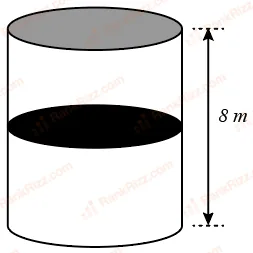
A thermally isolated cylindrical closed vessel of height 8 m is kept vertically. It is divided into two equal parts by a diathermic (perfect thermal conductor) frictionless partition of mass 8.3 kg. Thus the partition is held initially at a distance of 4 m from the top, as shown in the schematic figure below. Each of the two parts of the vessel contains 0.1 mole of an ideal gas at temperature 300 K. The partition is now released and moves without any gas leaking from one part of the vessel to the other. When equilibrium is reached, the distance of the partition from the top (in m) will be _______ (take the acceleration due to gravity = 10 ms−2^{-2} and the universal gas constant = 8.3 J mol−1^{-1} K−1^{-1}).

Figure for JEE Advanced 2020 Physics question on Ideal gas equation and gas laws
JEE ADVANCED 2020 · PAPER 1Ideal gas equation and gas laws

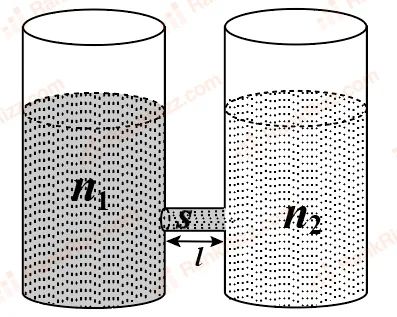
As shown schematically in the figure, two vessels contain water solutions (at temperature 𝑇) of
potassium permanganate (KMnO4KMnO_{4}) of different concentrations n1n_{1} and n2(n1>n2)n_{2} (n_{1} > n_{2}) molecules per unit volume with △n=(n1−n2)<<n1\triangle n = (n_{1} − n_{2}) << n_{1}. When they are connected by a tube of small length l and cross-sectional area S, KMnO4KMnO_{4} starts to diffuse from the left to the right vessel through the tube. Consider the collection of molecules to behave as dilute ideal gases and the difference in their partial pressure in the two vessels causing the diffusion. The speed 𝑣 of the molecules is limited by the viscous force −βvoneachmolecule,where−\beta v on each molecule, where\betaisaconstant.Neglectingalltermsoftheorderis a constant. Neglecting all terms of the order\left(\tirangle n\right)^{2},whichofthefollowingis/arecorrect?(, which of the following is/are correct? (k_{B}$$ is the Boltzmann constant)

Figure for JEE Advanced 2020 Physics question on Ideal gas equation and gas laws
  1. A

    the force causing the molecules to move across the tube is △nkBTS\triangle nk_{B}TS

  2. B

    force balance implies n1βvl=△nkBTn_{1} \beta vl = \triangle nk_{B}T

  3. C

    total number of molecules going across the tube per sec is (△nl)(kBTβ)\left(\frac{\triangle n}{l}\right) \left(\frac{k_{B}T}{\beta}\right)

  4. D

    rate of molecules getting transferred through the tube does not change with time

JEE ADVANCED 2017 · PAPER 1Ideal gas equation and gas laws

A flat plate is moving normal to its plane through a gas under the action of a constant force F. The gas is kept at a very low pressure. The speed of the plate v is much less than the average speed u of the gas molecules. Which of the following options is/are true?

  1. A

    The pressure difference between the leading and trailing faces of the plate is proportional to uv

  2. B

    The resistive force experienced by the plate is proportional to v

  3. C

    The plate will continue to move with constant non-zero acceleration, at all times

  4. D

    At a later time the external force F balances the resistive force

JEE ADVANCED 2015 · PAPER 1Degrees of freedom, equipartition of energy and internal energy

A containerof fixed volume has a mixture of one mole of hydrogen and one mole of helium in equilibrium at temperature T. Assuming The average energy per mole of the gas mixture is 2RT.the gases are ideal, the correct statement(s) is(are)

  1. A

    The average energy per mole of the gas mixture is 2RT.

  2. B

    The ratio of speed of soundin the gas mixture to that in helium gas is 65\sqrt{\frac {6}{5}}

  3. C

    The ratio of the rms speed of helium atoms to that of hydrogen molecules is 12\frac {1}{2}

  4. D

    The ratio of the rms speed of helium atoms to that of hydrogen molecules is 12\frac {1}{\sqrt 2}

JEE ADVANCED 2013 · PAPER 1Ideal gas equation and gas laws

Two non-reactive monoatomic ideal gases have their atomic masses in the ratio 2 : 3. The ratio of their partial pressures, when enclosed in a vessel kept at a constant temperature, is 4 : 3. The ratio of their densities is

  1. A

    1 : 4

  2. B

    1 : 2

  3. C

    6 : 9

  4. D

    8 : 9

JEE ADVANCED 2012 · PAPER 1Degrees of freedom, equipartition of energy and internal energy

A mixture of 2 moles of helium gas (atomic mass = 4 amu) and 1 mole of argon gas (atomic mass = 40 amu) is kept at 300 K in a container. The ratio of the rms speeds
(vrms(helium)vrms(argon))\left(\frac{v_{rms}(helium)}{v_{rms}(argon)}\right)

  1. A

    0.32

  2. B

    0.45

  3. C

    2.24

  4. D

    3.16

JEE ADVANCED 2010 · PAPER 1Ideal gas equation and gas laws

A real gas behaves like an ideal gas if its

  1. A

    pressure and temperature are both high

  2. B

    pressure and temperature are both low

  3. C

    pressure is high and temperature is low

  4. D

    pressure is low and temperature is high

JEE ADVANCED 2009 · PAPER 1Degrees of freedom, equipartition of energy and internal energy

CvC_v and CpC_p denote the molar specific heat capacities of a gas at constant volume and constant pressure, respectively. Then

  1. A

    Cp−CvC_p - C_v is larger for a diatomic ideal gas than for a monoatomic ideal gas

  2. B

    Cp+CvC_p + C_v is larger for a diatomic ideal gas than for a monoatomic ideal gas

  3. C

    Cp/CvC_p / C_v is larger for a diatomic ideal gas than for a monoatomic ideal gas

  4. D

    Cp.CvC_p . C_v is larger for a diatomic ideal gas than for a monoatomic ideal gas

JEE ADVANCED 2008 · PAPER 1Ideal gas equation and gas laws

An ideal gas is expanding such that PT2=PT^2 = constant. The coefficient of volume expansion of the gas is

  1. A

    1T\frac{1}{T}

  2. B

    2T\frac{2}{T}

  3. C

    3T\frac{3}{T}

  4. D

    4T\frac{4}{T}

JEE ADVANCED 2007 · PAPER 2Ideal gas equation and gas laws

STATEMENT-1
The total translational kinetic energy of all the molecules of a given massof an ideal gas is 1.5 times the product of its pressure and its volume.
because
STATEMENT-2
The molecules of a gas collide with each other and the velocities of the molecules change dueto thecollision.

  1. A

    Statement-1 is True, Statement-2 is True; Statement-2 is a correct explanation for Statement-1

  2. B

    Statement-1 is True, Statement-2 is True; Statement-2 is NOT a correct explanation for Statement-1

  3. C

    Statement-1 is True, Statement-2 is False

  4. D

    Statement-1 is False, Statement-2 is True

JEE ADVANCED 2007 · PAPER 1Ideal gas equation and gas laws

The piston is now pulled out slowly and held at a distance 2L from the top. The pressure in the cylinder between its top and the piston will then be

  1. A

    P0P_0

  2. B

    P02\frac{P_0}{2}

  3. C

    P02+MgπR2\frac{P_0}{2} + \frac{Mg}{\pi R^2}

  4. D

    P02−MgπR2\frac{P_0}{2} - \frac{Mg}{\pi R^2}

JEE ADVANCED 2007 · PAPER 1Ideal gas equation and gas laws

While the piston is at a distance 2L from the top, the hole at the top is sealed. The piston is then released, to a position where it can stay in equilibrium. In this condition, the distance of the piston from the top is

  1. A

    (2P0πR2πR2P0+Mg)(2L)\left(\frac{2P_0\pi R^2}{\pi R^2 P_0 + Mg}\right)(2L)

  2. B

    (P0πR2−MgπR2P0)(2L)\left(\frac{P_0\pi R^2 - Mg}{\pi R^2 P_0}\right)(2L)

  3. C

    (P0πR2+MgπR2P0)(2L)\left(\frac{P_0\pi R^2 + Mg}{\pi R^2 P_0}\right)(2L)

  4. D

    (P0πR2πR2P0−Mg)(2L)\left(\frac{P_0\pi R^2}{\pi R^2 P_0 - Mg}\right)(2L)