JEE MAIN 2021 · 20 JUL S1Stoichiometry, limiting reagent and percentage yield
250 mL of 0.5M NaOH was added to 500 mL of 1M HCl. The number of unreacted HCl molecules in the solution is p. Find out p.
(Nearest integer) (N = 6.022 )
Every Some Basic Concepts of Chemistry question JEE Main has set from 2004–2026, grouped by the idea it tests rather than the order of the syllabus. 252 questions across 5 distinct ideas. Free to read, answer key on every one.
DATA UPDATED
Questions
252
Distinct ideas
5
Share of marks
4.4%
Difficulty
EASY
A chapter is not one subject — it is a handful of procedures the examiner reuses. These are the ones Some Basic Concepts of Chemistry questions actually test.
161–180 OF 252 · NEWEST FIRST
250 mL of 0.5M NaOH was added to 500 mL of 1M HCl. The number of unreacted HCl molecules in the solution is p. Find out p.
(Nearest integer) (N = 6.022 )
4 g equimolar mixture of NaOH and NaCO contains xg of NaOH and yg of NaCO. The value of x is ___g. (Nearest integer)
10.0 ml of NaCO solution is titrated against 0.2 M HCl solution. The following values were obtained in 5 readings. 4.8 ml, 4.9 ml, 5.0 ml, 5.0 ml and 5.0 ml
Based on these readings, and convention of titrimetric estimation of concentration of NaCO solution is ___ mM.
(Round off to the Nearest integer)
The mole fraction of a solute in a 100 molal aqueous solution is ________ . (Round off to the Nearest Integer).
[Given: Atomic masses: H: 1.0 u, O: 16.0 u]
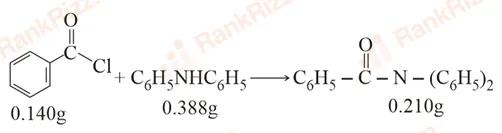
Consider the above reaction. The percentage yield of amide product is ________ (Round off to the Nearest Integer).
(Given: Atomic mass: C: 12.0u, H: 1.0u, N: 14.0u, O: 16.0u, Cl: 35.5u)
Complete combustion of 750 g of an organic compound provides 420 g of and 210 g of . The percentage composition of carbon and hydrogen in organic compound is 15.3 and ________ respectively. (Round off to the Nearest Integer)
A 6.50 molal solution of KOH (aq.) has a density of 1.89 g cm. The molarity of the solution is ________ mol dm. (Round off to the Nearest Integer).
[Atomic masses: K: 39.0 u; O: 16.0 u; H: 1.0 u]
The exact volumes of 1 M NaOH solution required to neutralise 50 mL of 1 M solution and 100 mL of 2 M solution, respectively, are:
100 mL and 100 mL
100 mL and 50 mL
100 mL and 200 mL
50 mL and 50 mL
When 35 mL of 0.15 M lead nitrate solution is mixed with 20 mL of 0.12 M chromic sulphate solution, ________ moles of lead sulphate precipitate out. (Round off to the Nearest Integer).
The weighed out to make 50 mL of an aqueous solution containing 70.0 mg Na per mL is ______ g.
(Rounded off to the nearest integer) [Given: Atomic weight in g mol - Na: 23; N: 14; O: 16]
Complete combustion of 1.80 g of an oxygen containing compound () gave 2.64 g of and 1.08 g of . The percentage of oxygen in the organic compound is:
53.33
50.33
51.63
63.53
4.5 g of compound A (M.W. = 90) was used to make 250 mL of its aqueous solution. The molarity of the solution in M is . The value of is ______ (Rounded off to the nearest integer)
The formula of a gaseous hydrocarbon which requires 6 times of its own volume of for complete oxidation and produces 4 times its own volume of is . The value of y is ______.
1.86 g of aniline completely reacts to form acetanilide. 10% of the product is lost during purification. Amount of acetanilide obtained after purification (in g) is ______ .
A solution of two components containing moles of the 1st component and moles of the 2nd component is prepared. and are the molecular weights of component 1 and 2 respectively. If is the density of the solution in , is the molarity and is the mole fraction of the 2nd component, then can be expressed as:
The average molar mass of chlorine is . The ratio of to in naturally occurring chlorine is close to:
4 : 1
3 : 1
2 : 1
1 : 1
The mass of ammonia in grams produced when 2.8 kg of dinitrogen quantitatively reacts with 1 kg of dihydrogen is __________
A 20.0 mL solution containing 0.2 g impure reacts completely with 0.316 g of in acid solution. The purity of (in %) is __________ (mol. wt. of = 34; mol. wt. of = 158)
The mole fraction of glucose () in an aqueous binary solution is 0.1. The mass percentage of water in it, to the nearest integer, is .........
The volume strength of 8.9 M solution calculated at 273 K and 1 atm is ......... ( L atm K mol) (rounded off to the nearest integer)
JEE Advanced has set 15 Some Basic Concepts of Chemistry questions too. Some Basic Concepts of Chemistry JEE Advanced PYQs →
OTHER CHEMISTRY CHAPTERS