JEE MAIN 2019 · 12 APR S1Crystal lattices, unit cells and density
An element has a face-centered cubic fcc structure with a cell edge of a. The distance between the centres of two nearest tetrahedral voids in the lattice is
- A
- B
- C
a
- D
Every Solid State question JEE Main has set from 2004–2024, grouped by the idea it tests rather than the order of the syllabus. 78 questions across 6 distinct ideas. Free to read, answer key on every one.
DATA UPDATED
Questions
78
Distinct ideas
6
Share of marks
0%
Difficulty
EASY
A chapter is not one subject — it is a handful of procedures the examiner reuses. These are the ones Solid State questions actually test.
41–60 OF 78 · NEWEST FIRST
An element has a face-centered cubic fcc structure with a cell edge of a. The distance between the centres of two nearest tetrahedral voids in the lattice is
a
The ratio of number of atoms present in a simple cubic, body centered cubic and face centered cubic structure are, respectively:
4 : 2 : 1
1 : 2 : 4
4 : 2 : 3
8 : 1 : 6
10 mL of 1 mM surfactant solution forms a monolayer covering 0.24 cm on a polar substrate. If the polar head is approximated as a cube, what is its edge length?
1.0 pm
0.1 nm
2.0 pm
2.0 nm
Element B forms ccp structure and A occupies half of the octahedral voids, while oxygen atoms occupy all the tetrahedral voids. The structure of bimetallic oxide is:
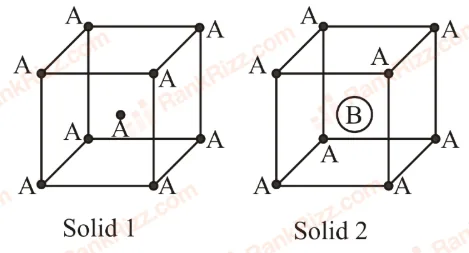
Consider the bcc unit cells of the solids 1 and 2 with the position of atoms as shown below. The radius of atom B is twice that of atom A. The unit cell edge length is 50% more in solid 2 than in 1. What is the approximate packing efficiency in solid 2?
90 %
45 %
75 %
65 %
A solid having density of kg m forms face centred cubic crystals of edge length pm. What is the molar mass of the solid? [Avogadro constant mol, ]
0.0432 kg mol
0.0216 kg mol
0.0305 kg mol
0.4320 kg mol
The radius of the largest sphere which fits properly at the centre of the edge of a body centred cubic unit cell is: (Edge length is represented by 'a')
0.027 a
0.047 a
0.134 a
0.067 a
Which primitive unit cell has unequal edge lengths () and all axial angles different from 90?
Hexagonal
Monoclinic
Triclinic
Tetragonal
A compound of formula has the HCP lattice. Which atom forms the HCP lattice and what fraction of the tetrahedral voids are occupied by the other atoms?
HCP lattice - B, tetrahedral voids - A
HCP lattice - A, tetrahedral voids - B
HCP lattice - B, tetrahedral voids - A
HCP lattice - A, tetrahedral voids - B
At 100C, copper (Cu) has FCC unit cell structure with cell edge length of . What is the approximate density of Cu (in g cm) at this temperature? [Atomic Mass of Cu = 63.55 u]
Which of the following arrangements shows the schematic alignment of magnetic moments of antiferromagnetic substance?


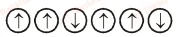
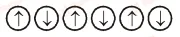
All of the following share the same crystal structure except:
RbCl
NaCl
CsCl
LiCl
A metal crystallizes in a face centred cubic structure. If the edge length of its unit cell is 'a', the closest approach between two atoms in the metallic crystal will be
Sodium metal crystallizes in a body centred cubic lattice with a unit cell edge of 4.29 . The radius of sodium atom is approximately:
0.93
1.86
3.22
5.72
The total number of octahedral void(s) per atom present in a cubic close packed structure is:
1
2
3
4
In a monoclinic unit cell, the relation of sides and angles are respectively:
a = b c and °
a b c and °
a b c and °
a b c and °
The appearance of colour in solid alkali metal halides is generally due to:
Schottky defect
Frenkel defect
Interstitial position
F-centres
In a face centered cubic lattice atoms A are at the corner points and atoms B at the face centered points. If atom B is missing from one of the face centered points, the formula of the ionic compound is:
AB
AB
AB
AB
CsCl crystallises in body centred cubic lattice. If 'a' is its edge length then which of the following expressions is correct?
Copper crystallises in fcc with a unit length of 361 pm. What is the radius of copper atom?
157 pm
128 pm
108 pm
181 pm
JEE Advanced has set 20 Solid State questions too. Solid State JEE Advanced PYQs →
OTHER CHEMISTRY CHAPTERS