JEE MAIN 2021 · 17 MAR S1Alkali metals: properties and trends
The correct order of conductivity of ions in water is:
- A
- B
- C
- D
Every s-Block Elements question JEE Main has set from 2004–2024, grouped by the idea it tests rather than the order of the syllabus. 98 questions across 4 distinct ideas. Free to read, answer key on every one.
DATA UPDATED
Questions
98
Distinct ideas
4
Share of marks
0%
Difficulty
EASY
A chapter is not one subject — it is a handful of procedures the examiner reuses. These are the ones s-Block Elements questions actually test.
61–80 OF 98 · NEWEST FIRST
The correct order of conductivity of ions in water is:
One of the by-products formed during the recovery of NH from Solvay process is:
Ca(OH)
NaHCO
CaCl
NHCl
Given below are two statements:
Statement I: Both and undergo dehydration on heating.
Statement II: BeO is amphoteric, whereas the oxides of other elements in the same group are acidic.
In the light of the above statements, choose the correct answer from the options given below:
Statement I is false but statement II is true
Both statement I and statement II are false
Both statement I and statement II are true
Statement I is true but statement II is false
Match List - I with List - II.
| List-I (Salt) | List-II (Flame colour wavelength) |
|---|---|
| (a) LiCl | (i) 455.5 nm |
| (b) NaCl | (ii) 670.8 nm |
| (c) RbCl | (iii) 780.0 nm |
| (d) CsCl | (iv) 589.2 nm |
(a)-(iv), (b)-(ii), (c)-(iii), (d)-(i)
(a)-(i), (b)-(iv), (c)-(ii), (d)-(iii)
(a)-(ii), (b)-(i), (c)-(iv), (d)-(iii)
(a)-(ii), (b)-(iv), (c)-(iii), (d)-(i)
Match the following compounds (Column-I) with their uses (Column-II):
S. No. Column-I S.No. Column-II
(I) - (A) casts of statues
(II) NaCl - (B) white wash
(III) - (C) antacid
(IV) - (D) washing soda preparation
(I)-(D), (II)-(A), (III)-(C), (IV)-(B)
(I)-(B), (II)-(D), (III)-(A), (IV)-(C)
(I)-(B), (II)-(C), (III)-(D), (IV)-(A)
(I)-(D), (II)-(C), (III)-(B), (IV)-(A)
On combustion of Li, Na and K in excess of air, the major oxides formed, respectively, are:
, and
, and
, and
, and
The metal mainly used in devising photoelectric cells is:
Na
Li
Rb
Cs
Among the statements (a) - (d), the correct ones are:
(a) Lithium has the highest hydration enthalpy among the alkali metals.
(b) Lithium chloride is insoluble in pyridine.
(c) Lithium cannot form ethynide upon its reaction with ethyne.
(d) Both lithium and magnesium react slowly with .
(a), (b) and (d) only
(a), (c) and (d) only
(b) and (c) only
(a) and (d) only
When gypsum is heated to 393K, it forms:
Anhydrous CaSO
CaSO . 5HO
CaSO . 0.5HO
Dead burnt plaster
The correct sequence of thermal stability of the following carbonates is:
BaCO < CaCO < SrCO < MgCO
MgCO < CaCO < SrCO < BaCO
BaCO < SrCO < CaCO < MgCO
MgCO < SrCO < CaCO < BaCO
The incorrect statement is:
LiNO decomposes on heating to give LiNO and O.
LiCl crystallises from aqueous solution as LiCl - 2HO.
Lithium is the strongest reducing agent among the alkali metals.
Lithium is least reactive with water among the alkali metals.
The alloy used in the construction of aircrafts is:
Mg - Al
Mg - Mn
Mg - Sn
Mg - Zn
A hydrated solid X on heating initially gives a monohydrated compound Y. Y upon heating above 373 K leads to an anhydrous white powder Z. X and Z, respectively, are;
washing soda and soda ash.
baking soda and soda ash.
washing soda and dead burnt plaster.
baking soda and dead burnt plaster.
Magnesium powder burns in air to give:
MgO and MgN
MgO only
Mg(NO) and MgN
MgO and Mg(NO)
The structures of beryllium chloride in the solid state and vapour phase, respectively, are:
chain and chain
dimeric and chain
chain and dimeric
dimeric and dimeric
The correct order of hydration enthalpies of alkali metal ions is:
A metal on combustion in excess air forms X. X upon hydrolysis with water yields and along with another product. The metal is:
Na
Mg
Li
Rb
Match the following items in column I with the corresponding items in column II.
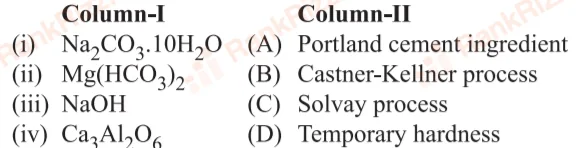
(i) (B); (ii) (C); (iii) (A); (iv) (D)
(i) (C); (ii) (B); (iii) (D); (iv) (A)
(i) (D); (ii) (A); (iii) (B); (iv) (C)
(i) (C); (ii) (D); (iii) (B); (iv) (A)
The metal used for making X-ray tube window is:
Mg
Na
Be
Ca
Sodium metal on dissolution in liquid ammonia gives a deep blue solution due to the formation of:
Sodamide
Sodium-ammonia complex
Sodium ion-ammonia complex
Ammoniated electrons
OTHER CHEMISTRY CHAPTERS