RankRizz

Alkali metals: properties and trends — JEE Main Previous Year Questions

Alkali metals: properties and trends has been asked 28 times in JEE Main, in 9 different years between 2006 and 2024, and in 3 of the last five exam years (2022–2026), 13 questions in all. That is 29% of s-Block Elements, one of its three most-asked topics. Last asked in JEE Main 06 Apr 2024, Shift 2. 27 are multiple choice and 1 numerical-value; 18 easy and 8 medium by our difficulty labels. All of them are below, newest first, free to read.

Questions

28

Years asked

9

Since

2006

Of the chapter

29%

When JEE Main asked it

Questions on Alkali metals: properties and trends in every year it was asked, newest first.

JEE Main questions on Alkali metals: properties and trends by year, 2006–2024
YearRelative frequencyQuestions
20241
20237
20225
20214
20203
20194
20162
20121
20061
Total28

Every Alkali metals: properties and trends question

1–20 OF 28 · NEWEST FIRST

JEE MAIN 2024 · 06 APR S2Alkali metals: properties and trends

Match List - I with List - II. 
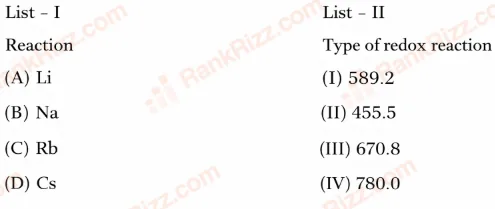
{D97C65AE-15A6-40AF-8C85-D744211FD230}

Choose the correct answer from the options given below :

  1. A

    (A)-(II), (B)-(IV), (C)-(III), (D)-(I)

  2. B

    (A)-(I), (B)-(IV), (C)-(III), (D)-(II)

  3. C

    (A)-(IV), (B)-(II), (C)-(I), (D)-(III)

  4. D

    (A)-(III), (B)-(I), (C)-(IV), (D)-(II)

JEE MAIN 2023 · 12 APR S1Alkali metals: properties and trends

The density of alkali metals is in the order

  1. A

    K << Cs << Na << Rb

  2. B

    Na << Rb << K << Cs

  3. C

    Na << K << Cs << Rb

  4. D

    K << Na << Rb << Cs

JEE MAIN 2023 · 11 APR S2Alkali metals: properties and trends

Alkali metal from the following with least melting point is

  1. A

    Cs

  2. B

    Rb

  3. C

    Na

  4. D

    K

JEE MAIN 2023 · 08 APR S2Alkali metals: properties and trends

Given below are two statements: One is labelled as Assertion A and the other is labelled as Reason R.
Assertion A: Sodium is about 30 times as abundant as potassium in the oceans.
Reason R: Potassium is bigger in size than sodium.
In the light of the above statements, choose the correct answer from the options given below

  1. A

    Both A and R are true and R is the correct explanation of A

  2. B

    A is true but R is false

  3. C

    Both A and R are true but R is NOT the correct explanation of A

  4. D

    Both A and R are false

JEE MAIN 2023 · 31 JAN S2Alkali metals: properties and trends

The number of alkali metal(s), from Li, K, Cs, Rb having ionization enthalpy greater than 400 kJ mol−1^{-1} and forming stable super oxide is

JEE MAIN 2023 · 25 JAN S2Alkali metals: properties and trends

Given below are two statements, one is labelled as Assertion A and the other is labelled as Reason R
Assertion A: The alkali metals and their salts impart characteristic colour to reducing flame.
Reason R: Alkali metals can be detected using flame tests.
In the light of the above statements, choose the most appropriate answer from the options given below

  1. A

    Both A and R are correct but R is NOT the correct explanation of A.

  2. B

    A is correct but R is not correct.

  3. C

    A is not correct but R is correct

  4. D

    Both A and R are correct and R is the correct explanation of A.

JEE MAIN 2023 · 25 JAN S2Alkali metals: properties and trends

Which one among the following metals is the weakest reducing agent?

  1. A

    K

  2. B

    Rb

  3. C

    Na

  4. D

    Li

JEE MAIN 2023 · 24 JAN S2Alkali metals: properties and trends

Identify the correct statements about alkali metals.
A. The order of standard reduction potential (M+^+ | M) for alkali metal ions is Na > Rb > Li.
B. CsI is highly soluble in water.
C. Lithium carbonate is highly stable to heat.
D. Potassium dissolved in concentrated liquid ammonia is blue and paramagnetic.
E. All alkali metal hydrides are ionic solids.
Choose the correct answer from the options given below

  1. A

    A, B, D only

  2. B

    C and E only

  3. C

    A and E only

  4. D

    A, B and E only

JEE MAIN 2022 · 28 JUL S1Alkali metals: properties and trends

Which of the following statement is incorrect?

  1. A

    Low solubility of LiF in water is due to its small hydration enthalpy.

  2. B

    KO2KO_2 is paramagnetic.

  3. C

    Solution of sodium in liquid ammonia is conducting in nature.

  4. D

    Sodium metal has higher density than potassium metal

JEE MAIN 2022 · 25 JUL S1Alkali metals: properties and trends

Choose the correct order of density of the alkali metals

  1. A

    Li<K<Na<Rb<CsLi < K < Na < Rb < Cs

  2. B

    Li<Na<K<Rb<CsLi < Na < K < Rb < Cs

  3. C

    Li<Na<K<Cs<RbLi < Na < K < Cs < Rb

  4. D

    Cs<Rb<K<Na<LiCs < Rb < K < Na < Li

JEE MAIN 2022 · 29 JUN S1Alkali metals: properties and trends

Arrange the following in the decreasing order of their covalent character:
(A) LiCl
(B) NaCl
(C) KCl
(D) CsCl
Choose the most appropriate answer from the options given below

  1. A

    (A) > (C) > (B) > (D)

  2. B

    (B) > (A) > (C) > (D)

  3. C

    (A) > (B) > (C) > (D)

  4. D

    (A) > (B) > (D) > (C)

JEE MAIN 2022 · 29 JUN S1Alkali metals: properties and trends

Match List-I with Match List-II
List-I (Metal)              List-II (Emitted light wavelength (nm))
(A) Li                           (I)   670.8
(B) Na                         (II)  589.2
(C) Rb                         (III) 780.0
(D) Cs                         (V)  455.5
Choose the most appropriate answer from the options given below

  1. A

    (A) - (I), (B) - (II), (C) - (III), (D) - (IV)

  2. B

    (A) - (III), (B) - (II), (C) - (I), (D) - (IV)

  3. C

    (A) - (III), (B) - (I), (C) - (II), (D) - (IV)

  4. D

    (A) - (IV), (B) - (II), (C) - (I), (D) - (III)

JEE MAIN 2022 · 24 JUN S1Alkali metals: properties and trends

Which of the following statements are correct?
(A) Both LiCl and MgCl2_2 are soluble in ethanol.
(B) The oxides Li2_2O and MgO combine with excess of oxygen to give superoxide.
(C) LiF is less soluble in water than other alkali metal fluorides.
(D) Li2_2O is more soluble in water than other alkali metal oxides.
Choose the most appropriate answer from the options given below

  1. A

    (A) and (C) only

  2. B

    (A), (C) and (D) only

  3. C

    (B) and (C) only

  4. D

    (A) and (D) only

JEE MAIN 2021 · 31 AUG S2Alkali metals: properties and trends

Given below are two statements : one is labelled as Assertion (A) and the other is labelled as Reason (R).
Assertion (A): Lithium salts are hydrated.
Reason (R): Lithium has higher polarising power than other alkali metal group members.
In the light of the above statements, choose the most appropriate answer from the options given below:

  1. A

    (A) is not correct but (R) is correct.

  2. B

    (A) is correct but (R) is not correct.

  3. C

    Both (A) and (R) are correct but (R) is NOT the correct explanation of (A).

  4. D

    Both (A) and (R) are correct and (R) is the correct explanation of (A).

JEE MAIN 2021 · 27 JUL S1Alkali metals: properties and trends

Given below are two statements: One is labelled as Assertion A and the other labelled as Reason R.
Assertion A : Lithium halides are somewhat covalent in nature.
Reason R : Lithium possess high polarisation capability.
In the light of the above statements, choose the most appropriate answer from the options given below:

  1. A

    A is true but R is false

  2. B

    A is false but R is true

  3. C

    Both A and R are true but R is NOT the correct explanation of A

  4. D

    Both A and R are true and R is the correct explanation of A

JEE MAIN 2021 · 17 MAR S1Alkali metals: properties and trends

The correct order of conductivity of ions in water is:

  1. A

    Na+>K+>Rb+>Cs+Na^+ > K^+ > Rb^+ > Cs^+

  2. B

    Cs+>Rb+>K+>Na+Cs^+ > Rb^+ > K^+ > Na^+

  3. C

    K+>Na+>Cs+>Rb+K^+ > Na^+ > Cs^+ > Rb^+

  4. D

    Rb+>Na+>K+>Li+Rb^+ > Na^+ > K^+ > Li^+

JEE MAIN 2021 · 24 FEB S2Alkali metals: properties and trends

Match List - I with List - II.

List-I (Salt)List-II (Flame colour wavelength)
(a) LiCl(i) 455.5 nm
(b) NaCl(ii) 670.8 nm
(c) RbCl(iii) 780.0 nm
(d) CsCl(iv) 589.2 nm

Choose the correct answer from the options given below:
  1. A

    (a)-(iv), (b)-(ii), (c)-(iii), (d)-(i)

  2. B

    (a)-(i), (b)-(iv), (c)-(ii), (d)-(iii)

  3. C

    (a)-(ii), (b)-(i), (c)-(iv), (d)-(iii)

  4. D

    (a)-(ii), (b)-(iv), (c)-(iii), (d)-(i)

JEE MAIN 2020 · 04 SEP S1Alkali metals: properties and trends

On combustion of Li, Na and K in excess of air, the major oxides formed, respectively, are:

  1. A

    Li2O2Li_2O_2, Na2ONa_2O and K2O2K_2O_2

  2. B

    Li2OLi_2O, Na2O2Na_2O_2 and KO2KO_2

  3. C

    Li2OLi_2O, Na2ONa_2O and K2O2K_2O_2

  4. D

    Li2OLi_2O, Na2O2Na_2O_2 and K2OK_2O

JEE MAIN 2020 · 02 SEP S1Alkali metals: properties and trends

The metal mainly used in devising photoelectric cells is:

  1. A

    Na

  2. B

    Li

  3. C

    Rb

  4. D

    Cs

JEE MAIN 2020 · 09 JAN S2Alkali metals: properties and trends

Among the statements (a) - (d), the correct ones are:
(a) Lithium has the highest hydration enthalpy among the alkali metals.
(b) Lithium chloride is insoluble in pyridine.
(c) Lithium cannot form ethynide upon its reaction with ethyne.
(d) Both lithium and magnesium react slowly with H2OH_2O.

  1. A

    (a), (b) and (d) only

  2. B

    (a), (c) and (d) only

  3. C

    (b) and (c) only

  4. D

    (a) and (d) only

Alkali metals: properties and trends: common questions

How many Alkali metals questions have come in JEE Main?
Alkali metals has been asked 28 times in JEE Main, in 9 different years between 2006 and 2024. It came up in 3 of the last five exam years (2022–2026), 13 questions in all.
Is Alkali metals important for JEE Main?
It is one of the three most-asked topics in s-Block Elements: 28 of the chapter's 98 JEE Main questions (29%). It came up in 3 of the last five exam years (2022–2026), 13 questions in all.
When was Alkali metals last asked in JEE Main?
Most recently in JEE Main 06 Apr 2024, Shift 2. Questions on this page are newest first, so the latest ones are at the top.
What kind of Alkali metals questions does JEE Main ask?
27 are multiple choice and 1 numerical-value; 18 easy and 8 medium by our difficulty labels. Each question shows its answer key and worked solution where we have them.