Which is wrong with respect to our responsibility as a human being to protect our environment?
- A
Using plastic bags.
- B
Restricting the use of vehicles
- C
Avoiding the use of floodlighted facilities
- D
Setting up compost tin in gardens
Every Environmental Chemistry question JEE Main has set from 2004–2024, grouped by the idea it tests rather than the order of the syllabus. 113 questions across 4 distinct ideas. Free to read, answer key on every one.
DATA UPDATED
Questions
113
Distinct ideas
4
Share of marks
0%
Difficulty
EASY
A chapter is not one subject — it is a handful of procedures the examiner reuses. These are the ones Environmental Chemistry questions actually test.
81–100 OF 113 · NEWEST FIRST
Which is wrong with respect to our responsibility as a human being to protect our environment?
Using plastic bags.
Restricting the use of vehicles
Avoiding the use of floodlighted facilities
Setting up compost tin in gardens
Assertion: Ozone is destroyed by CFCs in the upper stratosphere.
Reason: Ozone holes increase the amount of UV radiation reaching the earth.
Assertion and reason are correct, but the reason is not the explanation for the assertion.
The assertion is false, but the reason is correct.
Assertion and reason are incorrect.
Assertion and reason are both correct, and the reason is the correct explanation for the assertion.
The maximum prescribed concentration of copper in drinking water is:
3 ppm
5 ppm
0.5 ppm
0.05 ppm
Water samples with BOD values of 4 ppm and 18 ppm, respectively, are:
Highly polluted and Highly polluted
Clean and Clean
Highly polluted and Clean
Clean and Highly polluted
The molecule that has minimum or no role in the formation of photochemical smog, is:
NO
The compound that is NOT a common component of photochemical smog is:

The upper stratosphere consisting of the ozone layer, protects us from the sun's radiation that falls in the wavelength region of
200 - 315 nm
600 - 750 nm
400 - 550 nm
0.8 - 1.5 nm
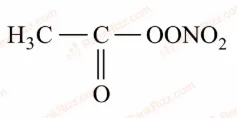
Peroxyacetyl nitrate (PAN), an eye irritant, is produced by:
Classical smog
Acid rain
Organic waste
Photochemical smog
The concentration of dissolved oxygen (DO) in cold water can go upto
14 ppm
8 ppm
10 ppm
16 ppm
Taj Mahal is being slowly disfigured and discoloured. This is primarily due to
Global warming
Acid rain
Water pollution
Soil pollution
The higher concentration of which gas in air can cause stiffness of flower buds?
NO
SO
CO
Water filled in two glasses A and B gave BOD values of 10 and 20, respectively. The correct statement regarding them is:
A is suitable for drinking, whereas B is not
B is more polluted than A
Both A and B are suitable for drinking
A is more polluted than B
The reaction that is not involved in the ozone layer depletion mechanism in the stratosphere is:
A water sample has ppm level concentration of the following metals: Fe = 0.2; Mn = 5.0; Cu = 3.0; Zn = 5.0. The metal that makes the water sample unsuitable for drinking is:
Zn
Fe
Mn
Cu
Which of the following conditions in drinking water causes methemoglobinemia?
> 50 ppm of nitrate
> 50 ppm of chloride
> 100 ppm of sulphate
> 50 ppm of lead
Biochemical oxygen demand (BOD) value can be a measure of water pollution caused by the organic matter. Which of the following statements is correct?
Polluted water has BOD value higher than 10 ppm
Aerobic bacteria decreases the BOD value
Anaerobic bacteria increases the BOD value
Clean water has BOD value higher than 10 ppm
Which of the following is a set of greenhouse gases?
O, NO, SO, Cl
CH, O, N, SO
CO, CH, NO, O
O, N, CO, NO
Identify the pollutant gases largely responsible for the discoloured and lustreless nature of marble of the Taj Mahal.
and
and
and
and
A water sample has ppm level concentration of following anions
F = 10; SO = 100; NO = 50
The anion/anions that make/makes the water sample unsuitable for drinking is/are
Both SO and NO
Only F
Only SO
Only NO
Which one of the following substances used in dry cleaning is a better strategy to control environmental pollution?
Sulphur dioxide
Carbon dioxide
Nitrogen dioxide
Tetrachloroethylene
OTHER CHEMISTRY CHAPTERS