RankRizz

Environmental Chemistry — JEE Main Previous Year Questions

Every Environmental Chemistry question JEE Main has set from 2004–2024, grouped by the idea it tests rather than the order of the syllabus. 113 questions across 4 distinct ideas. Free to read, answer key on every one.

DATA UPDATED

Questions

113

Distinct ideas

4

Share of marks

0%

Difficulty

EASY

The ideas inside Environmental Chemistry

A chapter is not one subject — it is a handful of procedures the examiner reuses. These are the ones Environmental Chemistry questions actually test.

Every Environmental Chemistry question

21–40 OF 113 · NEWEST FIRST

JEE MAIN 2023 · 29 JAN S2Water pollution

The concentration of dissolved Oxygen in water for growth of fish should be more than X ppm and Biochemical Oxygen Demand in clean water should be less than Y ppm. X and Y in ppm are, respectively.

  1. A

    X=6, Y=5

  2. B

    X=4, Y=8

  3. C

    X=4, Y=15

  4. D

    X=6, Y=12

JEE MAIN 2023 · 25 JAN S1Stratospheric pollution and ozone depletion

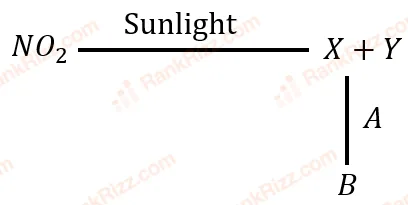
Some reactions of NO2_2 relevant to photochemical smog formation are

Figure for JEE Main 2023 Chemistry question on Stratospheric pollution and ozone depletion

Identify A, B, X and Y

  1. A

    X = [O], Y = NO, A = O2_2, B = O3_3

  2. B

    X = N2_2O, Y = [O], A = O3_3, B = NO

  3. C

    X = 12\frac{1}{2}O2_2, Y = NO2_2, A = O3_3, B = O2_2

  4. D

    X = NO, Y = [O], A = O2_2, B = N2_2O3_3

JEE MAIN 2023 · 25 JAN S2Stratospheric pollution and ozone depletion

A. Ammonium salts produce haze in atmosphere.
B. Ozone gets produced when atmospheric oxygen reacts with chlorine radicals.
C. Polychlorinated biphenyls act as cleansing solvents.
D. 'Blue baby' syndrome occurs due to the presence of excess of sulphate ions in water.
Choose the correct answer from the options below:-

  1. A

    A, B and C only

  2. B

    B and C only

  3. C

    A and D only

  4. D

    A and C only

JEE MAIN 2023 · 24 JAN S1Air pollution: tropospheric pollutants, smog, acid rain and greenhouse effect

Which of the following is true about freons?

  1. A

    These are chlorofluorocarbon compounds

  2. B

    These are chemicals causing skin cancer

  3. C

    These are radicals of chlorine and chlorine monoxide

  4. D

    All radicals are called freons

JEE MAIN 2023 · 24 JAN S2Air pollution: tropospheric pollutants, smog, acid rain and greenhouse effect

Correct statement is:

  1. A

    An average human being consumes more food than air

  2. B

    An average human being consumes nearly 15 times more air than food

  3. C

    An average human being consumes equal amount of food and air

  4. D

    An average human being consumes 100 times more air than food

JEE MAIN 2022 · 29 JUL S1Soil pollution, industrial waste and green chemistry

Which among the following pairs has only herbicides?

  1. A

    Aldrin and Dieldrin

  2. B

    Sodium chlorate and Aldrin

  3. C

    Sodium arsinate and Dieldrin

  4. D

    Sodium chlorate and sodium arsenite

JEE MAIN 2022 · 28 JUL S1Water pollution

Given below are two statements:
Statement I: In polluted water values of both dissolved oxygen and BOD are very low.
Statement II: Eutrophication results in decrease in the amount of dissolved oxygen.
In the light of the above statements, choose the most appropriate answer from the options given below:

  1. A

    Both Statement I and Statement II are true

  2. B

    Both Statement I and Statement II are false

  3. C

    Statement I is true but Statement II is false

  4. D

    Statement I is false but Statement II is true

JEE MAIN 2022 · 27 JUL S1Water pollution

Match List-I with List-II

Figure for JEE Main 2022 Chemistry question on Water pollution

Choose the correct answer from the options given below

  1. A

    A-IV, B-III, C-II, D-I

  2. B

    A-IV, B-II, C-I, D-III

  3. C

    A-III, B-IV, C-I, D-II

  4. D

    A-IV, B-III, C-I, D-II

JEE MAIN 2022 · 27 JUL S2Water pollution

Given below are two statements:
Statement I: The non bio-degradable fly ash and slag from steel industry can be used by cement industry.
Statement II: The fuel obtained from plastic waste is lead free.
In the light of the above statements, choose the most appropriate answer from the options given below:

  1. A

    Both Statement I and Statement II are correct

  2. B

    Both Statement I and Statement II are incorrect

  3. C

    Statement I is correct but Statement II is incorrect

  4. D

    Statement I is incorrect but Statement II is correct

JEE MAIN 2022 · 26 JUL S2Water pollution

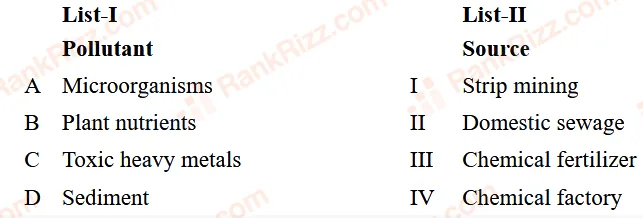
Match List I with List II

Figure for JEE Main 2022 Chemistry question on Water pollution

Choose the correct answer from the options given below

  1. A

    A-II, B-III, C-IV, D-I

  2. B

    A-II, B-I, C-IV, D-III

  3. C

    A-I, B-IV, C-II, D-III

  4. D

    A-I, B-IV, C-III, D-II

JEE MAIN 2022 · 25 JUL S1Stratospheric pollution and ozone depletion

The photochemical smog does not generally contain

  1. A

    NONO

  2. B

    NO2NO_2

  3. C

    SO2SO_2

  4. D

    HCHOHCHO

JEE MAIN 2022 · 29 JUN S1Stratospheric pollution and ozone depletion

The acid that is believed to be mainly responsible for the damage of Taj Mahal is

  1. A

    sulfuric acid.

  2. B

    hydrofluoric acid.

  3. C

    phosphoric acid.

  4. D

    hydrochloric acid.

JEE MAIN 2022 · 28 JUN S1Soil pollution, industrial waste and green chemistry

Which amongst the following is not a pesticide?

  1. A

    DDT

  2. B

    Dieldrin

  3. C

    Organophosphate

  4. D

    Sodium Arsenite

JEE MAIN 2022 · 28 JUN S2Air pollution: tropospheric pollutants, smog, acid rain and greenhouse effect

Correct statement about photo-chemical smog is

  1. A

    It occurs in humid climate.

  2. B

    It is a mixture of smoke, fog and SO2_2.

  3. C

    It is reducing smog.

  4. D

    It results from reaction of unsaturated hydrocarbons.

JEE MAIN 2022 · 27 JUN S1Air pollution: tropospheric pollutants, smog, acid rain and greenhouse effect

Given below are two Statements :
Statement I : Classical smog occurs in cool humid climate. It is a reducing mixture of smoke, fog and sulphur dioxide.
Statement II : Photochemical smog has components, ozone, nitric oxide, acrolein, formaldehyde, PAN etc.
In the light of the above statements, choose the most appropriate answer from the options given below.

  1. A

    Both Statement I and Statement II are correct.

  2. B

    Both Statement I and Statement II are incorrect.

  3. C

    Statement I is incorrect but Statement II is correct.

  4. D

    Statement I is correct but Statement II is incorrect.

JEE MAIN 2022 · 27 JUN S2Stratospheric pollution and ozone depletion

On the surface of polar stratospheric clouds, hydrolysis of chlorine nitrate gives A and B while its reaction with HCl produces B and C. A, B and C are, respectively

  1. A

    HOCl, HNO3HNO_3, Cl2Cl_2

  2. B

    Cl2Cl_2, HNO3HNO_3, HOCl

  3. C

    HClO2HClO_2, HNO2HNO_2, HOCl

  4. D

    HOCl, HNO2HNO_2, Cl2OCl_2O

JEE MAIN 2022 · 26 JUN S1Stratospheric pollution and ozone depletion

Polar stratospheric clouds facilitate the formation of

  1. A

    ClONO2ClONO_2

  2. B

    HOCl

  3. C

    ClO

  4. D

    CH4CH_4

JEE MAIN 2022 · 26 JUN S2Water pollution

The measured BOD values for four different water samples (A - D) are as follows: A = 3 ppm; B = 18 ppm; C = 21 ppm; D = 4 ppm. The water samples which can be called as highly polluted with organic wastes, are

  1. A

    A & B

  2. B

    A & D

  3. C

    B & C

  4. D

    B & D

JEE MAIN 2022 · 25 JUN S1Water pollution

The eutrophication of water body results in

  1. A

    Increase in biodiversity

  2. B

    Loss in biodiversity

  3. C

    Break down of organic matter

  4. D

    decrease in BOD.