Solutions JEE Advanced PYQs with answer key
CHEMISTRY · 26 PAST QUESTIONS · 7 TOPICS · 2007–2026
HOW TO USE THIS SHEET
Every JEE Advanced Solutions question we hold, grouped by topic, most-asked topic first and newest first inside each. The answer key is at the end (19 of 26 questions have a checked key); the worked solution is on each question’s page, printed beside it.
Abnormal molar mass and van't Hoff factor 6
In a solvent S, a compound B is partially dissociated into C and D as given below:
B, C and D are non-volatile in nature. The molar mass of B is 10 times the molar mass of S. The standard boiling point and the standard enthalpy of vaporization of S are 400 K and J mol, respectively ( is the gas constant in J K mol). A solution of B in S with an initial concentration of B as 0.25% (mass/mass) has a boiling point of 408 K at 1 bar pressure. In this solution, the mole percent of B that has been dissociated is ___.
Answer: ____________
rr2.rankrizz.com/jee-advanced/chemistry/solutions/q/2026-paper-2-q30
An aqueous solution is prepared by dissolving 0.1 mol of an ionic salt in 1.8 kg of water at 35 C. The salt remains 90% dissociated in the solution. The vapour pressure of the solution is 59.724 mm of Hg. Vapor pressure of water at 35 C is 60.000 mm of Hg. The number of ions present per formula unit of the ionic salt is _______.
Answer: ____________
rr2.rankrizz.com/jee-advanced/chemistry/solutions/q/2022-paper-2-q38
The plot given below shows 𝑃 − 𝑇 curves (where P is the pressure and T is the temperature) for two solvents X and Y and isomolal solutions of NaCl in these solvents. NaCl completely dissociates in both the solvents.
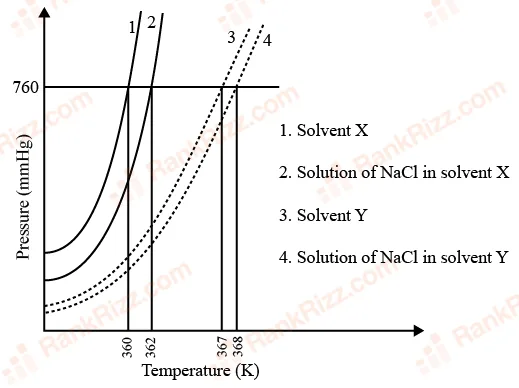
On addition of equal number of moles of a non-volatile solute S in equal amount (in kg) of
these solvents, the elevation of boiling point of solvent X is three times that of solvent Y.
Solute S is known to undergo dimerization in these solvents. If the degree of dimerization is
0.7 in solvent Y, the degree of dimerization in solvent X is ____.Answer: ____________
rr2.rankrizz.com/jee-advanced/chemistry/solutions/q/2018-paper-1-q32
dissociates into and ions in an aqueous solution, with a degree of dissociation of 0.5. The ratio of the observed depression of freezing point of the aqueous solution to the value of the depression of freezing point in the absence of ionic dissociation is
Answer: ____________
rr2.rankrizz.com/jee-advanced/chemistry/solutions/q/2014-paper-1-q40
The freezing point (in ) of a solution containing 0.1 g of in 100 g of water is
- (A)
- (B)
- (C)
- (D)
rr2.rankrizz.com/jee-advanced/chemistry/solutions/q/2011-paper-2-q5
- (A)
When 20 g of naphthoic acid is dissolved in 50 g of benzene = 1.72 K kg mol), a freezing point depression of 2 K is observed. The van't Hoff factor (i) is
- (A)
0.5
- (B)
1
- (C)
2
- (D)
3
rr2.rankrizz.com/jee-advanced/chemistry/solutions/q/2007-paper-1-q30
- (A)
Elevation in boiling point 5
Vessel-1 contains g of a non-volatile solute X dissolved in g of water. Vessel-2 contains g of another non-volatile solute Y dissolved in g of water. Both the vessels are at the same temperature and pressure. The molar mass of X is 80% of that of Y. The van't Hoff factor for X is 1.2 times of that of Y for their respective concentrations.
The elevation of boiling point for solution in Vessel-1 is ______ % of the solution in Vessel-2.
Answer: ____________
rr2.rankrizz.com/jee-advanced/chemistry/solutions/q/2024-paper-2-q43
The value of x is ___.
Answer: ____________
rr2.rankrizz.com/jee-advanced/chemistry/solutions/q/2021-paper-1-q47
The value of is ___.
Answer: ____________
rr2.rankrizz.com/jee-advanced/chemistry/solutions/q/2021-paper-1-q48
For a dilute solution containing 2.5 g of a non- volatile non- electrolyte solute in 100 g of water, the elevation in boiling point at 1 atm pressure is . Assuming concentration of solute is much lower than the concentration of solvent, the vapour pressure (mm of Hg) of the solution is (take K kg )
- (A)
724
- (B)
740
- (C)
736
- (D)
718
rr2.rankrizz.com/jee-advanced/chemistry/solutions/q/2012-paper-2-q28
- (A)
Water is added to the solution M such that the mole fraction of water in the solution becomes 0.9. The boiling point of this solution is
- (A)
380.4 K
- (B)
376.2 K
- (C)
375.5 K
- (D)
354.7 K
rr2.rankrizz.com/jee-advanced/chemistry/solutions/q/2008-paper-1-q69
- (A)
Raoult's law, ideal and non-ideal solutions 4
Question Stem (Q15 & Q16): Two volatile liquids A and B form an ideal solution. Consider a 5 molal solution of B in A inside a closed container having a total vapour pressure of 100 mm Hg at 300 K. The vapour pressure of pure A at 300 K is 105 mm Hg. Assume that A and B behave as ideal gases in the vapour phase.
Given: The gas constant L atm K mol;
Molar mass of A is 50 g mol;
Molar mass of B is 57 g mol;
Density of liquid B at 300 K is 0.5 g/mL; 1 atm mm Hg.At 300 K, the ratio of the molar volume of pure B in vapour phase to its molar volume in liquid phase is ___.
Answer: ____________
rr2.rankrizz.com/jee-advanced/chemistry/solutions/q/2026-paper-2-q33
Question Stem (Q15 & Q16): Two volatile liquids A and B form an ideal solution. Consider a 5 molal solution of B in A inside a closed container having a total vapour pressure of 100 mm Hg at 300 K. The vapour pressure of pure A at 300 K is 105 mm Hg. Assume that A and B behave as ideal gases in the vapour phase.
Given: The gas constant L atm K mol;
Molar mass of A is 50 g mol;
Molar mass of B is 57 g mol;
Density of liquid B at 300 K is 0.5 g/mL; 1 atm mm Hg.The mole fraction of B in vapour phase which is in equilibrium with this solution is ___.
Answer: ____________
rr2.rankrizz.com/jee-advanced/chemistry/solutions/q/2026-paper-2-q34
Mixture(s) showing positive deviation from Raoult’s law at is(are)
- (A)
carbon tetrachloride + methanol
- (B)
carbon disulphide + acetone
- (C)
benzene + toluene
- (D)
phenol + aniline
rr2.rankrizz.com/jee-advanced/chemistry/solutions/q/2016-paper-2-q26
- (A)
The mole fraction of a solute in a solution is 0.1. At 298 K, molarity of this solution is the sameas its molality. Density of this solution at 298 K is 2.0 gcm. Theratio of the molecular weights of the solute and solvent, , is
Answer: ____________
rr2.rankrizz.com/jee-advanced/chemistry/solutions/q/2016-paper-1-q32
Relative lowering of vapour pressure 4
Liquids A and B form ideal solution for all compositions of A and B at 25 . Two such solutions with 0.25 and 0.50 mole fractions of A have the total vapor pressures of 0.3 and 0.4 bar, respectively. What is the vapor pressure of pure liquid B in bar?
Answer: ____________
rr2.rankrizz.com/jee-advanced/chemistry/solutions/q/2020-paper-2-q32
Liquids A and B form ideal solution over the entire range of composition. At temperature T, equimolar binary solution of liquids A and B has vapour pressure 45 Torr. At the same temperature, a new solution of A and B having mole fractions , respectively, has vapour pressure of 22.5 Torr. The value of in the new solution is ____.
(given that the vapour pressure of pure liquid A is 20 Torr at temperature T)Answer: ____________
rr2.rankrizz.com/jee-advanced/chemistry/solutions/q/2018-paper-1-q30
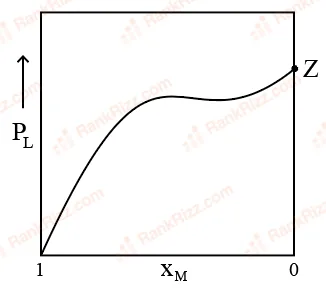
For a solution formed by mixing liquids L and M, the vapour pressure of L plotted against the mole fraction of M in solution is shown in the following figure. Here and represent mole fractions of L and M, respectively, in the solution. The correct statement(s) applicable to this system is(are)
- (A)
The point Z represents vapour pressure of pure liquid M and Raoult’s law is obeyed from to
- (B)
The point Z represents vapour pressure of pure liquid L and Raoult’s law is obeyed when
- (C)
The point Z represents vapour pressure of pure liquid M and Raoult’s law is obeyed when
- (D)
Attractive intermolecular interactions between L-L in pure liquid L and M-M in pure liquid M are stronger than those between L-M when mixed in solution
rr2.rankrizz.com/jee-advanced/chemistry/solutions/q/2017-paper-1-q20
- (A)
The vapour pressure of the solution M is
- (A)
39.3 mm Hg
- (B)
36.0 mm Hg
- (C)
29.5 mm Hg
- (D)
28.8 mm Hg
rr2.rankrizz.com/jee-advanced/chemistry/solutions/q/2008-paper-1-q68
- (A)
Depression in freezing point 4
On dissolving 0.5 g of a non-volatile non-ionic solute to 39 g of benzene, its vapor pressure decreases from 650 mm Hg to 640 mm Hg. The depression of freezing point of benzene (in K) upon addition of the solute is ___________ .
(Given data: Molar mass and the molal freezing point depression constant of benzene are respectively)Answer: ____________
rr2.rankrizz.com/jee-advanced/chemistry/solutions/q/2019-paper-1-q34
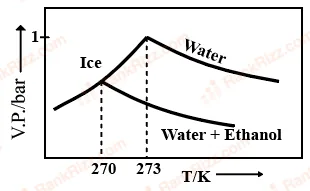
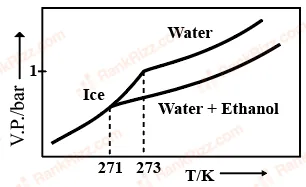
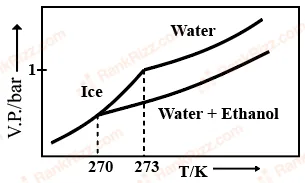
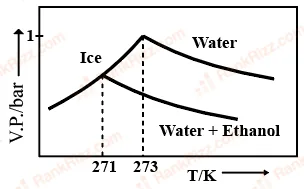
Pure water freezes at 273 K and 1 bar. The addition of 34.5 g of ethanol to 500 g of water changes the freezing point of the solution. Use the freezing point depression constant of water as 2 K kg . The figures shown below represent plots of vapour pressure (V.P.) versus temperature (T). [molecular weight of ethanol is 46 g ] Among the following, the option representing change in the freezing point is
- (A)
- (B)
- (C)
- (D)
rr2.rankrizz.com/jee-advanced/chemistry/solutions/q/2017-paper-2-q19
- (A)
If the freezing point of a 0.01 molal aqueous solution of a cobalt(III) chloride-ammonia complex (which behaves as a strong electrolyte) is the numberof chloride(s) in the coordination sphere of the complex is of water = 1.86 K kg ]
Answer: ____________
rr2.rankrizz.com/jee-advanced/chemistry/solutions/q/2015-paper-1-q28
The freezing point of the solution M is
- (A)
268.7 K
- (B)
268.5 K
- (C)
234.2 K
- (D)
150.9 K
rr2.rankrizz.com/jee-advanced/chemistry/solutions/q/2008-paper-1-q67
- (A)
Osmosis and osmotic pressure 2
At 300 K, an ideal dilute solution of a macromolecule exerts osmotic pressure that is expressed in terms of the height (h) of the solution (density = 1.00 g cm) where h is equal to 2.00 cm. If the concentration of the dilute solution of the macromolecule is 2.00 g dm, the molar mass of the macromolecule is g mol. The value of is ______.
Use: Universal gas constant (R) = 8.3 J K mol and acceleration due to gravity (g) = 10 m s
Answer: ____________
rr2.rankrizz.com/jee-advanced/chemistry/solutions/q/2025-paper-2-q45
50 mL of 0.2 molal urea solution (density = 1.012 g mL at 300 K) is mixed with 250 mL of a solution containing 0.06 g of urea. Both the solutions were prepared in the same solvent. The osmotic pressure (in Torr) of the resulting solution at 300 K is ____.
[Use: Molar mass of urea = 60 g mol; gas constant, R = 62 L Torr K mol; Assume, , ]
Answer: ____________
rr2.rankrizz.com/jee-advanced/chemistry/solutions/q/2023-paper-2-q46
Solubility of gases and Henry's law 1
The Henry's law constant for the solubility of gas in water at 298 K is atm. The mole fraction of in air is 0.8. The number of moles of from air dissolved in 10 moles of water at 298 K and 5 atm pressure is -
- (A)
- (B)
- (C)
- (D)
rr2.rankrizz.com/jee-advanced/chemistry/solutions/q/2009-paper-1-q5
- (A)
Answer key
- 01 —
- 02 5
- 03 —
- 04 2
- 05 A
- 06 A
- 07 150
- 08 100.10
- 09 2.50
- 10 A
- 11 B
- 12 —
- 13 0.16
- 14 A, B
- 15 9
- 16 —
- 17 —
- 18 B, D
- 19 B
- 20 —
- 21 C
- 22 1
- 23 D
- 24 —
- 25 682
- 26 A
“—” marks a question whose key we have not checked yet; its page shows the latest on it.
Past questions are reproduced with their sitting. Not affiliated with NTA or the IITs. Every question, online and free: rr2.rankrizz.com/jee-advanced/chemistry/solutions