RankRizz

Rotational Motion — JEE Main Previous Year Questions

Every Rotational Motion question JEE Main has set from 2004–2026, grouped by the idea it tests rather than the order of the syllabus. 276 questions across 10 distinct ideas. Free to read, answer key on every one.

DATA UPDATED

Questions

276

Distinct ideas

10

Share of marks

5.6%

Difficulty

MEDIUM

The ideas inside Rotational Motion

A chapter is not one subject — it is a handful of procedures the examiner reuses. These are the ones Rotational Motion questions actually test.

Every Rotational Motion question

221–240 OF 276 · NEWEST FIRST

JEE MAIN 2019 · 09 JAN S2Rolling with friction, slipping and impulsive forces

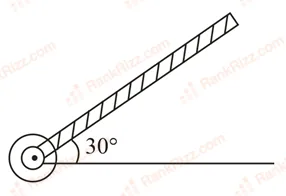
A rod of length 50 cm is pivoted at one end. It is raised such that it makes an angle of 30∘^{\circ} from the horizontal as shown and released from rest. Its angular speed when it passes through the horizontal (in rad s−1^{-1}) will be: (g=10g = 10 ms−2^{-2})

Figure for JEE Main 2019 Physics question on Rolling with friction, slipping and impulsive forces
  1. A

    203\sqrt{\frac{20}{3}}

  2. B

    30\sqrt{30}

  3. C

    302\sqrt{\frac{30}{2}}

  4. D

    302\frac{\sqrt{30}}{2}

JEE MAIN 2018 · 16 APR ONLINEMoment of inertia of standard bodies and composite systems

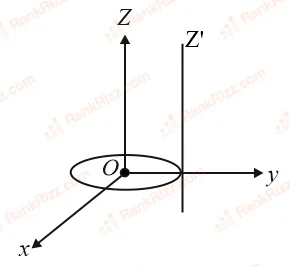
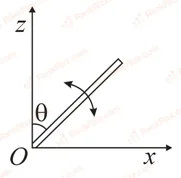
A thin circular disk is in the xy plane as shown in the figure. The ratio of its moment of inertia about z and z' axes will be:

Figure for JEE Main 2018 Physics question on Moment of inertia of standard bodies and composite systems
  1. A

    1 : 4

  2. B

    1 : 5

  3. C

    1 : 3

  4. D

    1 : 2

JEE MAIN 2018 · 15 APR S1Torque and the rotational form of Newton's second law

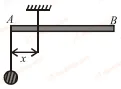
A uniform rod AB is suspended from a point X, at a variable distance x from A, as shown. To make the rod horizontal, a mass m is suspended from its end A. A set of (m, x) values is recorded. The appropriate variable that give a straight line, when plotted, are:

Figure for JEE Main 2018 Physics question on Torque and the rotational form of Newton's second law
  1. A

    m,1xm, \frac{1}{x}

  2. B

    m,1x2m, \frac{1}{x^2}

  3. C

    m,xm, x

  4. D

    m,x2m, x^2

JEE MAIN 2018 · 15 APR S1Torque and the rotational form of Newton's second law

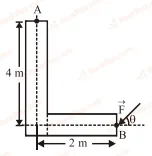
A force of 40 N acts on a point B at the end of an L-shaped object, as shown in the figure. The angle θ\theta that will produce maximum moment of the force about point A is given by:
Figure for JEE Main 2018 Physics question on Torque and the rotational form of Newton's second law

  1. A

    tan⁡θ=14\tan \theta = \frac{1}{4}

  2. B

    tan⁡θ=2\tan \theta = 2

  3. C

    tan⁡θ=12\tan \theta = \frac{1}{2}

  4. D

    tan⁡θ=4\tan \theta = 4

JEE MAIN 2018 · 15 APR S2Torque and the rotational form of Newton's second law

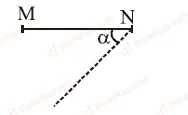
A thin rod MN, free to rotate in the vertical plane about the fixed end N, is held horizontal. When the end M is released, the speed of this end, when the rod makes an angle α\alpha with the horizontal, will be proportional to: (see figure)

Figure for JEE Main 2018 Physics question on Torque and the rotational form of Newton's second law
  1. A

    cos⁡α\sqrt{\cos \alpha}

  2. B

    cos⁡α\cos \alpha

  3. C

    sin⁡α\sin \alpha

  4. D

    sin⁡α\sqrt{\sin \alpha}

JEE MAIN 2018 · 15 APR S2Angular momentum of particles and rigid bodies

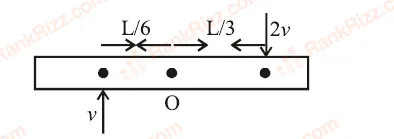
A thin uniform bar of length L and mass 8 m lies on a smooth horizontal table. Two point masses m and 2 m moving in the same horizontal plane from opposite sides of the bar with speeds 2v and v respectively. The masses stick to the bar after collision at a distance L3\frac{L}{3} and L6\frac{L}{6} respectively from the centre of the bar. If the bar starts rotating about its center of mass as a result of collision, the angular speed of the bar will be:

Figure for JEE Main 2018 Physics question on Angular momentum of particles and rigid bodies
  1. A

    v6L\frac{v}{6L}

  2. B

    6v5L\frac{6v}{5L}

  3. C

    3v5L\frac{3v}{5L}

  4. D

    v5L\frac{v}{5L}

JEE MAIN 2018 · 08 APR OFFLINEParallel and perpendicular axis theorems

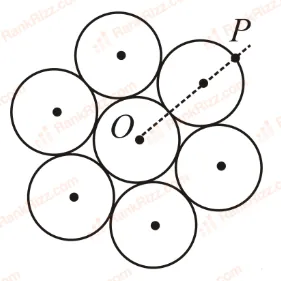
Seven identical circular planar disks, each of mass M and radius R are welded symmetrically as shown. The moment of inertia of the arrangement about the axis normal to the plane and passing through the point P is:

Figure for JEE Main 2018 Physics question on Parallel and perpendicular axis theorems
  1. A

    1812MR2\frac{181}{2}MR^2

  2. B

    192MR2\frac{19}{2}MR^2

  3. C

    552MR2\frac{55}{2}MR^2

  4. D

    732MR2\frac{73}{2}MR^2

JEE MAIN 2018 · 08 APR OFFLINEParallel and perpendicular axis theorems

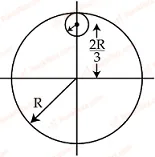
From a uniform circular disc of radius R and mass 9 M, a small disc of radius R3\frac{R}{3} is removed as shown in the figure. The moment of inertia of the remaining disc about an axis perpendicular to the plane of the disc and passing through centre of disc is:
Figure for JEE Main 2018 Physics question on Parallel and perpendicular axis theorems

  1. A

    379MR2\frac{37}{9}MR^2

  2. B

    4MR24MR^2

  3. C

    409MR2\frac{40}{9}MR^2

  4. D

    10MR210MR^2

JEE MAIN 2017 · 09 APR ONLINERolling without slipping: kinematics and energy

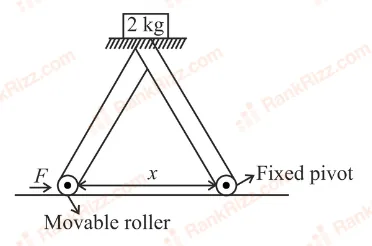
The machine as shown has 2 rods of length 1 m connected by a pivot at the top. The end of one rod is connected to the floor by a stationary pivot and the end of the other rod has a roller that rolls along the floor in a slot. As the roller goes back and forth, a 2 kg weight moves up and down. If the roller is moving towards right at a constant speed, the weight moves up with a:

Figure for JEE Main 2017 Physics question on Rolling without slipping: kinematics and energy
  1. A

    Speed which is 34\frac{3}{4} th of that of the roller when the weight is 0.4 m above the ground

  2. B

    Constant speed

  3. C

    Decreasing speed

  4. D

    Increasing speed

JEE MAIN 2017 · 09 APR ONLINEMoment of inertia of standard bodies and composite systems

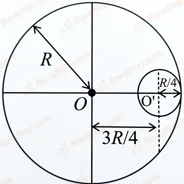
A circular hole of radius R4\frac{R}{4} is made in a thin uniform disc having mass and radius RR, as shown in figure. The moment of inertia of the remaining portion of the disc about an axis passing through the point O and perpendicular to the plane of the disc is-

Figure for JEE Main 2017 Physics question on Moment of inertia of standard bodies and composite systems
  1. A

    219MR2256\frac{219MR^2}{256}

  2. B

    237MR2512\frac{237MR^2}{512}

  3. C

    197MR2256\frac{197MR^2}{256}

  4. D

    19MR2512\frac{19MR^2}{512}

JEE MAIN 2017 · 08 APR ONLINETorque and the rotational form of Newton's second law

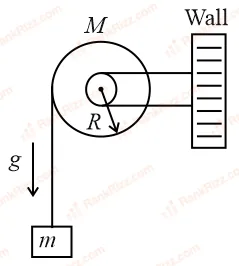
A uniform disc of radius RR and mass MM is free to rotate only about its axis. A string is wrapped over its rim and a body of mass mm is tied to the free end of the string as shown in the figure. The body is released from rest. Then the acceleration of the body is:

Figure for JEE Main 2017 Physics question on Torque and the rotational form of Newton's second law
  1. A

    2Mg2m+M\frac{2Mg}{2m+M}

  2. B

    2Mg2M+m\frac{2Mg}{2M+m}

  3. C

    2mg2M+m\frac{2mg}{2M+m}

  4. D

    2mg2m+M\frac{2mg}{2m+M}

JEE MAIN 2017 · 08 APR ONLINEMoment of inertia of standard bodies and composite systems

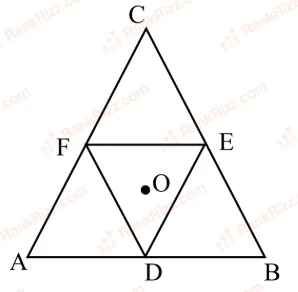
Moment of inertia of an equilateral triangular lamina ABCABC, about the axis passing through its centre OO and perpendicular to its plane is I0I_0 as shown in the figure. A cavity DEFDEF is cut out from the lamina, where DD, EE, FF are the mid points of the sides. Moment of inertia of the remaining part of lamina about the same axis is:

Figure for JEE Main 2017 Physics question on Moment of inertia of standard bodies and composite systems
  1. A

    78I0\frac{7}{8}I_0

  2. B

    1516I0\frac{15}{16}I_0

  3. C

    34I0\frac{3}{4}I_0

  4. D

    3132I0\frac{31}{32}I_0

JEE MAIN 2017 · 08 APR ONLINETorque and the rotational form of Newton's second law

In a physical balance working on the principle of moments, when 5 mg weight is placed on the left pan, the beam becomes horizontal. Both the empty pans of the balance are of equal mass. Which of the following statements is correct?

  1. A

    Every object that is weighed using this balance appears lighter than its actual weight

  2. B

    Left arm is shorter than the right arm

  3. C

    Both the arms are of same length

  4. D

    Left arm is longer than the right arm

JEE MAIN 2017 · 02 APR OFFLINEMoment of inertia of standard bodies and composite systems

The moment of inertia of a uniform cylinder of length ll and radius RR about its perpendicular bisector is II. What is the ratio l/Rl/R such that the moment of inertia is minimum?

  1. A

    32\frac{3}{\sqrt{2}}

  2. B

    32\sqrt{\frac{3}{2}}

  3. C

    32\frac{\sqrt{3}}{2}

  4. D

    1

JEE MAIN 2017 · 02 APR OFFLINETorque and the rotational form of Newton's second law

A slender uniform rod of mass MM and length ll is pivoted at one end so that it can rotate in a vertical plane (see figure). There is negligible friction at the pivot. The free end is held vertically above the pivot and then released. The angular acceleration of the rod when it makes an angle θ\theta with the vertical is:

Figure for JEE Main 2017 Physics question on Torque and the rotational form of Newton's second law
  1. A

    2g3lcos⁡θ\frac{2g}{3l}\cos\theta

  2. B

    3g2lsin⁡θ\frac{3g}{2l}\sin\theta

  3. C

    2g3lsin⁡θ\frac{2g}{3l}\sin\theta

  4. D

    3g2lcos⁡θ\frac{3g}{2l}\cos\theta

JEE MAIN 2016 · 09 APR ONLINEAngular momentum of particles and rigid bodies

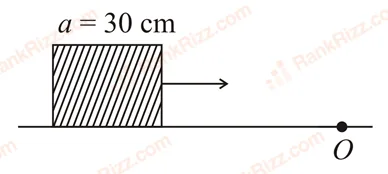
A cubical block of side 30 cm is moving with velocity 2 m s−1^{-1} on a smooth horizontal surface. The surface has a bump at a point O as shown in the figure. The angular velocity (in rad/s) of the block immediately after it hits the bump, is:

Figure for JEE Main 2016 Physics question on Angular momentum of particles and rigid bodies
  1. A

    13.3

  2. B

    5.0

  3. C

    9.4

  4. D

    6.7

JEE MAIN 2016 · 03 APR OFFLINEAngular momentum of particles and rigid bodies

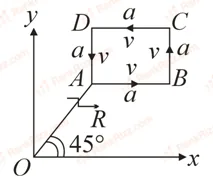
A particle of mass m is moving along the side of a square of side 'a', with a uniform speed v in the x-y plane as shown in the figure:

Figure for JEE Main 2016 Physics question on Angular momentum of particles and rigid bodies


Which of the following statements is false for the angular momentum L⃗\vec{L} about the origin?

  1. A

    L⃗=mv[R2+a]k^\vec{L} = mv\left[\frac{R}{\sqrt{2}} + a\right]\hat{k} when the particle is moving from B to C.

  2. B

    L⃗=mv2Rk^\vec{L} = \frac{mv}{\sqrt{2}}R\hat{k} when the particle is moving from D to A.

  3. C

    L⃗=−mv2Rk^\vec{L} = -\frac{mv}{\sqrt{2}}R\hat{k} when the particle is moving from A to B.

  4. D

    L⃗=mv[R2+a]k^\vec{L} = mv\left[\frac{R}{\sqrt{2}} + a\right]\hat{k} when the particle is moving from C to D.

JEE MAIN 2016 · 03 APR OFFLINETorque and the rotational form of Newton's second law

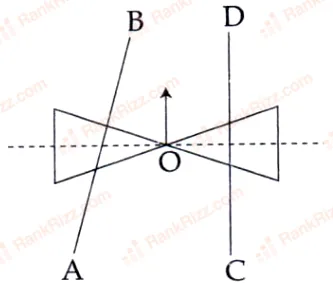
A roller is made by joining together two cones at their vertices O. It is kept on two rails AB and CD which are placed asymmetrically, with its axis perpendicular to CD and its centre O at the centre of line joining AB and CD (see the figure below). It is given a light push so that it starts rolling with its centre O moving parallel to CD in the direction shown. As it moves, the roller will tend to:

Figure for JEE Main 2016 Physics question on Torque and the rotational form of Newton's second law
  1. A

    go straight.

  2. B

    turn left and right alternately.

  3. C

    turn left.

  4. D

    turn right.

JEE MAIN 2015 · 11 APR ONLINEAngular momentum of particles and rigid bodies

A particle of mass 2 kg is on a smooth horizontal table and moves in a circular path of radius 0.6 m. The height of the table from the ground is 0.8 m. If the angular speed of the particle is 12 rad s−1^{-1}, the magnitude of its angular momentum about a point on the ground right under the center of the circle is:

  1. A

    14.4 kg m2^2 s−1^{-1}

  2. B

    11.52 kg m2^2 s−1^{-1}

  3. C

    20.16 kg m2^2 s−1^{-1}

  4. D

    8.64 kg m2^2 s−1^{-1}

JEE MAIN 2015 · 10 APR ONLINEMoment of inertia of standard bodies and composite systems

Consider a thin uniform square sheet made of a rigid material. If its side is aa, mass m and moment of inertia II about one of its diagonals, then:

  1. A

    I=ma224I = \frac{ma^2}{24}

  2. B

    ma224<I<ma212\frac{ma^2}{24} < I < \frac{ma^2}{12}

  3. C

    I>ma212I > \frac{ma^2}{12}

  4. D

    I=ma212I = \frac{ma^2}{12}