JEE MAIN 2026 · 28 JAN S2Angular momentum of particles and rigid bodies
When the position vector changes sign as , which one of the following vector will not flip under sign change?
- A
Angular momentum
- B
Velocity
- C
Linear momentum
- D
Acceleration
Angular momentum of particles and rigid bodies has been asked 48 times in JEE Main, in 15 different years between 2007 and 2026, and in all of the last five exam years (2022–2026), 18 questions in all. That is 17% of Rotational Motion, one of its three most-asked topics. Last asked in JEE Main 28 Jan 2026, Shift 2. 34 are multiple choice and 14 numerical-value; 7 easy, 37 medium and 2 hard by our difficulty labels. All of them are below, newest first, free to read.
Questions
48
Years asked
15
Since
2007
Of the chapter
17%
Questions on Angular momentum of particles and rigid bodies in every year it was asked, newest first.
| Year | Relative frequency | Questions |
|---|---|---|
| 2026 | 3 | |
| 2025 | 3 | |
| 2024 | 6 | |
| 2023 | 4 | |
| 2022 | 2 | |
| 2021 | 6 | |
| 2020 | 8 | |
| 2019 | 5 | |
| 2018 | 1 | |
| 2016 | 2 | |
| 2015 | 1 | |
| 2014 | 3 | |
| 2013 | 2 | |
| 2010 | 1 | |
| 2007 | 1 | |
| Total | 48 |
1–20 OF 48 · NEWEST FIRST
When the position vector changes sign as , which one of the following vector will not flip under sign change?
Angular momentum
Velocity
Linear momentum
Acceleration
Two small balls with masses m and 2m are attached to both ends of a rigid rod of length d and negligible mass. If angular momentum of this system is L about an axis (A) passing through its centre of mass and perpendicular to the rod then angular velocity of the system about A is :
Two cars A and B each of mass kg are moving on parallel tracks separated by a distance of 10 m, in same direction with speeds 72 km/h and 36 km/h. The magnitude of angular momentum of car A with respect to car B is __________ J.s.
If and represent the angular momentum and linear momentum respectively of a particle of mass 'm' having position vector . The direction of force is
Opposite to the direction of
Opposite to the direction of
Opposite to the direction of
Opposite to the direction of
An object of mass is projected from origin in a vertical plane at an angle with the -axis with an initial velocity The magnitude and direction of the angular momentum of the object with respect to origin, when it reaches at the maximum height, will be is acceleration due to gravity]
The position vectors of two 1 kg particles, (A) and (B), are given by respectively; where t is time, n and p are constants. At and velocities and of the particles are orthogonal to each other. At the magnitude of angular momentum of particle (A) with respect to the position of particle (B) is _______ .
A thin circular disc of mass and radius is rotating in a horizontal plane about an axis passing through its centre and perpendicular to its plane with angular velocity . If another disc of same dimensions but of mass is placed gently on the first disc co-axially, then the new angular velocity of the system is :
A uniform rod AB of mass 2 kg and length 30 cm at rest on a smooth horizontal surface. An impulse of force 0.2 N s is applied to end B. The time taken by the rod to turn through at right angles will be s, where = ______.
A body of mass is projected with a speed making an angle of with the ground. The angular momentum of the body about the point of projection, at the highest point is expressed as . The value of is
A particle of mass projected with a velocity making an angle of with the horizontal. The magnitude of angular momentum of the projectile about the point of projection when the particle is at its maximum height is :
zero
Two discs of moment of inertia kg m and kg m about their central axes & normal to their planes, rotating with angular speeds 10 rad s & 4 rad s respectively are brought into contact face to face with their axes of rotation coincident. The loss in kinetic energy of the system in the process is _________ J.
A body of mass kg moving with a uniform speed in plane along the line . The angular momentum of the particle about the origin will be ______ kg m s.
A solid sphere of mass 500 g radius 5 cm is rotated about one of its diameter with angular speed of 10 rad s. If the moment of inertia of the sphere about its tangent is times its angular momentum about the diameter. Then the value of will be _______
A circular plate is rotating in horizontal plane, about an axis passing through its centre and perpendicular to the plate, with an angular velocity . A person sits at the centre having two dumbbells in his hands. When he stretched out his hands, the moment of inertia of the system becomes triple. If be the initial Kinetic energy of the system, then final Kinetic energy will be . The value of is _______
Given below are two statements: one is labelled as Assertion A and the other is labelled as Reason R
Assertion A: An electric fan continues to rotate for some time after the current is switched off.
Reason R: Fan continues to rotate due to inertia of motion.
In the light of above statements, choose the most appropriate answer from the options given below.
A is correct but R is not correct
A is not correct but R is correct
Both A and R are correct and R is the correct explanation of A
Both A and R are correct but R is NOT the correct explanation of A
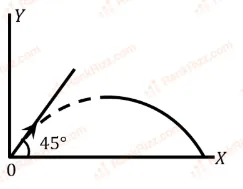
A particle of mass g is projected at time with a speed m s at an angle to the horizontal as given in the figure. The magnitude of the angular momentum of the particle about the starting point at time s is found to be kg m s. The value of is ______.
(Take m s)
The position vector of kg object is m and its velocity m s. The magnitude of its angular momentum is N m s, where is ______
A thin circular ring of mass and radius is rotating with a constant angular velocity rad s in a horizontal plane about an axis vertical to its plane and passing through the center of the ring. If two objects each of mass be attached gently to the opposite ends of a diameter of ring, the ring will then rotate with an angular velocity (in rad s).
A 2 kg steel rod of length 0.6 m is clamped on a table vertically at its lower end and is free to rotate in the vertical plane. The upper end is pushed so that the rod falls under gravity. Ignoring the friction due to clamping at its lower end, the speed of the free end of the rod when it passes through its lowest position is _________ m s.
(Take m s)
Angular momentum of a single particle moving with constant speed along circular path:
remains same in magnitude but changes in the direction
remains same in magnitude and direction
is zero
changes in magnitude but remains same in the direction
RELATED ROTATIONAL MOTION TOPICS