RankRizz

Rotational Motion — JEE Main Previous Year Questions

Every Rotational Motion question JEE Main has set from 2004–2026, grouped by the idea it tests rather than the order of the syllabus. 276 questions across 10 distinct ideas. Free to read, answer key on every one.

DATA UPDATED

Questions

276

Distinct ideas

10

Share of marks

5.6%

Difficulty

MEDIUM

The ideas inside Rotational Motion

A chapter is not one subject — it is a handful of procedures the examiner reuses. These are the ones Rotational Motion questions actually test.

Every Rotational Motion question

121–140 OF 276 · NEWEST FIRST

JEE MAIN 2022 · 27 JUN S2Rolling with friction, slipping and impulsive forces

A rolling wheel of 1212 kg is on an inclined plane at position PP and connected to a mass of 33 kg through a string of fixed length and pulley as shown in figure. Consider PR as friction free surface. The velocity of centre of mass of the wheel when it reaches at the bottom QQ of the inclined plane PQPQ will be 12xgh\frac{1}{2}\sqrt{xgh} m s−1^{-1}. The value of xx (rounded off to the nearest integer) is ______.
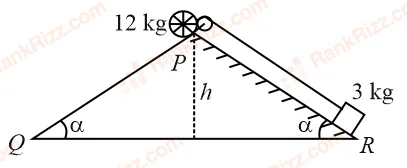
Figure for JEE Main 2022 Physics question on Rolling with friction, slipping and impulsive forces
JEE MAIN 2022 · 26 JUN S1Angular momentum of particles and rigid bodies

A thin circular ring of mass MM and radius RR is rotating with a constant angular velocity 22 rad s−1^{-1} in a horizontal plane about an axis vertical to its plane and passing through the center of the ring. If two objects each of mass mm be attached gently to the opposite ends of a diameter of ring, the ring will then rotate with an angular velocity (in rad s−1^{-1}).

  1. A

    M(M+m)\frac{M}{(M+m)}

  2. B

    (M+2m)2M\frac{(M+2m)}{2M}

  3. C

    2M(M+2m)\frac{2M}{(M+2m)}

  4. D

    2(M+2m)M\frac{2(M+2m)}{M}

JEE MAIN 2022 · 26 JUN S2Rolling with friction, slipping and impulsive forces

A solid spherical ball is rolling on a frictionless horizontal plane surface about its axis of symmetry. The ratio of rotational kinetic energy of the ball to its total kinetic energy is

  1. A

    15\frac{1}{5}

  2. B

    25\frac{2}{5}

  3. C

    27\frac{2}{7}

  4. D

    710\frac{7}{10}

JEE MAIN 2022 · 25 JUN S1Torque and the rotational form of Newton's second law

If force F⃗=3i^+4j^−2k^\vec{F} = 3\hat{i} + 4\hat{j} - 2\hat{k} acts on a particle having position vector 2i^+j^+2k^2\hat{i} + \hat{j} + 2\hat{k} then, the torque about the origin will be:

  1. A

    −10i^+10j^+5k^-10\hat{i} + 10\hat{j} + 5\hat{k}

  2. B

    3i^+4j^−2k^3\hat{i} + 4\hat{j} - 2\hat{k}

  3. C

    10i^+5j^−10k^10\hat{i} + 5\hat{j} - 10\hat{k}

  4. D

    10i^+j^−5k^10\hat{i} + \hat{j} - 5\hat{k}

JEE MAIN 2022 · 25 JUN S2Moment of inertia of standard bodies and composite systems

Moment of Inertia (M.I.) of four bodies having same mass MM and radius 2R2R are as follows
I1I_1 = M.I. of solid sphere about its diameter
I2I_2 = M.I. of solid cylinder about its axis
I3I_3 = M.I. of solid circular disc about its diameter
I4I_4 = M.I. of thin circular ring about its diameter
If 2(I2+I3)+I4=xI12(I_2 + I_3) + I_4 = xI_1 then the value of xx will be ______.

JEE MAIN 2022 · 24 JUN S1Torque and the rotational form of Newton's second law

A metre scale is balanced on a knife edge at its centre. When two coins, each of mass 1010 g are put one on the top of the other at the 10.010.0 cm mark the scale is found to be balanced at 40.040.0 cm mark. The mass of the metre scale is found to be x×10−2x \times 10^{-2} kg. The value of xx is ______.

JEE MAIN 2022 · 24 JUN S2Fixed-axis rotation: kinematics, rotational energy and pulleys

A fly wheel is accelerated uniformly from rest and rotates through 55 rad in the first second. The angle rotated by the fly wheel in the next second, will be :

  1. A

    7.5 rad

  2. B

    15 rad

  3. C

    20 rad

  4. D

    30 rad

JEE MAIN 2021 · 01 SEP S2Angular momentum of particles and rigid bodies

A 2 kg steel rod of length 0.6 m is clamped on a table vertically at its lower end and is free to rotate in the vertical plane. The upper end is pushed so that the rod falls under gravity. Ignoring the friction due to clamping at its lower end, the speed of the free end of the rod when it passes through its lowest position is _________ m s−1^{-1}.
(Take g=10g = 10 m s−2^{-2})

JEE MAIN 2021 · 31 AUG S1Angular momentum of particles and rigid bodies

Angular momentum of a single particle moving with constant speed along circular path:

  1. A

    remains same in magnitude but changes in the direction

  2. B

    remains same in magnitude and direction

  3. C

    is zero

  4. D

    changes in magnitude but remains same in the direction

JEE MAIN 2021 · 31 AUG S2Moment of inertia of standard bodies and composite systems

A system consists of two identical spheres each of mass 1.5 kg and radius 50 cm at the ends of a light rod. The distance between the centres of the two spheres is 5 m. What will be the moment of inertia of the system about an axis perpendicular to the rod passing through its midpoint?

  1. A

    1.905×1051.905 \times 10^5 kg m2^2

  2. B

    18.75 kg m2^2

  3. C

    19.05 kg m2^2

  4. D

    1.875×1051.875 \times 10^5 kg m2^2

JEE MAIN 2021 · 27 AUG S1Moment of inertia of standard bodies and composite systems

Moment of inertia of a square plate of side ll about the axis passing through one of the corner and perpendicular to the plane of square plate is given by:

  1. A

    Ml26\frac{Ml^2}{6}

  2. B

    23Ml2\frac{2}{3}Ml^2

  3. C

    Ml2Ml^2

  4. D

    Ml212\frac{Ml^2}{12}

JEE MAIN 2021 · 27 AUG S2Angular momentum of particles and rigid bodies

Two discs have moments of inertia I1I_1 and I2I_2 about their respective axes perpendicular to the plane and passing through the centre. They are rotating with angular speeds, ω1\omega_1 and ω2\omega_2 respectively and are brought into contact face to face with their axes of rotation coaxial. The loss in kinetic energy of the system in the process is given by:

  1. A

    I1I2(I1+I2)(ω1−ω2)2\frac{I_1 I_2}{(I_1+I_2)}(\omega_1 - \omega_2)^2

  2. B

    (ω1−ω2)22(I1+I2)\frac{(\omega_1-\omega_2)^2}{2(I_1+I_2)}

  3. C

    I1I22(I1+I2)(ω1−ω2)2\frac{I_1 I_2}{2(I_1+I_2)}(\omega_1 - \omega_2)^2

  4. D

    (I1−I2)2ω1ω22(I1+I2)\frac{(I_1-I_2)^2 \omega_1 \omega_2}{2(I_1+I_2)}

JEE MAIN 2021 · 26 AUG S1Moment of inertia of standard bodies and composite systems

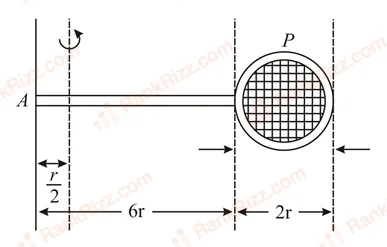
Consider a badminton racket with length scales as shown in the figure.

Figure for JEE Main 2021 Physics question on Moment of inertia of standard bodies and composite systems


If the mass of the linear and circular portions of the badminton racket are same (M) and the mass of the threads are negligible, the moment of inertia of the racket about an axis perpendicular to the handle and in the plane of the ring at, r2\frac{r}{2} distance from the end A of the handle will be _________ Mr2Mr^2.

JEE MAIN 2021 · 26 AUG S2Moment of inertia of standard bodies and composite systems

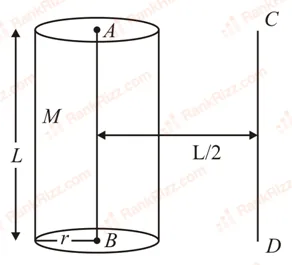
The solid cylinder of length 80 cm and mass MM has a radius of 20 cm. Calculate the density of the material used if the moment of inertia of the cylinder about an axis CDCD parallel to ABAB as shown in figure is 2.7 kg m2^2.

Figure for JEE Main 2021 Physics question on Moment of inertia of standard bodies and composite systems
  1. A

    1.49×1021.49 \times 10^2 kg m−3^{-3}

  2. B

    7.5×1017.5 \times 10^1 kg m−3^{-3}

  3. C

    14.9 kg m−3^{-3}

  4. D

    7.5×1027.5 \times 10^2 kg m−3^{-3}

JEE MAIN 2021 · 27 JUL S1Moment of inertia of standard bodies and composite systems

List-I                                                                                                                                                                     List-II
(a) MI of the rod (length LL, Mass MM, about an axis ⊥\perp to the rod passing through the midpoint)          (i) 8ML23\frac{8ML^2}{3}
(b) MI of the rod (length LL, Mass 2M, about an axis ⊥\perp to the rod passing through one of its end)        (ii) ML23\frac{ML^2}{3}
(c) MI of the rod (length 2L, Mass MM, about an axis ⊥\perp to the rod passing through its midpoint)          (iii) ML212\frac{ML^2}{12}
(d) MI of the rod (Length 2L, Mass 2M, about an axis ⊥\perp to the rod passing through one of its end)        (iv) 2ML23\frac{2ML^2}{3}

Choose the correct answer from the options given below:

  1. A

    (a)-(ii), (b)-(iii), (c)-(i), (d)-(iv)

  2. B

    (a)-(ii), (b)-(i), (c)-(iii), (d)-(iv)

  3. C

    (a)-(iii), (b)-(iv), (c)-(ii), (d)-(i)

  4. D

    (a)-(iii), (b)-(iv), (c)-(i), (d)-(ii)

JEE MAIN 2021 · 27 JUL S1Moment of inertia of standard bodies and composite systems

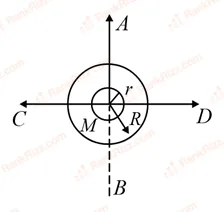
The figure shows two solid discs with radius RR and rr respectively. If mass per unit area is the same for both, what is the ratio of MI of bigger disc around axis ABAB (Which is ⊥\perp to the plane of the disc and passing through its centre) of MI of smaller disc around one of its diameters lying on its plane? Given MM is the mass of the larger disc.

Figure for JEE Main 2021 Physics question on Moment of inertia of standard bodies and composite systems
  1. A

    R2:r2R^2 : r^2

  2. B

    2r4:R42r^4 : R^4

  3. C

    2R2:r22R^2 : r^2

  4. D

    2R4:r42R^4 : r^4

JEE MAIN 2021 · 27 JUL S2Moment of inertia of standard bodies and composite systems

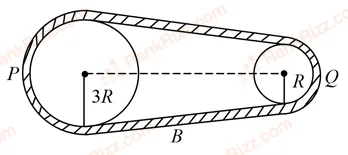
In the given figure, two wheels PP and QQ are connected by a belt BB. The radius of PP is three times that of QQ. In the case of the same rotational kinetic energy, the ratio of rotational inertias (I1I2)\left(\frac{I_1}{I_2}\right) will be x:1x : 1. The value of xx will be _________.

Figure for JEE Main 2021 Physics question on Moment of inertia of standard bodies and composite systems
JEE MAIN 2021 · 25 JUL S1Moment of inertia of standard bodies and composite systems

Given below are two statements: one is labelled as Assertion A and the other is labelled as Reason R.
Assertion A: Moment of inertia of a circular disc of mass M and radius R about X, Y axes (passing through its plane) and Z-axis which is perpendicular to its plane were found to be IxI_x, IyI_y and IzI_z, respectively. The respective radii of gyration about all the three axes will be the same.
Reason R: A rigid body making rotational motion has fixed mass and shape. In the light of the above statements, choose the most appropriate answer from the options given below:

  1. A

    Both A and R are correct but R is not the correct explanation of A.

  2. B

    A is not correct but R is correct.

  3. C

    A is correct but R is not correct.

  4. D

    Both A and R are correct and R is the correct explanation of A.

JEE MAIN 2021 · 25 JUL S1Angular momentum of particles and rigid bodies

A particle of mass mm is moving in time tt on a trajectory given by,
r⃗=10αt2i^+5β(t−5)j^\vec{r} = 10\alpha t^2 \hat{i} + 5\beta (t - 5)\hat{j}
where α\alpha and β\beta are dimensional constants. The angular momentum of the particle becomes the same as it was for t=0t = 0 at time t=t = ___ seconds.

JEE MAIN 2021 · 25 JUL S2Torque and the rotational form of Newton's second law

A solid disc of radius 20 cm and mass 10 kg is rotating with an angular velocity of 600 rpm, about an axis normal to its circular plane and passing through its centre of mass. The retarding torque required to bring the disc at rest in 10 s is _________ π×10−1\pi \times 10^{-1} N m