RankRizz
JEE MAIN 2018 · 15 APR S1+4 / −1EASY

JEE Main 2018 Physics question — Torque and the rotational form of Newton's second law

A force of 40 N acts on a point B at the end of an L-shaped object, as shown in the figure. The angle θ\theta that will produce maximum moment of the force about point A is given by:
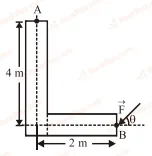
Figure for JEE Main 2018 Physics question on Torque and the rotational form of Newton's second law

SOLUTION

Key idea: The moment ∣r⃗×F⃗∣|\vec r\times\vec F| is maximum when F⃗\vec F is perpendicular to r⃗AB\vec r_{AB}.

  1. Take A as the origin. From the figure, B is 2 m to the right and 4 m below A, so r⃗=2i^−4j^\vec r = 2\hat i - 4\hat j.
  2. The force makes angle θ\theta with the horizontal: F⃗=40(cos⁡θ i^+sin⁡θ j^)\vec F = 40(\cos\theta\,\hat i + \sin\theta\,\hat j).
  3. Moment: τ=rxFy−ryFx=80sin⁡θ+160cos⁡θ\tau = r_xF_y - r_yF_x = 80\sin\theta + 160\cos\theta
  4. This is maximum when dτdθ=80cos⁡θ−160sin⁡θ=0\dfrac{d\tau}{d\theta} = 80\cos\theta - 160\sin\theta = 0, which gives tan⁡θ=12\tan\theta = \frac{1}{2} Check: this direction, (2,1)(2, 1), is indeed perpendicular to r⃗=(2,−4)\vec r = (2, -4).

Answer: (C)

Topic: Torque and the rotational form of Newton's second law

SubjectPhysics
TopicTorque and the rotational form of Newton's second law
TypeMultiple choice
Report an error in this question
What is wrong?

QUESTION pyq:492221