RankRizz

Rotational Motion — JEE Main Previous Year Questions

Every Rotational Motion question JEE Main has set from 2004–2026, grouped by the idea it tests rather than the order of the syllabus. 276 questions across 10 distinct ideas. Free to read, answer key on every one.

DATA UPDATED

Questions

276

Distinct ideas

10

Share of marks

5.6%

Difficulty

MEDIUM

The ideas inside Rotational Motion

A chapter is not one subject — it is a handful of procedures the examiner reuses. These are the ones Rotational Motion questions actually test.

Every Rotational Motion question

201–220 OF 276 · NEWEST FIRST

JEE MAIN 2019 · 09 APR S2Angular momentum of particles and rigid bodies

A thin smooth rod of length L and mass M is rotating freely with angular speed ω0\omega_0 about an axis perpendicular to the rod and passing through center. Two beads of mass m and negligible size are at the center of the rod initially.The beads of mass mm and negligible size are at the center of the rod initially. The beads are free to slide along the rod. The angular speed of the system, when the beads reach the opposite ends of the rod, will be:

  1. A

    Mω0M+3m\frac{M\omega_0}{M + 3m}

  2. B

    Mω0M+2m\frac{M\omega_0}{M + 2m}

  3. C

    Mω0M+6m\frac{M\omega_0}{M + 6m}

  4. D

    Mω0M+m\frac{M\omega_0}{M + m}

JEE MAIN 2019 · 09 APR S2Moment of inertia of standard bodies and composite systems

Moment of inertia of a body about a given axis is 1.5 kg m2^2. Initially the body is at rest. In order to produce a rotational kinetic energy of 1200 J, the angular acceleration of 20 rad/s2^2 must be applied about the axis for a duration of:

  1. A

    3 s

  2. B

    2 s

  3. C

    2.5 s

  4. D

    5 s

JEE MAIN 2019 · 08 APR S1Moment of inertia of standard bodies and composite systems

A thin circular plate of mass MM and radius RR has its density varying as ρ(r)=ρ0r\rho(r) = \rho_0 r with ρ0\rho_0 as constant and rr is the distance from its centre. The moment of Inertia of the circular plate about an axis perpendicular to the plate and passing through its edge is I=aMR2I = aMR^{2}. The value of the coefficient aa is:

  1. A

    35\frac{3}{5}

  2. B

    12\frac{1}{2}

  3. C

    85\frac{8}{5}

  4. D

    32\frac{3}{2}

JEE MAIN 2019 · 08 APR S2Angular momentum of particles and rigid bodies

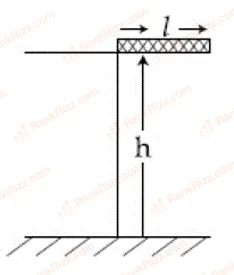
A rectangular solid box of length 0.3 m is held horizontally, with one of its sides on the edge of a platform of height 5 m. When released, it slips off the table in a very short time τ=0.01\tau = 0.01 s, remaining essentially horizontal. The angle by which it would rotate when it hits the ground will be (in radians) close to:

Figure for JEE Main 2019 Physics question on Angular momentum of particles and rigid bodies
  1. A

    0.5

  2. B

    0.3

  3. C

    0.02

  4. D

    0.28

JEE MAIN 2019 · 08 APR S2Rolling with friction, slipping and impulsive forces

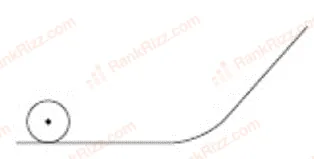
A solid sphere and solid cylinder of identical radii approach an incline with the same linear velocity (see figure). Both roll without slipping all throughout. The two climb maximum heights hsphh_{sph} and hcylh_{cyl} on the incline. The ratio hsphhcyl\frac{h_{sph}}{h_{cyl}} is given by:

Figure for JEE Main 2019 Physics question on Rolling with friction, slipping and impulsive forces
  1. A

    25\frac{2}{\sqrt{5}}

  2. B

    45\frac{4}{5}

  3. C

    1415\frac{14}{15}

  4. D

    1

JEE MAIN 2019 · 12 JAN S1Moment of inertia of standard bodies and composite systems

Let the moment of inertia of a hollow cylinder of length 30 cm (inner radius 10 cm and outer radius 20 cm), about its axis be I. The radius of a thin cylinder of the same mass such that its moment of inertia about its axis is also I, is:

  1. A

    16 cm

  2. B

    14 cm

  3. C

    12 cm

  4. D

    18 cm

JEE MAIN 2019 · 12 JAN S2Rolling without slipping: kinematics and energy

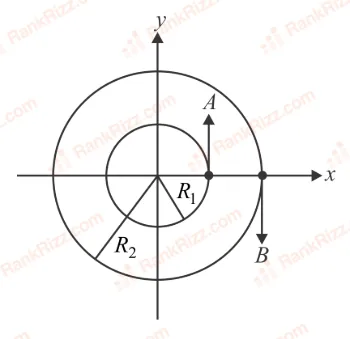
Two particles A, B are moving on two concentric circles of radii R1R_1 and R2R_2 with equal angular speed ω\omega. At t=0t = 0, their positions and direction of motion are shown in the figure. The relative velocity VA⃗−VB⃗\vec{V_A} - \vec{V_B} at t=π2ωt = \frac{\pi}{2\omega} is given by:

q2_replace
  1. A

    ω(R1+R2)i^\omega(R_1 + R_2)\hat{i}

  2. B

    −ω(R1+R2)i^-\omega(R_1 + R_2)\hat{i}

  3. C

    ω(R1−R2)i^\omega(R_1 - R_2)\hat{i}

  4. D

    ω(R2−R1)i^\omega(R_2 - R_1)\hat{i}

JEE MAIN 2019 · 12 JAN S2Angular momentum of particles and rigid bodies

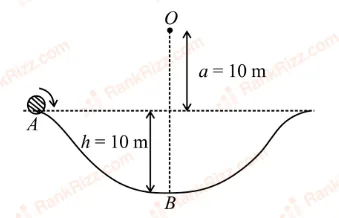
A particle of mass 20 g is released with an initial velocity 5 m s−1^{-1} along the curve from the point A, as shown in the figure. The point A is at height h from point B. The particle slides along the frictionless surface. When the particle reaches point B, its angular momentum about O will be: (Take g=10g = 10 m s−2^{-2})

Figure for JEE Main 2019 Physics question on Angular momentum of particles and rigid bodies
  1. A

    3 kg m2^2 s−1^{-1}

  2. B

    2 kg m2^2 s−1^{-1}

  3. C

    6 kg m2^2 s−1^{-1}

  4. D

    8 kg m2^2 s−1^{-1}

JEE MAIN 2019 · 12 JAN S2Moment of inertia of standard bodies and composite systems

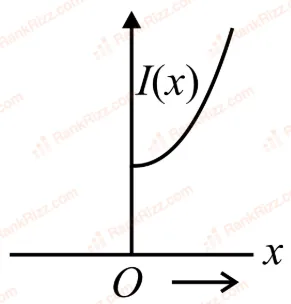
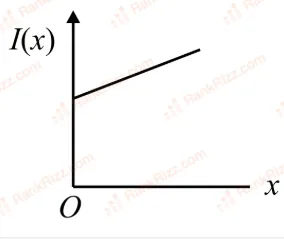
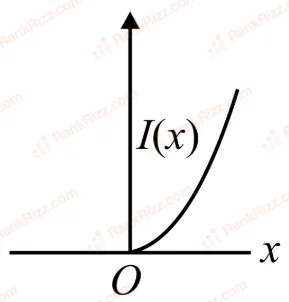
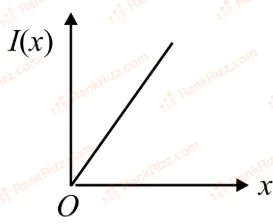
The moment of inertia of a solid sphere, about an axis parallel to its diameter and at a distance of x from it, is I(x)I(x). Which one of the graphs represents the variation of I(x)I(x) with x correctly?

  1. A
    Figure for JEE Main 2019 Physics question on Moment of inertia of standard bodies and composite systems
  2. B
    Figure for JEE Main 2019 Physics question on Moment of inertia of standard bodies and composite systems
  3. C
    Figure for JEE Main 2019 Physics question on Moment of inertia of standard bodies and composite systems
  4. D
    Figure for JEE Main 2019 Physics question on Moment of inertia of standard bodies and composite systems
JEE MAIN 2019 · 11 JAN S1Torque and the rotational form of Newton's second law

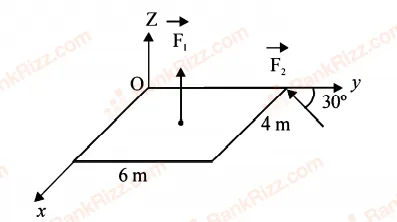
A slab is subjected to two forces F1⃗\vec{F_1} and F2⃗\vec{F_2} of same magnitude FF as shown in the figure. Force F2⃗\vec{F_2} is in XY-plane while force F1⃗\vec{F_1} acts along z-axis at the point (2i^+3j^)(2\hat{i} + 3\hat{j}). The moment of these forces about point O will be:

Figure for JEE Main 2019 Physics question on Torque and the rotational form of Newton's second law
  1. A

    (3i^−2j^+3k^)(3\hat{i} - 2\hat{j} + 3\hat{k}) F

  2. B

    (3i^−2j^−3k^)(3\hat{i} - 2\hat{j} - 3\hat{k}) F

  3. C

    (3i^+2j^−3k^)(3\hat{i} + 2\hat{j} - 3\hat{k}) F

  4. D

    (3i^+2j^+3k^)(3\hat{i} + 2\hat{j} + 3\hat{k}) F

JEE MAIN 2019 · 11 JAN S1Moment of inertia of standard bodies and composite systems

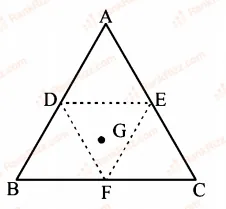
An equilateral triangle ABC is cut from a thin solid sheet of wood. (See figure) D, E and F are the mid-points of its sides as shown and G is the centre of the triangle. The moment of inertia of the triangle about an axis passing through G and perpendicular to the plane of the triangle is I0I_0. If the smaller triangle DEF is removed from ABC, the moment of inertia of the remaining figure about the same axis is II. Then

Figure for JEE Main 2019 Physics question on Moment of inertia of standard bodies and composite systems
  1. A

    I=1516I0I = \frac{15}{16}I_0

  2. B

    I=34I0I = \frac{3}{4}I_0

  3. C

    I=916I0I = \frac{9}{16}I_0

  4. D

    I=I04I = \frac{I_0}{4}

JEE MAIN 2019 · 11 JAN S2Torque and the rotational form of Newton's second law

The magnitude of torque on a particle of mass 1 kg is 2.5 Nm about the origin. If the force acting on it is 1 N, and the distance of the particle from the origin is 5 m, the angle between the force and the position vector is (in radians):

  1. A

    π6\frac{\pi}{6}

  2. B

    π3\frac{\pi}{3}

  3. C

    π8\frac{\pi}{8}

  4. D

    π4\frac{\pi}{4}

JEE MAIN 2019 · 11 JAN S2Torque and the rotational form of Newton's second law

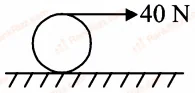
A string is wound around a hollow cylinder of mass 5 kg and radius 0.5 m. If the string is now pulled with a horizontal force of 40 N, and the cylinder is rolling without slipping on a horizontal surface (see figure), then the angular acceleration of the cylinder will be (Neglect the mass and thickness of the string)

Figure for JEE Main 2019 Physics question on Torque and the rotational form of Newton's second law
  1. A

    20 rad/s2^2

  2. B

    16 rad/s2^2

  3. C

    12 rad/s2^2

  4. D

    10 rad/s2^2

JEE MAIN 2019 · 11 JAN S2Moment of inertia of standard bodies and composite systems

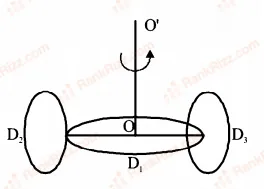
A circular disc D1D_1 of mass M and radius R has two identical discs D2D_2 and D3D_3 of the same mass M and radius R attached rigidly at its opposite ends (see figure). The moment of inertia of the system about the axis OO', passing through the centre of D1D_1, as shown in the figure, will be

Figure for JEE Main 2019 Physics question on Moment of inertia of standard bodies and composite systems
  1. A

    MR2MR^2

  2. B

    3MR23MR^2

  3. C

    45MR2\frac{4}{5}MR^2

  4. D

    23MR2\frac{2}{3}MR^2

JEE MAIN 2019 · 10 JAN S1Torque and the rotational form of Newton's second law

To mop-clean a floor, a cleaning machine presses a circular mop of radius RR vertically down with a total force FF and rotates it with a constant angular speed about its axis. If the force FF is distributed uniformly over the mop and if coefficient of friction between the mop and the floor is μ\mu, the torque, applied by the machine on the mop is:

  1. A

    2μFR/32\mu FR/3

  2. B

    μFR/3\mu FR/3

  3. C

    μFR/6\mu FR/6

  4. D

    μFR/2\mu FR/2

JEE MAIN 2019 · 10 JAN S1Rolling with friction, slipping and impulsive forces

A homogeneous solid cylindrical roller of radius RR and mass MM is pulled on a cricket pitch by a horizontal force. Assuming rolling without slipping, angular acceleration of the cylinder is:

  1. A

    F3mR\frac{F}{3mR}

  2. B

    3F2mR\frac{3F}{2mR}

  3. C

    2F3mR\frac{2F}{3mR}

  4. D

    F2mR\frac{F}{2mR}

JEE MAIN 2019 · 10 JAN S2Moment of inertia of standard bodies and composite systems

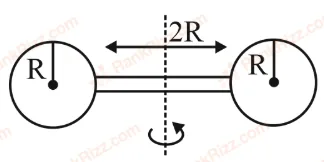
Two identical spherical balls of mass MM and radius RR each are stuck on two ends of a rod of length 2R2R and mass MM (see figure). The moment of inertia of the system about the axis passing perpendicularly through the centre of the rod is:

Figure for JEE Main 2019 Physics question on Moment of inertia of standard bodies and composite systems
  1. A

    20915MR2\frac{209}{15}MR^2

  2. B

    15215MR2\frac{152}{15}MR^2

  3. C

    13715MR2\frac{137}{15}MR^2

  4. D

    1715MR2\frac{17}{15}MR^2

JEE MAIN 2019 · 10 JAN S2Torque and the rotational form of Newton's second law

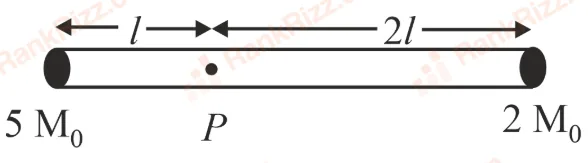
A rigid massless rod of length 3l3l has two masses attached at each end as shown in the figure. The rod is pivoted at point P on the horizontal axis. When released from the initial horizontal position, its instantaneous angular acceleration will be:

Figure for JEE Main 2019 Physics question on Torque and the rotational form of Newton's second law
  1. A

    g2l\frac{g}{2l}

  2. B

    7g3l\frac{7g}{3l}

  3. C

    g3l\frac{g}{3l}

  4. D

    g13l\frac{g}{13l}

JEE MAIN 2019 · 09 JAN S1Fixed-axis rotation: kinematics, rotational energy and pulleys

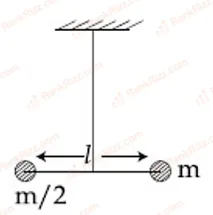
Two masses mm and m2\frac{m}{2} are connected at the two ends of a massless rigid rod of length ll. The rod is suspended by a thin wire of torsional constant kk at the centre of mass of the rod-mass system (see figure). Because of torsional constant kk, the restoring torque is τ=kθ\tau = k\theta for angular displacement θ\theta. If the rod is rotated by θ0\theta_0 and released, the tension in it when it passes through its mean position will be:

Figure for JEE Main 2019 Physics question on Fixed-axis rotation: kinematics, rotational energy and pulleys
  1. A

    kθ02k\theta_0^2

  2. B

    3kθ02l\frac{3k\theta_0^2}{l}

  3. C

    2kθ02l\frac{2k\theta_0^2}{l}

  4. D

    kθ02l\frac{k\theta_0^2}{l}

JEE MAIN 2019 · 09 JAN S1Torque and the rotational form of Newton's second law

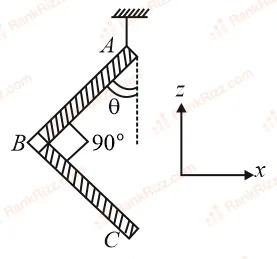
An LL-shaped object, made of thin rods of uniform mass density, is suspended with a string as shown in figure. If AB=BCAB = BC, and the angle made by ABAB with downward vertical is θ\theta, then:

Figure for JEE Main 2019 Physics question on Torque and the rotational form of Newton's second law
  1. A

    tan⁡θ=23\tan\theta = \frac{2}{\sqrt{3}}

  2. B

    tan⁡θ=13\tan\theta = \frac{1}{3}

  3. C

    tan⁡θ=12\tan\theta = \frac{1}{2}

  4. D

    tan⁡θ=123\tan\theta = \frac{1}{2\sqrt{3}}