RankRizz

Rotational Motion — JEE Main Previous Year Questions

Every Rotational Motion question JEE Main has set from 2004–2026, grouped by the idea it tests rather than the order of the syllabus. 276 questions across 10 distinct ideas. Free to read, answer key on every one.

DATA UPDATED

Questions

276

Distinct ideas

10

Share of marks

5.6%

Difficulty

MEDIUM

The ideas inside Rotational Motion

A chapter is not one subject — it is a handful of procedures the examiner reuses. These are the ones Rotational Motion questions actually test.

Every Rotational Motion question

181–200 OF 276 · NEWEST FIRST

JEE MAIN 2020 · 09 JAN S1Moment of inertia of standard bodies and composite systems

Three solid spheres each of mass mm and diameter dd are stuck together such that the lines connecting the centres form an equilateral triangle of side of length dd. The ratio I0IA\frac{I_0}{I_A} of moment of inertia I0I_0 of the system about an axis passing the centroid and about center of any of the spheres IAI_A and perpendicular to the plane of the triangle is:
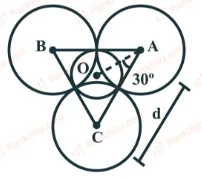
Figure for JEE Main 2020 Physics question on Moment of inertia of standard bodies and composite systems
  1. A

    1323\frac{13}{23}

  2. B

    1513\frac{15}{13}

  3. C

    2313\frac{23}{13}

  4. D

    1315\frac{13}{15}

JEE MAIN 2020 · 09 JAN S1Fixed-axis rotation: kinematics, rotational energy and pulleys

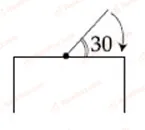
One end of a straight uniform 1  m1 \; m long bar is pivoted on horizontal table. It is released from rest when it makes an angle 30°30° from the horizontal (see figure). Its angular speed when it hits the table is given as n\sqrt{n} rad s−1s^{-1}, where nn is an integer. The value of nn is ___________.

Figure for JEE Main 2020 Physics question on Fixed-axis rotation: kinematics, rotational energy and pulleys
JEE MAIN 2020 · 09 JAN S2Angular momentum of particles and rigid bodies

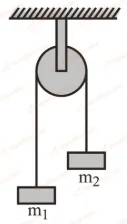
A uniformly thick wheel with moment of inertia II and radius RR is free to rotate about its centre of mass (see fig). A massless string is wrapped over its rim and two blocks of masses m1m_1 and m2m_2 (m1>m2)(m_1 > m_2) are attached to the ends of the string. The system is released from rest. The angular speed of the wheel when m1m_1 descends by a distance hh is:

Figure for JEE Main 2020 Physics question on Angular momentum of particles and rigid bodies
  1. A

    [2(m1−m2)gh(m1+m2)R2+I]12\left[\dfrac{2(m_1-m_2)gh}{(m_1+m_2)R^2+I}\right]^{\dfrac{1}{2}}

  2. B

    [2(m1+m2)gh(m1+m2)R2+I]12\left[\dfrac{2(m_1+m_2)gh}{(m_1+m_2)R^2+I}\right]^{\dfrac{1}{2}}

  3. C

    [(m1−m2)(m1+m2)R2+1]12gh\left[\dfrac{(m_1-m_2)}{(m_1+m_2)R^2+1}\right]^{\dfrac{1}{2}}gh

  4. D

    [m1+m2(m1+m2)R2+I]12gh\left[\dfrac{m_1+m_2}{(m_1+m_2)R^2+I}\right]^{\dfrac{1}{2}}gh

JEE MAIN 2020 · 08 JAN S1Angular momentum of particles and rigid bodies

Consider a uniform rod of mass M=4M = 4 m and length ll pivoted about its centre. A mass mm moving with velocity vv making angle θ=π4\theta = \frac{\pi}{4} to the rod's long axis collides with one end of the rod and sticks to it. The angular speed of the rod-mass system just after the collision is:

  1. A

    372vl\frac{3}{7\sqrt{2}} \frac{v}{l}

  2. B

    37vl\frac{3}{7} \frac{v}{l}

  3. C

    327vl\frac{3\sqrt{2}}{7} \frac{v}{l}

  4. D

    47vl\frac{4}{7} \frac{v}{l}

JEE MAIN 2020 · 08 JAN S2Rolling with friction, slipping and impulsive forces

A uniform sphere of mass 500 g rolls without slipping on a plane horizontal surface with its centre moving at a speed of 5.00 cm s−1^{-1}. Its kinetic energy is:

  1. A

    8.75×10−48.75 \times 10^{-4} J

  2. B

    8.75×10−38.75 \times 10^{-3} J

  3. C

    6.25×10−46.25 \times 10^{-4} J

  4. D

    1.13×10−31.13 \times 10^{-3} J

JEE MAIN 2020 · 07 JAN S1Rolling with friction, slipping and impulsive forces

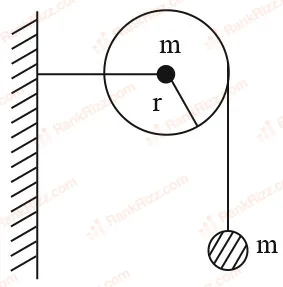
As shown in the figure, a bob of mass m is tied to a massless string whose other end portion is wound on a fly wheel (disc) of radius r and mass m. When released from rest the bob starts falling vertically. When it has covered a distance of h, the angular speed of the wheel will be:

Figure for JEE Main 2020 Physics question on Rolling with friction, slipping and impulsive forces
  1. A

    1r4gh3\frac{1}{r}\sqrt{\frac{4gh}{3}}

  2. B

    r32ghr\sqrt{\frac{3}{2gh}}

  3. C

    1r2gh3\frac{1}{r}\sqrt{\frac{2gh}{3}}

  4. D

    r34ghr\sqrt{\frac{3}{4gh}}

JEE MAIN 2020 · 07 JAN S1Moment of inertia of standard bodies and composite systems

The radius of gyration of a uniform rod of length ll, about an axis passing through a point l4\frac{l}{4} away from the centre of the rod, and perpendicular to it, is:

  1. A

    14l\frac{1}{4}l

  2. B

    18l\frac{1}{8}l

  3. C

    748 l\sqrt{\frac{7}{48}}\,l

  4. D

    38 l\sqrt{\frac{3}{8}}\,l

JEE MAIN 2020 · 07 JAN S2Moment of inertia of standard bodies and composite systems

Mass per unit area of a circular disc of radius a depends on the distance r from its centre as σ(r)=A+Br\sigma(r) = A + Br. The moment of inertia of the disc about the axis, perpendicular to the plane and passing through its centre is:

  1. A

    2πa4(A4+aB5)2\pi a^4\left(\frac{A}{4} + \frac{aB}{5}\right)

  2. B

    2πa4(aA4+B5)2\pi a^4\left(\frac{aA}{4} + \frac{B}{5}\right)

  3. C

    πa4(A4+aB5)\pi a^4\left(\frac{A}{4} + \frac{aB}{5}\right)

  4. D

    2πa4(A4+B5)2\pi a^4\left(\frac{A}{4} + \frac{B}{5}\right)

JEE MAIN 2020 · 07 JAN S2Equilibrium of rigid bodies and toppling

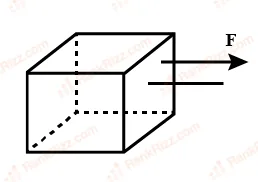
Consider a uniform cubical box of side a on a rough floor that is to be moved by applying minimum possible force F at a point b above its centre of mass (see figure). If the coefficient of friction is μ=0.4\mu = 0.4, the maximum possible value of 100×ba100 \times \frac{b}{a} for a box not to topple before moving is

Figure for JEE Main 2020 Physics question on Equilibrium of rigid bodies and toppling
JEE MAIN 2019 · 12 APR S1Angular momentum of particles and rigid bodies

A person of mass M is sitting on a swing of length L and swinging with an angular amplitude θ0\theta_0. If the person stands up when the swing passes through its lowest point, the work done by him, assuming that his centre of mass moves by a distance ll (l<<Ll << L), is close to:

  1. A

    Mgl(1−θ02)Mgl(1 - \theta_0^2)

  2. B

    Mgl(1+θ022)Mgl\left(1 + \frac{\theta_0^2}{2}\right)

  3. C

    MglMgl

  4. D

    Mgl(1+θ02)Mgl(1 + \theta_0^2)

JEE MAIN 2019 · 12 APR S1Torque and the rotational form of Newton's second law

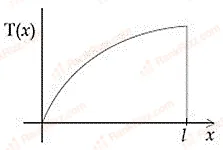
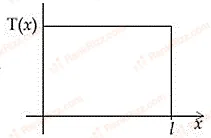
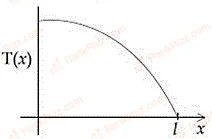
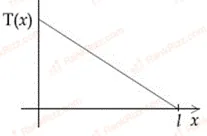
A uniform rod of length ll is being rotated in a horizontal plane with a constant angular speed about an axis passing through one of its ends. If the tension generated in the rod due to rotation is T(x) at a distance x from the axis, then which of the following graphs depicts it most closely?

  1. A
    Figure for JEE Main 2019 Physics question on Torque and the rotational form of Newton's second law
  2. B
    Figure for JEE Main 2019 Physics question on Torque and the rotational form of Newton's second law
  3. C
    Figure for JEE Main 2019 Physics question on Torque and the rotational form of Newton's second law
  4. D
    Figure for JEE Main 2019 Physics question on Torque and the rotational form of Newton's second law
JEE MAIN 2019 · 12 APR S1Moment of inertia of standard bodies and composite systems

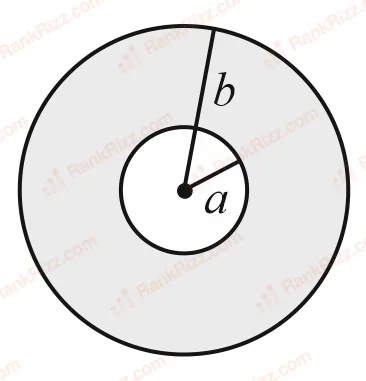
A circular disc of radius b has a hole of radius a at its centre (see figure). If the mass per unit area of the disc varies as σ0r\frac{\sigma_0}{r}, then the radius of gyration of the disc about its axis passing through the center is

Figure for JEE Main 2019 Physics question on Moment of inertia of standard bodies and composite systems
  1. A

    a+b3\frac{a+b}{3}

  2. B

    a2+b2+ab3\sqrt{\frac{a^2 + b^2 + ab}{3}}

  3. C

    a+b2\frac{a+b}{2}

  4. D

    a2+b2+ab2\sqrt{\frac{a^2 + b^2 + ab}{2}}

JEE MAIN 2019 · 10 APR S1Torque and the rotational form of Newton's second law

A particle of mass m is moving along a trajectory given by
x=x0+acos⁡ω1tx = x_0 + a\cos\omega_1 t
y=y0+bsin⁡ω2ty = y_0 + b\sin\omega_2 t
The torque, acting on the particle about the origin, at t = 0 is:

  1. A

    +my0aω12k^+my_0 a\omega_1^2 \hat{k}

  2. B

    −m(x0bω22−y0aω12)k^-m(x_0 b\omega_2^2 - y_0 a\omega_1^2)\hat{k}

  3. C

    Zero

  4. D

    m(−x0b+y0a)ω12k^m(-x_0 b + y_0 a)\omega_1^2 \hat{k}

JEE MAIN 2019 · 10 APR S1Moment of inertia of standard bodies and composite systems

A thin disc of mass M and radius R has mass per unit area σ(r)=kr2\sigma(r) = kr^2 where r is the distance from its centre. Its moment of inertia about an axis going through its centre of mass and perpendicular to its plane is:

  1. A

    MR23\frac{MR^2}{3}

  2. B

    MR22\frac{MR^2}{2}

  3. C

    MR26\frac{MR^2}{6}

  4. D

    2MR23\frac{2MR^2}{3}

JEE MAIN 2019 · 10 APR S1Conservation of angular momentum

Two coaxial discs, having moments of inertia I1I_1 and I12\frac{I_1}{2}, are rotating with respective angular velocities ω1\omega_1 and ω12\frac{\omega_1}{2}, about their common axis. They are brought in contact with each other and thereafter they rotate with a common angular velocity. If EfE_f and EiE_i are the final and initial total energies, then (Ef−Ei)(E_f - E_i) is:

  1. A

    I1ω126\frac{I_1\omega_1^2}{6}

  2. B

    38I1ω12\frac{3}{8}I_1\omega_1^2

  3. C

    −I1ω1212-\frac{I_1\omega_1^2}{12}

  4. D

    −I1ω1224-\frac{I_1\omega_1^2}{24}

JEE MAIN 2019 · 10 APR S2Moment of inertia of standard bodies and composite systems

A solid sphere of mass M and radius R is divided into two unequal parts. The first part has a mass of 7M8\frac{7M}{8} and is converted into uniform disc of radius 2R. The second part is converted into a uniform solid sphere. Let I1_1 be the moment of inertia of the disc about its axis and I2_2 be the moment of inertia of the new sphere about its axis. The ratio I1_1/I2_2 is given by:

  1. A

    140

  2. B

    185

  3. C

    65

  4. D

    285

JEE MAIN 2019 · 10 APR S2Torque and the rotational form of Newton's second law

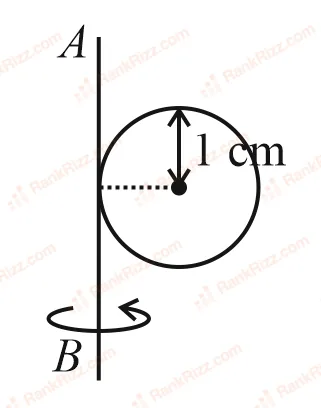
A metal coin of mass 5 g and radius 1 cm is fixed to a thin stick AB of negligible mass as shown in the figure. The system is initially at rest. The constant torque, that will make the system rotate about AB at 25 rotations per second in 5 s, is close to:

Figure for JEE Main 2019 Physics question on Torque and the rotational form of Newton's second law
  1. A

    1.6×10−51.6 \times 10^{-5} N m

  2. B

    2.0×10−52.0 \times 10^{-5} N m

  3. C

    7.9×10−67.9 \times 10^{-6} N m

  4. D

    4.0×10−64.0 \times 10^{-6} N m

JEE MAIN 2019 · 10 APR S2Angular momentum of particles and rigid bodies

The time dependence of the position of a particle of mass m = 2 is given by r⃗(t)=2ti^−3t2j^\vec{r}(t) = 2t\hat{i} - 3t^2\hat{j}. Its angular momentum, with respect to the origin, at time t = 2 is:

  1. A

    36k^36\hat{k}

  2. B

    48i^+j^48\hat{i} + \hat{j}

  3. C

    −48k^-48\hat{k}

  4. D

    −34k^−i^-34\hat{k} - \hat{i}

JEE MAIN 2019 · 09 APR S1Fixed-axis rotation: kinematics, rotational energy and pulleys

A stationary horizontal disc is free to rotate about its axis. When a torque is applied on it, its kinetic energy as a function of θ\theta, where θ\theta is the angle by which it has rotated, is given as kθ2k\theta^2. If its moment of inertia is I then the angular acceleration of the disc is:

  1. A

    2kIθ\frac{2k}{I}\theta

  2. B

    k2Iθ\frac{k}{2I}\theta

  3. C

    k4Iθ\frac{k}{4I}\theta

  4. D

    kIθ\frac{k}{I}\theta

JEE MAIN 2019 · 09 APR S1Rolling with friction, slipping and impulsive forces

The following bodies are made to roll up (without slipping) the same inclined plane from a horizontal plane: (i) a ring of radius R, (ii) a solid cylinder of radius R2\frac{R}{2} and (iii) a solid sphere of radius R4\frac{R}{4}. If, in each case, the speed of the center of mass at the bottom of the incline is same, the ratio of the maximum heights they climb is:

  1. A

    2 : 3 : 4

  2. B

    20 : 15 : 14

  3. C

    4 : 3 : 2

  4. D

    14 : 15 : 20