Rotational Motion — JEE Main Previous Year Questions
Every Rotational Motion question JEE Main has set from 2004–2026, grouped by the idea it tests rather than the order of the syllabus. 276 questions across 10 distinct ideas. Free to read, answer key on every one.
JEE MAIN 2025 · 02 APR S2Fixed-axis rotation: kinematics, rotational energy and pulleys
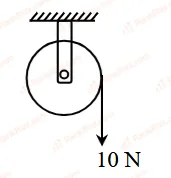
A wheel of radius 0.2 m rotates freely about its center when a string that is wrapped over its rim is pulled by force of 10 N as shown in the figure below. The established torque produces an angular acceleration of 2 rad/s2. Moment of inertia of the wheel is _________ kg m2. (Acceleration due to gravity = 10 m/s2)
JEE MAIN 2025 · 29 JAN S1Torque and the rotational form of Newton's second law
The coordinates of a particle with respect to origin in a given reference frame is (1, 1, 1) meters. If a force of F=i^−j^+k^ acts on the particle, then the magnitude of torque (with respect to origin) in z-direction is_________.
JEE MAIN 2025 · 29 JAN S2Conservation of angular momentum
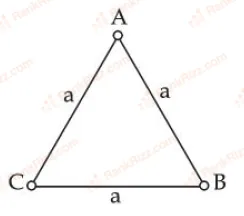
Three equal masses m are kept at vertices (A, B, C) of an equilateral triangle of side a in free space. At t=0, they are given an initial velocity VA=V0AC, VB=V0BA and VC=V0CB. Here AC, CB and BA are unit vectors along the edges of the triangle. If the three masses interact gravitationally, then the magnitude of the net angular momentum of the system at the point of collision is :
JEE MAIN 2025 · 28 JAN S1Parallel and perpendicular axis theorems
Two iron solid discs of negligible thickness have radii R1 and R2 and moment of intertia I1 and I2, respectively. For R2=2R1, the ratio of I1 and I2 would be 1/x, where x = __________.
JEE MAIN 2025 · 28 JAN S1Parallel and perpendicular axis theorems
The moment of inertia of a solid disc rotating along its diameter is 2.5 times higher than the moment of inertia of a ring rotating in similar way. The moment of inertia of a solid sphere which has same radius as the disc and rotating in similar way, is n times higher than the moment of inertia of the given ring. Here, n=_________Consider all the bodies have equal masses.
JEE MAIN 2025 · 28 JAN S2Equilibrium of rigid bodies and toppling
A uniform rod of mass 250 g having length 100 cm is balanced on a sharp edge at 40 cm mark. A mass of 400 g is suspended at 10 cm mark. To maintain the balance of the rod, the mass to be suspended at 90 cm mark, is
JEE MAIN 2025 · 24 JAN S1Rolling with friction, slipping and impulsive forces
A uniform solid cylinder of mass m and radius r rolls along an inclined rough plane of inclination 45∘. If it starts to roll from rest from the top of the plane, then the linear acceleration of the cylinder's axis will be:
JEE MAIN 2025 · 24 JAN S1Angular momentum of particles and rigid bodies
An object of mass m is projected from origin in a vertical xy plane at an angle 45∘ with the x -axis with an initial velocity v0. The magnitude and direction of the angular momentum of the object with respect to origin, when it reaches at the maximum height, will be [g is acceleration due to gravity]
JEE MAIN 2025 · 24 JAN S2Fixed-axis rotation: kinematics, rotational energy and pulleys
A solid sphere and a hollow sphere of the same mass and of same radius are rolled on an inclined plane. Let the time taken to reach the bottom by the solid sphere and the hollow sphere be t1 and t2, respectively, then
JEE MAIN 2025 · 24 JAN S2Fixed-axis rotation: kinematics, rotational energy and pulleys
A solid sphere is rolling without slipping on a horizontal plane. The ratio of the linear kinetic energy of the centre of mass of the sphere and rotational kinetic energy is :
JEE MAIN 2025 · 23 JAN S1Fixed-axis rotation: kinematics, rotational energy and pulleys
A solid sphere of mass 'm' and radius 'r' is allowed to roll without slipping from the highest point of an inclined plane of length 'L' and makes an angle 30∘ with the horizontal. The speed of the particle at the bottom of the plane is υ1 . If the angle of inclination is increased 45∘ to while keeping L constant. Then the new speed of the sphere at the bottom of the plane is υ2 . The ratio υ12:υ22 is
JEE MAIN 2025 · 23 JAN S2Torque and the rotational form of Newton's second law
A circular disk of radius R meter and mass M kg is rotating around the axis perpendicular to the disk. An external torque is applied to the disk such that θ(t)=5t2−8t, where θ(t) is the angular position of the rotating disc as a function of time t. How much power is delivered by the applied torque, when t = 2 s ?
JEE MAIN 2025 · 22 JAN S1Parallel and perpendicular axis theorems
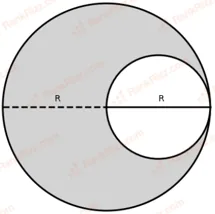
A uniform circular disc of radius ' R ' and mass ' M ' is rotating about an axis perpendicular to its plane and passing through its centre. A small circular part of radius R/2 is removed from the original disc as shown in the figure. Find the moment of inertia of the remaining part of the original disc about the axis as given.
JEE MAIN 2025 · 22 JAN S1Angular momentum of particles and rigid bodies
The position vectors of two 1 kg particles, (A) and (B), are given by rA=(α1t2i+α2tj+α3tk)m and rB=(β1ti+β2t2j+β3tk)m, respectively; (α1=1m/s2,α2=3nm/s,α3=2m/s,β1=2m/s,β2=−1m/s2,β3=4pm/s), where t is time, n and p are constants. At t=1s,∣VA∣=∣VB∣ and velocities VA and VB of the particles are orthogonal to each other. At t=1s, the magnitude of angular momentum of particle (A) with respect to the position of particle (B) is Lkgm2s−1. The value of L is _______ .
JEE MAIN 2024 · 09 APR S1Equilibrium of rigid bodies and toppling
A heavy iron bar, of weight W is having its one end on the ground and the other on the shoulder of a person. The bar makes an angle θ with the horizontal. The weight experienced by the person is :
JEE MAIN 2024 · 09 APR S1Torque and the rotational form of Newton's second law
A string is wrapped around the rim of a wheel of moment of inertia 0.40 kg m2 and radius 10 cm. The wheel is free to rotate about its axis. Initially the wheel is at rest. The string is now pulled by a force of 40 N. The angular velocity of the wheel after 10 s is x rad/s, where x is _______
JEE MAIN 2024 · 09 APR S2Rolling with friction, slipping and impulsive forces
A circular disc reaches from top to bottom of an inclined plane of length l. When it slips down the plane, it takes t s. When it rolls down the plane then it takes (2α)1/2t s, where α is ______
JEE MAIN 2024 · 08 APR S2Angular momentum of particles and rigid bodies
A thin circular disc of mass M and radius R is rotating in a horizontal plane about an axis passing through its centre and perpendicular to its plane with angular velocity ω. If another disc of same dimensions but of mass M/2 is placed gently on the first disc co-axially, then the new angular velocity of the system is :
JEE MAIN 2024 · 08 APR S2Rolling with friction, slipping and impulsive forces
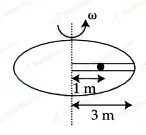
A circular table is rotating with an angular velocity of ω rad/s about its axis (see figure). There is a smooth groove along a radial direction on the table. A steel ball is gently placed at a distance of 1 m on the groove. All the surfaces are smooth. If the radius of the table is 3 m, the radial velocity of the ball w.r.t. the table at the time ball leaves the table is x2ω m/s, where the value of x is _____