RankRizz

Rotational Motion — JEE Main Previous Year Questions

Every Rotational Motion question JEE Main has set from 2004–2026, grouped by the idea it tests rather than the order of the syllabus. 276 questions across 10 distinct ideas. Free to read, answer key on every one.

DATA UPDATED

Questions

276

Distinct ideas

10

Share of marks

5.6%

Difficulty

MEDIUM

The ideas inside Rotational Motion

A chapter is not one subject — it is a handful of procedures the examiner reuses. These are the ones Rotational Motion questions actually test.

Every Rotational Motion question

261–276 OF 276 · NEWEST FIRST

JEE MAIN 2011Conservation of angular momentum

A thin horizontal circular disc is rotating about a vertical axis passing through its centre. An insect is at rest at a point near the rim of the disc. The insect now moves along a diameter of the disc to reach its other end. During the journey of the insect, the angular speed of the disc:

  1. A

    continuously decreases

  2. B

    continuously increases

  3. C

    first increases and then decreases

  4. D

    remains unchanged

JEE MAIN 2011Torque and the rotational form of Newton's second law

A pulley of radius 2 m2 \, \text{m} is rotated about its axis by a force F=(20t−5t2)F = (20t - 5t^2) Newton (where tt is measured in seconds) applied tangentially. If the moment of inertia of the pulley about its axis of rotation is 10 kg.m210\ kg.m^2, the number of rotation made by the pulley before its direction of motion if reversed, is :

  1. A

    more than 3 but less than 6

  2. B

    more than 6 but less than 9

  3. C

    more than 9

  4. D

    less than 3

JEE MAIN 2010Angular momentum of particles and rigid bodies

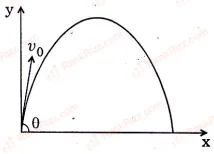
A small particle of mass mm is projected at an angle θ\theta with the x-axis with an initial velocity v0v_0 in the x−yx-y plane as shown in the figure. At a time t<v0sin⁡θgt < \frac{v_0 \sin\theta}{g}, the angular momentum of the particle is where i^,j^\hat{i}, \hat{j} and k^\hat{k} are unit vectors along x, y and z-axis respectively.
Figure for JEE Main 2010 Physics question on Angular momentum of particles and rigid bodies

  1. A

    −mgv0t2cos⁡θ j^-mgv_0 t^2 \cos\theta \, \hat{j}

  2. B

    mgv0tcos⁡θ k^mgv_0 t \cos\theta \, \hat{k}

  3. C

    −12mgv0t2cos⁡θ k^-\frac{1}{2} mgv_0 t^2 \cos\theta \, \hat{k}

  4. D

    12mgv0t2cos⁡θ i^\frac{1}{2} mgv_0 t^2 \cos\theta \, \hat{i}

JEE MAIN 2009Fixed-axis rotation: kinematics, rotational energy and pulleys

A thin uniform rod of length ℓ\ell and mass mm is swinging freely about a horizontal axis passing through its end. Its maximum angular speed is ω\omega. Its centre of mass rises to a maximum height of

  1. A

    13ℓ2ω2g\frac{1}{3}\frac{\ell^2\omega^2}{g}

  2. B

    16ℓωg\frac{1}{6}\frac{\ell\omega}{g}

  3. C

    12ℓ2ω2g\frac{1}{2}\frac{\ell^2\omega^2}{g}

  4. D

    16ℓ2ω2g\frac{1}{6}\frac{\ell^2\omega^2}{g}

JEE MAIN 2008Parallel and perpendicular axis theorems

Consider a uniform square plate of side 'aa' and mass 'mm'. The moment of inertia of this plate about an axis perpendicular to its plane and passing through one of its corners is

  1. A

    56ma2\frac{5}{6}ma^2

  2. B

    112ma2\frac{1}{12}ma^2

  3. C

    712ma2\frac{7}{12}ma^2

  4. D

    23ma2\frac{2}{3}ma^2

JEE MAIN 2007Parallel and perpendicular axis theorems
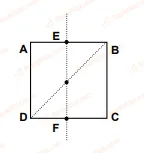
Figure for JEE Main 2007 Physics question on Parallel and perpendicular axis theorems
For the given uniform square lamina ABCD, whose centre is O,
  1. A

    2IAC=IEF\sqrt{2} I_{AC} = I_{EF}

  2. B

    IAD=3IEFI_{AD} = 3 I_{EF}

  3. C

    IAC=IEFI_{AC} = I_{EF}

  4. D

    IAC=2IEFI_{AC} = \sqrt{2} I_{EF}

JEE MAIN 2007Rolling without slipping: kinematics and energy

A round uniform body of radius RR, mass MM and moment of inertia II, rolls down (without slipping) an inclined plane making an angle θ\theta with the horizontal. Then its acceleration is

  1. A

    gsin⁡θ1+IMR2\frac{g \sin\theta}{1 + \frac{I}{MR^2}}

  2. B

    gsin⁡θ1+MR2I\frac{g \sin\theta}{1 + \frac{MR^2}{I}}

  3. C

    gsin⁡θ1−IMR2\frac{g \sin\theta}{1 - \frac{I}{MR^2}}

  4. D

    gsin⁡θ1−MR2I\frac{g \sin\theta}{1 - \frac{MR^2}{I}}

JEE MAIN 2007Angular momentum of particles and rigid bodies

Angular momentum of the particle rotating with a central force is constant due to

  1. A

    Constant Force

  2. B

    Constant linear momentum.

  3. C

    Zero Torque

  4. D

    Constant Torque

JEE MAIN 2006Torque and the rotational form of Newton's second law

A force of −Fk^-F\hat{k} acts on OO, the origin of the coordinate system. The torque about the point (1,−1)(1, -1) is

  1. A

    −F(i^−j^)-F(\hat{i} - \hat{j})

  2. B

    F(i^−j^)F(\hat{i} - \hat{j})

  3. C

    −F(i^+j^)-F(\hat{i} + \hat{j})

  4. D

    F(i^+j^)F(\hat{i} + \hat{j})

JEE MAIN 2006Conservation of angular momentum

A thin circular ring of mass mm and radius RR is rotating about its axis with a constant angular velocity ω\omega. Two objects each of mass MM are attached gently to the opposite ends of a diameter of the ring. The ring now rotates with an angular velocity ω′=\omega' =

  1. A

    ωm(m+2M)\dfrac{\omega m}{(m+2M)}

  2. B

    ω(m+2M)m\dfrac{\omega(m+2M)}{m}

  3. C

    ω(m−2M)(m+2M)\dfrac{\omega(m-2M)}{(m+2M)}

  4. D

    ωm(m+M)\dfrac{\omega m}{(m+M)}

JEE MAIN 2006Moment of inertia of standard bodies and composite systems

Four point masses, each of value mm, are placed at the corners of a square ABCDABCD of side ℓ\ell. The moment of inertia of system about an axis passing through AA and parallel to BDBD is

  1. A

    mℓ2m\ell^2

  2. B

    2mℓ22m\ell^2

  3. C

    3mℓ23m\ell^2

  4. D

    3 mℓ23\,m\ell^2

JEE MAIN 2005Equilibrium of rigid bodies and toppling

AA and BB are two like parallel forces. A couple of moment HH lies in the plane of AA and BB and is contained with them. The resultant of AA and BB after combining is displaced through a distance

  1. A

    2HA−B\frac{2H}{A-B}

  2. B

    HA−B\frac{H}{A-B}

  3. C

    H2(A+B)\frac{H}{2(A+B)}

  4. D

    HA+B\frac{H}{A+B}

JEE MAIN 2005Rolling without slipping: kinematics and energy

An annular ring with inner and outer radii R1R_1 and R2R_2 is rolling without slipping with a uniform angular speed. The ratio of the forces experienced by the two particles situated on the inner and outer parts of the ring, F1/F2F_1/F_2 is

  1. A

    R2R1\frac{R_2}{R_1}

  2. B

    (R1R2)2\left(\frac{R_1}{R_2}\right)^2

  3. C

    11

  4. D

    R1R2\frac{R_1}{R_2}

JEE MAIN 2005Moment of inertia of standard bodies and composite systems

The moment of inertia of a uniform semicircular disc of mass MM and radius rr about a line perpendicular to the plane of the disc through the centre is

  1. A

    14Mr2\frac{1}{4} Mr^2

  2. B

    25Mr2\frac{2}{5} Mr^2

  3. C

    Mr2Mr^2

  4. D

    12Mr2\frac{1}{2} Mr^2

JEE MAIN 2004Conservation of angular momentum

A solid sphere is rotating in free space. If the radius of the sphere is increased keeping mass same which one of the following will not be affected?

  1. A

    moment of inertia

  2. B

    angular momentum

  3. C

    angular velocity

  4. D

    rotational kinetic energy

JEE MAIN 2004Moment of inertia of standard bodies and composite systems

One solid sphere A and another hollow sphere B are of same mass and same outer radii. Their moment of inertia about their diameters are respectively IAI_A and IBI_B such that

  1. A

    IA=IBI_A = I_B

  2. B

    IA>IBI_A > I_B

  3. C

    IA<IBI_A < I_B

  4. D

    IA/IB=dA/dBI_A/I_B = d_A/d_B where dAd_A and dBd_B are their densities.