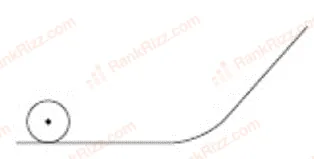
We begin by recalling a basic energy principle: when a body rolls without slipping, its total mechanical energy is the sum of its translational kinetic energy, its rotational kinetic energy, and its gravitational potential energy. On the horizontal surface (before climbing the incline) the potential energy is taken to be zero, so the total energy consists only of the two kinetic terms. As the body climbs the incline, it slows down, and at the highest point its speed becomes zero. At that instant the whole initial kinetic energy has converted into gravitational potential energy mgh.
Let the common mass of the bodies be m, the common radius be r and the common initial linear speed be v. The acceleration due to gravity is denoted by g. We now treat the two bodies separately.
For the solid sphere, we first state the moment of inertia formula for a solid sphere of radius r about its centre:
Isph=52mr2.
Because the sphere rolls without slipping, the condition v=ωr holds, where ω is the angular speed. Therefore ω=rv.
The total kinetic energy of the sphere just before climbing is:
Ksph=translational KE+rotational KE=21mv2+21Isphω2.
Substituting Isph=52mr2 and ω=rv, we obtain
Ksph=21mv2+21(52mr2)(rv)2=21mv2+21(52m)v2=21mv2+51mv2=(105+102)mv2=107mv2.
At the maximum height hsph the velocity is zero, hence energy conservation gives
mghsph=107mv2⟹hsph=107gv2.
For the solid cylinder, we now state its moment of inertia formula about its central axis:
Icyl=21mr2.
Using the same rolling condition ω=rv, the cylinder’s kinetic energy is
Kcyl=21mv2+21Icylω2=21mv2+21(21mr2)(rv)2=21mv2+21(21m)v2=21mv2+41mv2=(42+41)mv2=43mv2.
Converting this kinetic energy into gravitational potential energy at the maximum height hcyl gives
mghcyl=43mv2⟹hcyl=43gv2.
We are asked for the ratio hcylhsph. Substituting the two heights we derived, we have
hcylhsph=43gv2107gv2=107×34=3028=1514.
The numerical value 1514 matches Option C.
Hence, the correct answer is Option C.