JEE Main 2020 Physics question — Equilibrium of rigid bodies and toppling
Consider a uniform cubical box of side a on a rough floor that is to be moved by applying minimum possible force F at a point b above its centre of mass (see figure). If the coefficient of friction is , the maximum possible value of for a box not to topple before moving is
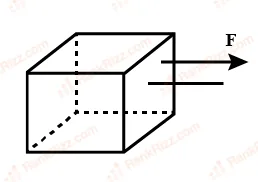
SOLUTION
Minimum Required Theory
- Sliding Condition: To initiate sliding, the minimum applied force must overcome limiting static friction ().
- No Toppling Condition: For the box not to tip over, the overturning torque about the pivoting edge (bottom front corner) must be less than or equal to the restoring torque provided by the box's weight.
- Overturning Torque: The force is applied at a height of from the ground. Torque
- Restoring Torque: The weight acts through the center of mass, a horizontal distance of from the edge. Torque
- The variable represents the distance above the center of mass.
- The center of mass is strictly at height .
- The total height of the cubical box is .
- Therefore, the physical top edge of the box is at a maximum distance of above the center of mass. You cannot apply a force higher than the box itself.
Step-by-Step Solution
Step 1: Determine the minimum force for sliding
For the box to just start moving:
Step 2: Set up the torque inequality for "No Toppling"
Calculate the torques about the bottom front edge.
For the box not to topple:
Step 3: Solve the mathematical inequality for
Substitute into the torque equation:
Cancel from both sides:
Substitute the given coefficient of friction ():
Mathematical Conclusion: To avoid toppling, can be up to .
Step 4: Apply the physical geometric constraint
Since is smaller than the limiting mathematical value of , the geometry dictates the maximum limit:
Step 5: Calculate the final requested value
The question asks for the maximum possible value of .
Final Answer: 50
Topic: Equilibrium of rigid bodies and toppling