RankRizz

Current Electricity — JEE Main Previous Year Questions

Every Current Electricity question JEE Main has set from 2004–2026, grouped by the idea it tests rather than the order of the syllabus. 386 questions across 10 distinct ideas. Free to read, answer key on every one.

DATA UPDATED

Questions

386

Distinct ideas

10

Share of marks

5.6%

Difficulty

MEDIUM

The ideas inside Current Electricity

A chapter is not one subject — it is a handful of procedures the examiner reuses. These are the ones Current Electricity questions actually test.

Every Current Electricity question

261–280 OF 386 · NEWEST FIRST

JEE MAIN 2019 · 12 APR S1Galvanometer conversion to ammeter and voltmeter

To verify Ohm's law, a student connects the voltmeter across the battery as shown in the figure. The measured voltage is plotted as a function of the current, and the following graph is obtained.
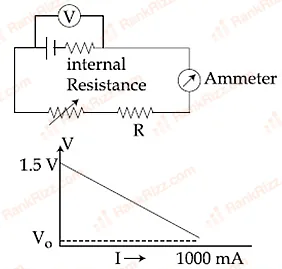
Figure for JEE Main 2019 Physics question on Galvanometer conversion to ammeter and voltmeter

If V0_0 is almost zero, identify the correct statement:

  1. A

    The emf of the battery is 1.5 V and its internal resistance is 1.5 Ω

  2. B

    The value of the resistance R is 1.5 Ω

  3. C

    The potential difference across the battery is 1.5 V when it sends a current of 1000 mA

  4. D

    The emf of the battery is 1.5 V and the value of R is 1.5 Ω
JEE MAIN 2019 · 12 APR S1Galvanometer conversion to ammeter and voltmeter

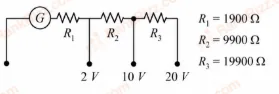
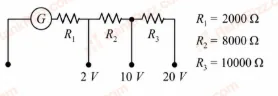
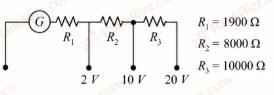
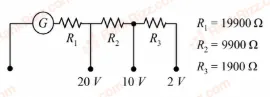
A galvanometer of resistance 100 Ω has 50 divisions on its scale and has sensitivity of 20 μA/division. It is to be converted to voltmeter with three ranges, of 0 - 2 V, 0 - 10 V and 0 - 20 V. The appropriate circuit to do so is:

  1. A
    Figure for JEE Main 2019 Physics question on Galvanometer conversion to ammeter and voltmeter
  2. B
    Figure for JEE Main 2019 Physics question on Galvanometer conversion to ammeter and voltmeter
  3. C
    Figure for JEE Main 2019 Physics question on Galvanometer conversion to ammeter and voltmeter
  4. D
    Figure for JEE Main 2019 Physics question on Galvanometer conversion to ammeter and voltmeter
JEE MAIN 2019 · 12 APR S1Electric power and heating effect of current

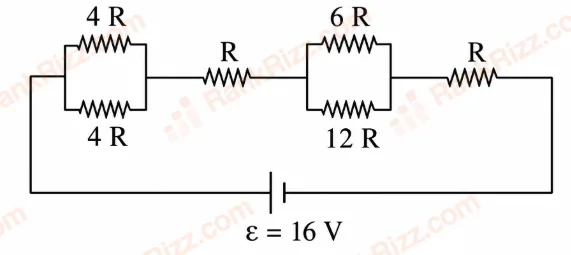
The resistive network shown below is connected to a D.C. source of 16 V. The power consumed by the network is 4 Watt. The value of R is:

Figure for JEE Main 2019 Physics question on Electric power and heating effect of current
  1. A

    16 Ω

  2. B

    8 Ω

  3. C

    6 Ω

  4. D

    1 Ω

JEE MAIN 2019 · 12 APR S2Galvanometer conversion to ammeter and voltmeter

A moving coil galvanometer, having a resistance G, produces full scale deflection when a current IG_G flows through it. This galvanometer can be converted into (i) an ammeter of range 0 to I0_0 (I0_0 > Ig_g) by connecting a shunt resistance RA_A to it and (ii) into a voltmeter of range 0 to V (V = GI0_0) by connecting a series resistance RV_V to it. Then,

  1. A

    RA_ARV_V = G2(I0−IgIg)^2\left(\frac{I_0 - I_g}{I_g}\right) and RARV=(IgI0−Ig)2\frac{R_A}{R_V} = \left(\frac{I_g}{I_0-I_g}\right)^2

  2. B

    RA_ARV_V = G2^2 and RARV=Ig(I0−Ig)\frac{R_A}{R_V} = \frac{I_g}{(I_0 - I_g)}

  3. C

    RA_ARV_V = G2(IgI0−Ig)^2\left(\frac{I_g}{I_0 - I_g}\right) and RARV=(I0−IgIg)2\frac{R_A}{R_V} = \left(\frac{I_0 - I_g}{I_g}\right)^2

  4. D

    RA_ARV_V = G2^2 and RARV=(IgI0−Ig)2\frac{R_A}{R_V} = \left(\frac{I_g}{I_0 - I_g}\right)^2

JEE MAIN 2019 · 10 APR S1Electric current, current density and drift velocity

A current of 5 A passes through a copper conductor (resistivity = 1.7×10−81.7 \times 10^{-8} Ω m) of radius of cross-section 5 mm. Find the mobility of the charges if their drift velocity is 1.1×10−31.1 \times 10^{-3} ms−1^{-1}.

  1. A

    1.5 m2^2 V−1^{-1} s−1^{-1}

  2. B

    1.8 m2^2 V−1^{-1} s−1^{-1}

  3. C

    1.0 m2^2 V−1^{-1} s−1^{-1}

  4. D

    1.3 m2^2 V−1^{-1} s−1^{-1}

JEE MAIN 2019 · 10 APR S1Galvanometer conversion to ammeter and voltmeter

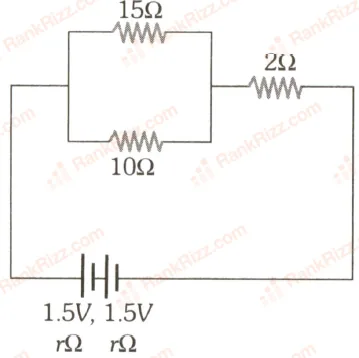
In the given circuit, an ideal voltmeter connected across the 10 Ω resistance reads 2 V. The internal resistance r, of each cell is:

Figure for JEE Main 2019 Physics question on Galvanometer conversion to ammeter and voltmeter
  1. A

    0 Ω

  2. B

    1.5 Ω

  3. C

    0.5 Ω

  4. D

    1 Ω

JEE MAIN 2019 · 10 APR S1Galvanometer conversion to ammeter and voltmeter

A moving coil galvanometer allows a full scale current of 10−410^{-4} A. A series resistance of 2×1042 \times 10^4 Ω is required to convert the galvanometer into a voltmeter of range 0 - 5 V. Therefore, the value of shunt resistance required to convert the above galvanometer into an ammeter of range 0 - 10 mA is:

  1. A

    100 Ω

  2. B

    200 Ω

  3. C

    300 Ω

  4. D

    10 Ω

JEE MAIN 2019 · 10 APR S1Ohm's law, resistance, resistivity and colour code

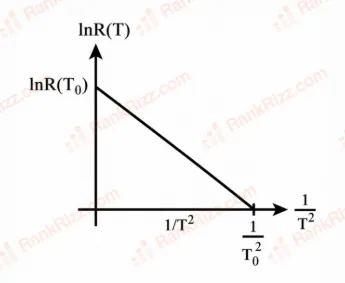
In an experiment, the resistance of a material is plotted as a function of temperature (in some range). As shown in the figure, it is a straight line.

Figure for JEE Main 2019 Physics question on Ohm's law, resistance, resistivity and colour code

One may conclude that

  1. A

    R(T)=R0eT2/T02R(T) = R_0 e^{T^2/T_0^2}

  2. B

    R(T)=R0T2R(T) = \frac{R_0}{T^2}

  3. C

    R(T)=R0e−T2/T02R(T) = R_0 e^{-T^2/T_0^2}

  4. D

    R(T)=R0e−T02/T2R(T) = R_0 e^{-T_0^2/T^2}

JEE MAIN 2019 · 10 APR S1Meter bridge

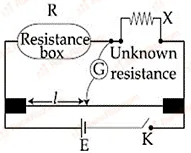
In a meter bridge experiment, the circuit diagram and the corresponding observation table are shown in figure.

Figure for JEE Main 2019 Physics question on Meter bridge


S. No.   R(Ω)       l(cm)
1.        1000         60
2.        100          13
3.        10            1.5
4.        1              1.0

Which of the reading is inconsistent?

  1. A

    1

  2. B

    3

  3. C

    2

  4. D

    4

JEE MAIN 2019 · 10 APR S2Ohm's law, resistance, resistivity and colour code

Space between two concentric conducting spheres of radii a and b (b > a) is filled with a medium of resistivity ρ\rho. The resistance between the two spheres will be:

  1. A

    ρ4π(1a+1b)\frac{\rho}{4\pi}\left(\frac{1}{a} + \frac{1}{b}\right)

  2. B

    ρ2π(1a+1b)\frac{\rho}{2\pi}\left(\frac{1}{a} + \frac{1}{b}\right)

  3. C

    ρ4π(1a−1b)\frac{\rho}{4\pi}\left(\frac{1}{a} - \frac{1}{b}\right)

  4. D

    ρ2π(1a−1b)\frac{\rho}{2\pi}\left(\frac{1}{a} - \frac{1}{b}\right)

JEE MAIN 2019 · 09 APR S1Combination of resistors and equivalent resistance

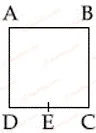
A wire of resistance R is bent to form a square ABCD as shown in the figure. The effective resistance between E and C is: (E is mid-point of arm CD)

Figure for JEE Main 2019 Physics question on Combination of resistors and equivalent resistance
  1. A

    R

  2. B

    764R\frac{7}{64}R

  3. C

    116R\frac{1}{16}R

  4. D

    34R\frac{3}{4}R

JEE MAIN 2019 · 09 APR S1Galvanometer conversion to ammeter and voltmeter

A moving coil galvanometer has resistance 50 Ω\Omega and it indicates full deflection at 4 mA current. A voltmeter is made using this galvanometer and a 5 kΩ\Omega resistance. The maximum voltage, that can be measured using this voltmeter, will be close to:

  1. A

    40 V

  2. B

    15 V

  3. C

    20 V

  4. D

    10 V

JEE MAIN 2019 · 09 APR S2Ohm's law, resistance, resistivity and colour code

A metal wire of resistance 3 Ω\Omega is elongated to make a uniform wire of double its previous length. This new wire is now bent and the ends joined to make a circle. If two points on this circle make an angle 60° at the center, the equivalent resistance between these two points will be:

  1. A

    53\frac{5}{3} Ω\Omega

  2. B

    125\frac{12}{5} Ω\Omega

  3. C

    72\frac{7}{2} Ω\Omega

  4. D

    52\frac{5}{2} Ω\Omega

JEE MAIN 2019 · 09 APR S2Galvanometer conversion to ammeter and voltmeter

The resistance of a galvanometer is 50 ohm and the maximum current which can be passed through it is 0.002 A. What resistance must be connected to it in order to convert it into an ammeter of range 0 - 0.5 A?

  1. A

    0.2 ohm

  2. B

    0.5 ohm

  3. C

    0.002 ohm

  4. D

    0.02 ohm

JEE MAIN 2019 · 09 APR S2Ohm's law, resistance, resistivity and colour code

In a conductor, if the number of conduction electrons per unit volume is 8.5×10288.5 \times 10^{28} m−3^{-3} and mean free time is 25 fs (femto second), it's approximate resistivity is: (me=9.1×10⁻³¹m_e = 9.1 \times 10^{-31} kg)

  1. A

    10−710^{-7} Ω\Omega m

  2. B

    10−610^{-6} Ω\Omega m

  3. C

    10−510^{-5} Ω\Omega m

  4. D

    10−810^{-8} Ω\Omega m

JEE MAIN 2019 · 08 APR S1Cells: emf, internal resistance and combinations

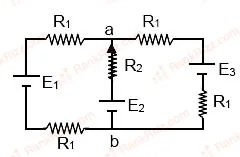
For the circuit shown, with R1=1.0  ΩR_1 = 1.0 \; \Omega, R2=2.0  ΩR_2 = 2.0 \; \Omega, E1=2E_1 = 2 V and E2=E3=4E_2 = E_3 = 4 V, the potential difference between the points 'a' and 'b' is approximately (in V):

Figure for JEE Main 2019 Physics question on Cells: emf, internal resistance and combinations
  1. A

    3.3

  2. B

    2.3

  3. C

    2.7

  4. D

    3.7

JEE MAIN 2019 · 08 APR S1Ohm's law, resistance, resistivity and colour code

A 200 Ω\Omega resistor has certain colour code. If one replaced the red colour by green in the code, the new resistance will be:

  1. A

    300 Ω\Omega

  2. B

    100 Ω\Omega

  3. C

    400 Ω\Omega

  4. D

    500 Ω\Omega

JEE MAIN 2019 · 08 APR S2Potentiometer

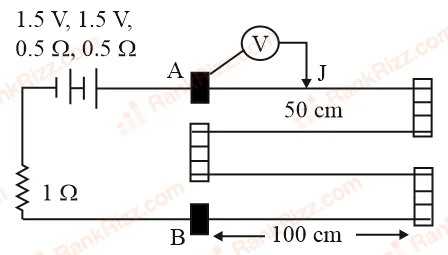
In the circuit shown, a four-wire potentiometer is made of a 400 cm long wire, which extends between A and B. The resistance per unit length of the potentiometer wire is r = 0.01 Ω\Omega/cm. If an ideal voltmeter is connected as shown with jockey J at 50 cm from end A, the expected reading of the voltmeter will be:

Figure for JEE Main 2019 Physics question on Potentiometer
  1. A

    0.50 V

  2. B

    0.25 V

  3. C

    0.75 V

  4. D

    0.20 V

JEE MAIN 2019 · 08 APR S2Electric power and heating effect of current

A cell of internal resistance r drives current through an external resistance R. The power delivered by the cell to the external resistance will be maximum when:

  1. A

    R = 2r

  2. B

    R = r

  3. C

    R = 1000 r

  4. D

    R = 0.001 r

JEE MAIN 2019 · 08 APR S2Kirchhoff's laws and circuit analysis

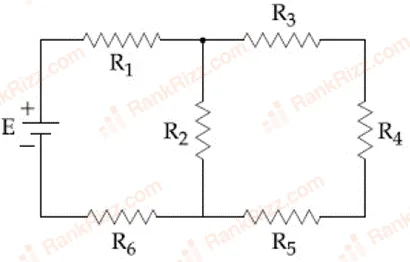
In the figure shown, what is the current (in Ampere) drawn from the battery? You are given: R1=15  ΩR_1 = 15 \; \Omega, R2=10  ΩR_2 = 10 \; \Omega, R3=20  ΩR_3 = 20 \; \Omega, R4=5  ΩR_4 = 5 \; \Omega, R5=25  ΩR_5 = 25 \; \Omega, R6=30  ΩR_6 = 30 \; \Omega, E=15E = 15 V

Figure for JEE Main 2019 Physics question on Kirchhoff's laws and circuit analysis
  1. A

    9/32

  2. B

    7/18

  3. C

    13/24

  4. D

    20/3