JEE MAIN 2026 · 28 JAN S2Electric current, current density and drift velocity
Which one of the following is not a measurable quantity ?
- A
Voltage difference
- B
Voltage
- C
Resistance
- D
Displacement current
Electric current, current density and drift velocity has been asked 24 times in JEE Main, in 10 different years between 2008 and 2026, and in all of the last five exam years (2022–2026), 14 questions in all. That is 6% of Current Electricity. Last asked in JEE Main 28 Jan 2026, Shift 2. 16 are multiple choice and 8 numerical-value; 12 easy and 11 medium by our difficulty labels. All of them are below, newest first, free to read.
Questions
24
Years asked
10
Since
2008
Of the chapter
6%
Questions on Electric current, current density and drift velocity in every year it was asked, newest first.
| Year | Relative frequency | Questions |
|---|---|---|
| 2026 | 2 | |
| 2025 | 1 | |
| 2024 | 2 | |
| 2023 | 5 | |
| 2022 | 4 | |
| 2021 | 5 | |
| 2019 | 2 | |
| 2018 | 1 | |
| 2015 | 1 | |
| 2008 | 1 | |
| Total | 24 |
1–20 OF 24 · NEWEST FIRST
Which one of the following is not a measurable quantity ?
Voltage difference
Voltage
Resistance
Displacement current
A cylindrical conductor of length 2 m and area of cross-section carries an electric current of 1.6 A when its ends are connected to a 2 V battery. Mobility of electrons in the conductor is The value of is :
(electron concentration = and electron charge = )
Current passing through a wire as function of time is given as A. The charge that will flow through the wire from s to s is:
0.06 C
0.02 C
0.07 C
0.04 C
The current in a conductor is expressed as , where is in Ampere and is in second. The amount of electric charge that flows through a section of the conductor during s to s is ____________ C.
The electric current through a wire varies with time as , where A and A s. The amount of electric charge crossed through a section of the wire in s is:
C
C
C
C
In a metallic conductor, under the effect of applied electric field, the free electrons of the conductor
Drift from higher potential to lower potential
Move with the uniform velocity throughout from lower potential to higher potential
Move in the straight line paths in the same direction
Move in the curved paths from lower potential to higher potential
A current of 2 A flows through a wire of cross-sectional area 25.0 mm. The number of free electrons in a cubic meter are . The drift velocity of the electrons is ______ ms
(given, charge on electron = C).
The number density of free electrons in copper is nearly m. A copper wire has its area of cross-section m and is carrying a current of 3.2 A. The drift speed of the electrons is _______ m s.
The drift velocity of electrons for a conductor connected in an electrical circuit is . The conductor is now replaced by another conductor with same material and same length but double the area of cross-section. The applied voltage remains same. The new drift velocity of electrons will be
The charge flowing in a conductor changes with time as , where , and are constants. Minimum value of current is:
A long copper wire carries a current of . If the cross section of the wire is and the resistivity of copper is . The force experienced by moving electron in the wire is ______ . (Charge of electron )
A. The drift velocity of electrons decreases with the increase in the temperature of conductor.
B. The drift velocity is inversely proportional to the area of cross-section of given conductor.
C. The drift velocity does not depend on the applied potential difference to the conductor.
D. The drift velocity of electron is inversely proportional to the length of the conductor.
E. The drift velocity increases with the increase in the temperature of conductor.
Choose the correct answer from the options given below:
A and B only
A and D only
B and E only
B and C only
The current density in a cylindrical wire of radius mm is A m. The current through the outer portion of the wire between radial distances and is ______ A.
The current density in a cylindrical wire of radius mm is . The current through the outer portion of the wire between radial distances and is A; where is ______
In the given figure, a battery of emf is connected across a conductor of length and different area of cross-sections having radii and ().
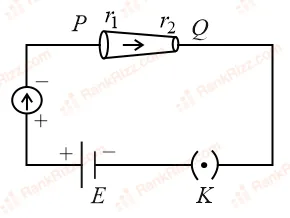
Choose the correct option as one moves from to .
Drift velocity of electron increases.
Electric field decreases.
Electron current decreases.
All of these
A current of 5 A is passing through a non-linear magnesium wire of cross-section 0.04 m. At every point the direction of current density is at an angle of 60 with the unit vector of area of cross-section. The magnitude of electric field at every point of the conductor is: (resistivity of magnesium m)
V m
V m
V m
V m
A current of 10 A exists in a wire of cross-sectional area of 5 mm with a drift velocity of m s. The number of free electrons in each cubic meter of the wire is:
A current through a wire depends on time as , where A s and A s. Find the charge crossed through a section of the wire in 15 s.
2250 C
11250 C
2100 C
260 C
A cylindrical wire of radius 0.5 mm and conductivity S m is subjected to an electric field of 10 mV m. The expected value of current in the wire will be mA. The value of is ______.
A current of 5 A passes through a copper conductor (resistivity = Ω m) of radius of cross-section 5 mm. Find the mobility of the charges if their drift velocity is ms.
1.5 m V s
1.8 m V s
1.0 m V s
1.3 m V s
RELATED CURRENT ELECTRICITY TOPICS