JEE MAIN 2017 · 02 APR OFFLINEKirchhoff's laws and circuit analysis
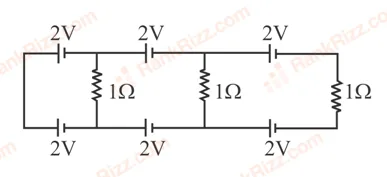
In the above circuit the current in each resistance is:
- A
0 A
- B
1 A
- C
0.25 A
- D
0.5 A
Every Current Electricity question JEE Main has set from 2004–2026, grouped by the idea it tests rather than the order of the syllabus. 386 questions across 10 distinct ideas. Free to read, answer key on every one.
DATA UPDATED
Questions
386
Distinct ideas
10
Share of marks
5.6%
Difficulty
MEDIUM
A chapter is not one subject — it is a handful of procedures the examiner reuses. These are the ones Current Electricity questions actually test.
321–340 OF 386 · NEWEST FIRST
In the above circuit the current in each resistance is:
0 A
1 A
0.25 A
0.5 A
Which of the following statements is false?
Kirchhoff's second law represents energy conservation
Wheatstone bridge is the most sensitive when all the four resistances are of the same order of magnitude
In a balanced Wheatstone bridge if the cell and the galvanometer are exchanged, the null point is disturbed
A rheostat can be used as a potential divider
When a current of 5 mA is passed through a galvanometer having a coil of resistance 15 Ω, it shows full-scale deflection. The value of the resistance to be put in series with the galvanometer to convert it into a voltmeter of range 0 - 10 V is:
Ω
Ω
Ω
Ω
A galvanometer has a 50 division scale. Battery has no internal resistance. It is found that there is deflection of 40 divisions when R.B. = 2400 . Deflection becomes 20 divisions when resistance taken from resistance box is 4900 . Then we can conclude:
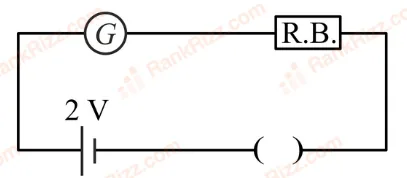
Note: This question is awarded as the bonus. Now the question is corrected.
Current sensitivity of galvanometer is 20
Resistance of galvanometer is 200 .
Resistance required on R.B. for a deflection of 10 divisions is 9800 .
Full scale deflection current is 2 mA.
The resistance of an electrical toaster has a temperature dependence given by in its range of operation. At K, and at K, . The toaster is connected to a voltage source at 200 V and its temperature is raised at a constant rate from 300 to 500 K in 30 s. The total work done in raising the temperature is:
Note: This question was awarded as the bonus since all options were incorrect in the exam.
J
J
300 J
J
In the circuit shown, the resistance r is a variable resistance. If for , the heat generation in r is maximum then the value of f is
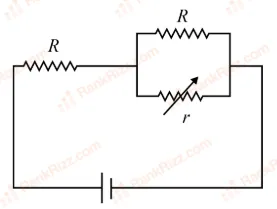
1
To know the resistance of a galvanometer by half deflection method, a battery of emf and resistance is used to deflect the galvanometer by angle . If a shunt of resistance is needed to get half deflection the , and are related by the equation:
A 50 resistance is connected to a battery of 5 V. A galvanometer of resistance 100 is to be used as an ammeter to measure current through the resistance, for this a resistance is connected to the galvanometer. Which of the following connections should be employed if the measured current is with in 1% of the current without the ammeter in the circuit?
in series with galvanometer
in series with galvanometer
in parallel with galvanometer
in parallel with the galvanometer
A galvanometer having a coil resistance of 100 gives a full scale deflection, when a current of 1 mA is passed through it. The value of the resistance, which can convert this galvanometer into ammeter giving a full scale deflection for a current of 10 A, is:
0.1
3
0.01
2
In the electric network shown, when no current flows through the 4 resistor in the arm EB, the potential difference between the points A and D will be:
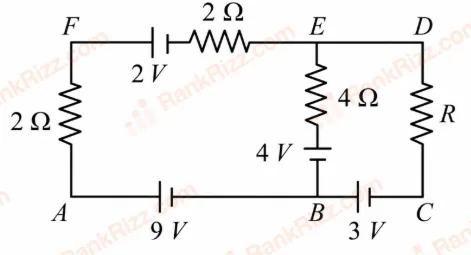
5 V
3 V
4 V
6 V
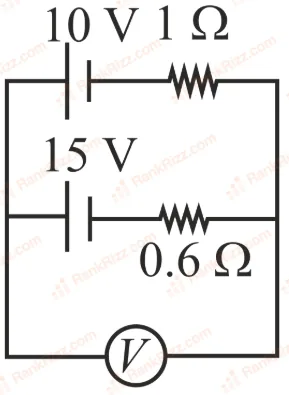
A 10 V battery with internal resistance 1 and a 15 V battery with internal resistance 0.6 are connected in parallel to a voltmeter (see figure). The reading in the voltmeter will be close to:
11.9 V
13.1 V
12.5 V
24.5 V
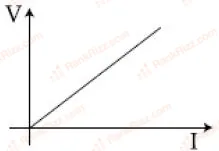
Suppose the drift velocity in a material varied with the applied electric field E as . Then V - I graph for a wire made of such a material is best given by:
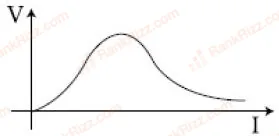
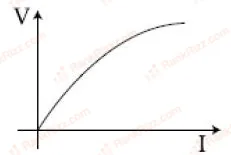
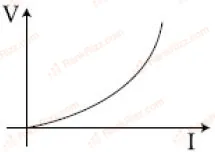
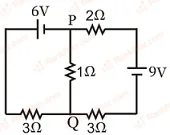
In the circuit shown, the current in the 1 resistor is:
0.13 A, from P to Q
1.3 A, from P to Q
1.3 A, from Q to P
0.13 A, from Q to P
When 5 V potential difference is applied across a wire of length 0.1 m, the drift speed of electrons is m s. If the electron density in the wire is m, the resistivity of the material is close to:
m
m
m
m
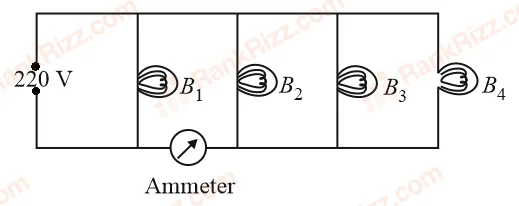
Four bulbs B, B, B and B of 100 W each are connected to 220 V main as shown in the figure. The reading in the ideal ammeter will be:
0.90 A
1.35 A
0.45 A
1.80 A
In the experiment of calibration of voltmeter, a standard cell of e.m.f. 1.1 volt is balanced against 440 cm of potential wire. The potential difference across the ends of resistance is found to balance against 220 cm of the wire. The corresponding reading of voltmeter is 0.5 volt. The error in the reading of volmeter will be:
volt
0.15 volt
0.5 volt
volt
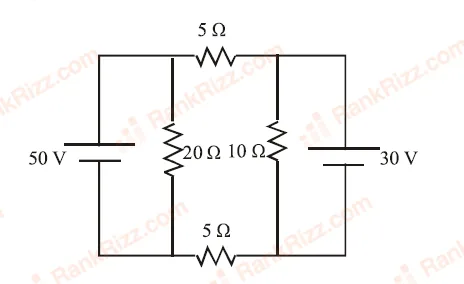
In the circuit shown, current (in A) through 50 V and 30 V batteries are, respectively:
2.5 and 3
3.5 and 2
4.5 and 1
3 and 2.5
In the circuit diagrams (A, B, C and D) shown below, R is a high resistance and S is a resistance of the order of galvanometer resistance G. The correct circuit, corresponding to the half deflection method for finding the resistance and figure of merit of the galvanometer, is the circuit labelled as:
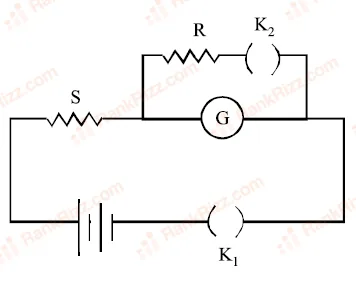
(a)
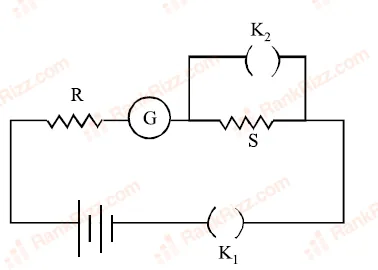
(b)
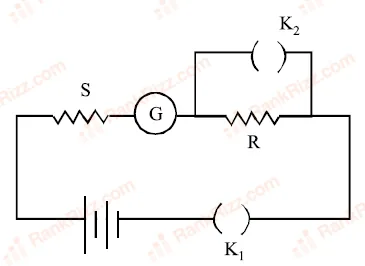
(c)
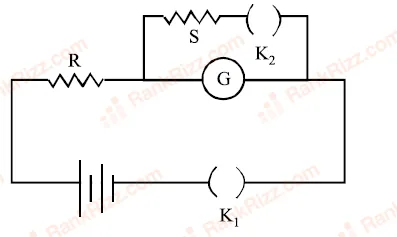
(d)
Circuit A with
Circuit B with G = S
Circuit C with G = S
Circuit D with
A d.c. main supply of e.m.f. 220 V is connected across a storage battery of e.m.f. 200 V through a resistance of 1 . The battery terminals are connected to external resistance . The minimum value of , so that a current passes through the battery to charge it is:
9
7
11
0
In a large building, there are 15 bulbs of 40 W, 5 bulbs of 100 W, 5 fans of 80 W and 1 heater of 1 kW. The voltage of the electric mains is 220 V. The minimum capacity of the main fuse of the building will be:
8 A
10 A
12 A
14 A
JEE Advanced has set 31 Current Electricity questions too. Current Electricity JEE Advanced PYQs →
OTHER PHYSICS CHAPTERS