JEE MAIN 2025 · 28 JAN S2Wheatstone bridge
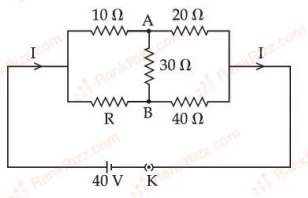
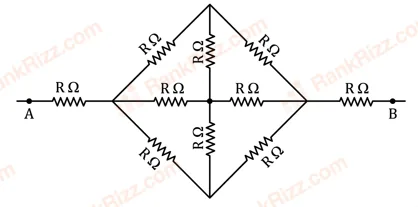
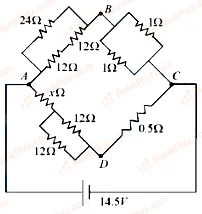
The value of current I in the electrical circuit as given below, when potential at A is equal to the potential at B, will be ____ A.
Every Current Electricity question JEE Main has set from 2004–2026, grouped by the idea it tests rather than the order of the syllabus. 386 questions across 10 distinct ideas. Free to read, answer key on every one.
DATA UPDATED
Questions
386
Distinct ideas
10
Share of marks
5.6%
Difficulty
MEDIUM
A chapter is not one subject — it is a handful of procedures the examiner reuses. These are the ones Current Electricity questions actually test.
41–60 OF 386 · NEWEST FIRST
The value of current I in the electrical circuit as given below, when potential at A is equal to the potential at B, will be ____ A.
A wire of resistance is bent to form an equilateral triangle. Then the equivalent resistance across any two vertices will be
A galvanometer having a coil of resistance 30Ω need 20 mA of current for full-scale deflection. If a maximum current of 3 A is to be measured using this galvanometer, the resistance of the shunt to be added to the galvanometer should be Ω.where X is Options
596
149
298
447
Given below are two statements :
Statement-I : The equivalent emf of two nonideal batteries connected in parallel is smaller than either of the two emfs.
Statement-II : The equivalent internal resistance of two nonideal batteries connected in parallel is smaller than the internal resistance of either of the two batteries. In the light of the above statements, choose the correct answer from the options given below.
Both Statement-I and Statement-II are false
Statement-I is false but Statement-II is true
Both Statement-I and Statement-II are true
Statement-I is true but Statement-II is false
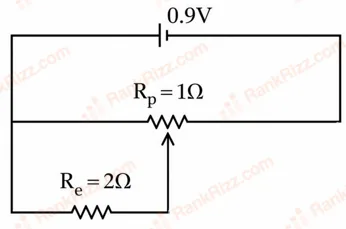
Sliding contact of a potentiometer is in the middle of the potentiometer wire having resistance as shown in the figure. An external resistance of is connected via the sliding contact. The electric current in the circuit is :
0.9 A
1.35 A
0.3 A
1.0 A
Which of the following resistivity temperature (T) curves is most suitable to be used in wire bound standard resistors?
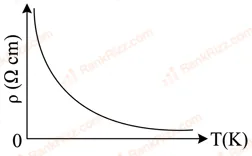
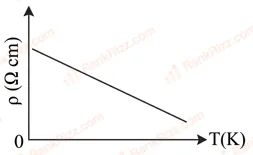
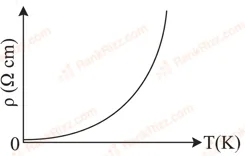
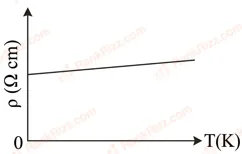
The net current flowing in the given circuit is_______ A.
image
A galvanometer has a coil of resistance with a full scale deflection at . The value of resistance to be added to use it as an ammeter of range mA is :
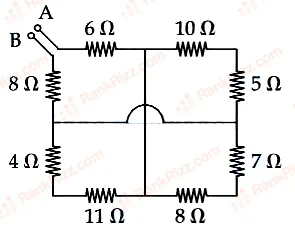
The equivalent resistance between A and B is :
The current flowing through the resistor is A. The value of is ________
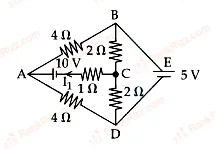
The effective resistance between and , if resistance of each resistor is , will be
At room temperature , the resistance of a heating element is . The temperature coefficient of the material is . The temperature of the element, when its resistance is , is ______ °C.
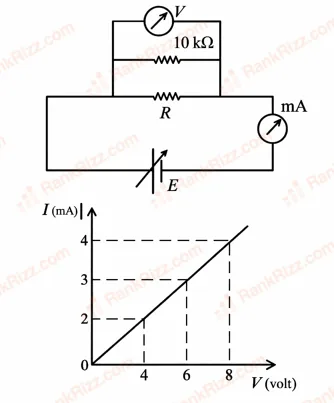
To determine the resistance of a wire, a circuit is designed below. The characteristic curve for this circuit is plotted for the voltmeter and the ammeter readings as shown in figure. The value of is ______ .
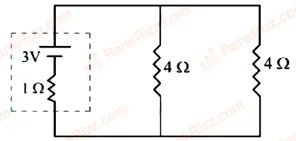
In the given circuit, the terminal potential difference of the cell is :
Resistance of a wire at , and is found to be , and respectively. The temperature in Kelvin scale is ________.
Water boils in an electric kettle in 20 minutes after being switched on. Using the same main supply, the length of the heating element should be _____ to _____ times of its initial length if the water is to be boiled in 15 minutes.
decreased, 3/4
increased, 4/3
decreased, 4/3
increased, 3/4
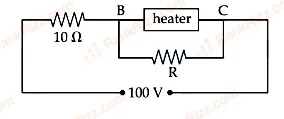
A heater is designed to operate with a power of 1000 W in a 100 V line. It is connected in combination with a resistance of and a resistance , to a 100 V mains as shown in figure. For the heater to operate at 62.5 W, the value of should be _____
The value of unknown resistance for which the potential difference between and will be zero in the arrangement shown, is :
A wire of resistance and radius is stretched till its radius became . If new resistance of the stretched wire is , then value of is _______
The number of electrons flowing per second in the filament of a bulb operating at is : (Given )
JEE Advanced has set 31 Current Electricity questions too. Current Electricity JEE Advanced PYQs →
OTHER PHYSICS CHAPTERS