RankRizz

Current Electricity — JEE Main Previous Year Questions

Every Current Electricity question JEE Main has set from 2004–2026, grouped by the idea it tests rather than the order of the syllabus. 386 questions across 10 distinct ideas. Free to read, answer key on every one.

DATA UPDATED

Questions

386

Distinct ideas

10

Share of marks

5.6%

Difficulty

MEDIUM

The ideas inside Current Electricity

A chapter is not one subject — it is a handful of procedures the examiner reuses. These are the ones Current Electricity questions actually test.

Every Current Electricity question

281–300 OF 386 · NEWEST FIRST

JEE MAIN 2019 · 12 JAN S1Galvanometer conversion to ammeter and voltmeter

The galvanometer deflection, when key K1K_1 is closed but K2K_2 is open, equals θ0\theta_0 (see figure). On closing K2K_2 also and adjusting R2R_2 to 5Ω5\Omega, the deflection in galvanometer becomes θ05\frac{\theta_0}{5}. The resistance of the galvanometer is, then, given by [Neglect the internal resistance of battery]:
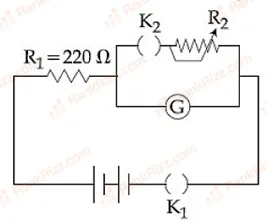
Figure for JEE Main 2019 Physics question on Galvanometer conversion to ammeter and voltmeter
  1. A

    12Ω12 \Omega

  2. B

    22Ω22 \Omega

  3. C

    5Ω5 \Omega

  4. D

    25Ω25 \Omega

JEE MAIN 2019 · 12 JAN S1Potentiometer

An ideal battery of emf 4V and resistance R are connected in series in the primary circuit of a potentiometer of length 1 m and resistance 5Ω5\Omega. The value of R, to give a potential difference of 5 mV across 10 cm of potentiometer wire, is:

  1. A

    480Ω480 \Omega

  2. B

    495Ω495 \Omega

  3. C

    395Ω395 \Omega

  4. D

    490Ω490 \Omega

JEE MAIN 2019 · 12 JAN S1Electric power and heating effect of current

Two electric bulbs, rated at (25 W, 220 V) and (100 W, 220 V), are connected in series across a 220 V voltage source. If the 25 W and 100 W bulbs draw powers P1P_1 and P2P_2 respectively, then:

  1. A

    P1=4P_1 = 4 W, P2=16P_2 = 16 W

  2. B

    P1=9P_1 = 9 W, P2=16P_2 = 16 W

  3. C

    P1=16P_1 = 16 W, P2=9P_2 = 9 W

  4. D

    P1=16P_1 = 16 W, P2=4P_2 = 4 W

JEE MAIN 2019 · 12 JAN S1Meter bridge

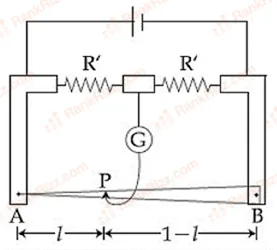
In a meter bridge, the wire of length 1 m has a non-uniform cross-section such that, the variation dRdl\frac{dR}{dl} of its resistance R with length l is dRdl∝1l\frac{dR}{dl} \propto \frac{1}{\sqrt{l}}. Two equal resistances are connected as shown in the figure. The galvanometer has zero deflection when the jockey is at point P. What is the length AP?

Figure for JEE Main 2019 Physics question on Meter bridge
  1. A

    0.2 m

  2. B

    0.35 m

  3. C

    0.3 m

  4. D

    0.25 m

JEE MAIN 2019 · 12 JAN S2Galvanometer conversion to ammeter and voltmeter

A galvanometer, whose resistance is 50 ohm, has 25 divisions in it. When a current of 4×10−44 \times 10^{-4} A passes through it, its needle (pointer) deflects by one division. To use this galvanometer as a voltmeter of range 2.5 V it should be connected to a resistance of:

  1. A

    6250 ohm

  2. B

    250 ohm

  3. C

    6200 ohm

  4. D

    200 ohm

JEE MAIN 2019 · 12 JAN S2Kirchhoff's laws and circuit analysis

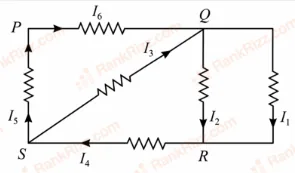
In the given circuit diagram, the currents, I1=−0.3I_1 = -0.3 A, I4=0.8I_4 = 0.8 A and I5=0.4I_5 = 0.4 A, are flowing as shown. The currents I2I_2, I3I_3 and I6I_6, respectively, are:

Figure for JEE Main 2019 Physics question on Kirchhoff's laws and circuit analysis
  1. A

    0.4A, 1.1A, 0.4A

  2. B

    1.1A, -0.4A, 0.4A

  3. C

    1.1A, 0.4A, 0.4A

  4. D

    -0.4A, 0.4A, 1.1A

JEE MAIN 2019 · 11 JAN S1Electric power and heating effect of current

Two equal resistances when connected in series to a battery, consume electric power of 60 W. If these resistance are now connected in parallel combination to the same battery, the electric power consumed will be:

  1. A

    60 W

  2. B

    240 W

  3. C

    120 W

  4. D

    30 W

JEE MAIN 2019 · 11 JAN S1Wheatstone bridge

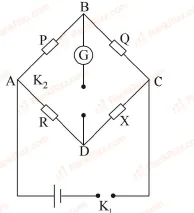
In a Wheatstone bridge (see fig.), Resistances P and Q are approximately equal. When R=400ΩR = 400\Omega, the bridge is balanced. On interchanging P and Q, the value of R, for balance, is 405Ω405\Omega. The value of Y is close to

Figure for JEE Main 2019 Physics question on Wheatstone bridge
  1. A

    401.5 ohm

  2. B

    404.5 ohm

  3. C

    403.5 ohm

  4. D

    402.5 ohm

JEE MAIN 2019 · 11 JAN S1Potentiometer

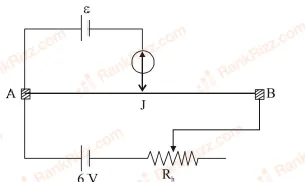
The resistance of the meter bridge AB in given figure is 4Ω4\Omega. With a cell of emf ε=0.5\varepsilon = 0.5 V and rheostat resistance Rh=2ΩR_h = 2\Omega the null point is obtained at some point J. When the cell is replaced by another one of emf ε=ε2\varepsilon = \varepsilon_2 the same null point J is found for Rh=6ΩR_h = 6\Omega. The emf ε2\varepsilon_2 is:

Figure for JEE Main 2019 Physics question on Potentiometer
  1. A

    0.4 V

  2. B

    0.3 V

  3. C

    0.6 V

  4. D

    0.5 V

JEE MAIN 2019 · 11 JAN S2Cells: emf, internal resistance and combinations

In the circuit shown, the potential difference between A and B is

Figure for JEE Main 2019 Physics question on Cells: emf, internal resistance and combinations
  1. A

    1 V

  2. B

    2 V

  3. C

    3V

  4. D

    6 V

JEE MAIN 2019 · 11 JAN S2Galvanometer conversion to ammeter and voltmeter

A galvanometer having a resistance of 20Ω20\Omega and 30 division on both sides has figure of merit 0.005 ampere/division. The resistance that should be connected in series such that it can be used as a voltmeter upto 15 volt, is:

  1. A

    100Ω100\Omega

  2. B

    120Ω120\Omega

  3. C

    80Ω80\Omega

  4. D

    125Ω125\Omega

JEE MAIN 2019 · 11 JAN S2Meter bridge

In the experimental set up of metre bridge shown in the figure, the null point is obtained at a distance of 40 cm from A. If a 10Ω10\Omega resistor is connected in series with R1R_1, the null point shifts by 10 cm. The resistance that should be connected in parallel with (R1+10)Ω(R_1 + 10)\Omega such that the null point shifts back to its initial position is

Figure for JEE Main 2019 Physics question on Meter bridge
  1. A

    20Ω20\Omega

  2. B

    40Ω40\Omega

  3. C

    60Ω60\Omega

  4. D

    30Ω30\Omega

JEE MAIN 2019 · 10 JAN S1Kirchhoff's laws and circuit analysis

In the given circuit the cells have zero internal resistance. The currents (in amperes) passing through resistance R1R_1 and R2R_2 respectively, are:

Figure for JEE Main 2019 Physics question on Kirchhoff's laws and circuit analysis
  1. A

    0, 1

  2. B

    2, 2

  3. C

    0.5, 0

  4. D

    1, 2

JEE MAIN 2019 · 10 JAN S1Combination of resistors and equivalent resistance

A uniform metallic wire has a resistance of 18 Ω\Omega and is bent into an equilateral triangle. Then, the resistance between any two vertices of the triangle is:

  1. A

    2 Ω\Omega

  2. B

    12 Ω\Omega

  3. C

    8 Ω\Omega

  4. D

    4 Ω\Omega

JEE MAIN 2019 · 10 JAN S1Ohm's law, resistance, resistivity and colour code

A 2 W carbon resistor is color coded with green, black, red and silver respectively. The maximum current which can be passed through this resistor is:

  1. A

    100 mA

  2. B

    0.4 mA

  3. C

    20 mA

  4. D

    63 mA

JEE MAIN 2019 · 10 JAN S1Potentiometer

A potentiometer wire AB having length LL and resistance 12r12r is joined to a cell D of emf ε\varepsilon and internal resistance rr. A cell C having EMF ε/2\varepsilon/2 and internal resistance 3r3r is connected. The length AJ, at which the galvanometer, as shown in the figure, shows no deflection is:

Figure for JEE Main 2019 Physics question on Potentiometer
  1. A

    512L\frac{5}{12}L

  2. B

    1124L\frac{11}{24}L

  3. C

    1112L\frac{11}{12}L

  4. D

    1324L\frac{13}{24}L

JEE MAIN 2019 · 10 JAN S2Galvanometer conversion to ammeter and voltmeter

The actual value of resistance RR, shown in the figure is 30Ω\Omega. This is measured in an experiment as shown using the standard formula R=VIR = \frac{V}{I}, where V and I are the readings of the voltmeter and ammeter, respectively. If the measured value of RR is 5% less, then the internal resistance of the voltmeter is:

Figure for JEE Main 2019 Physics question on Galvanometer conversion to ammeter and voltmeter
  1. A

    35 Ω\Omega

  2. B

    600 Ω\Omega

  3. C

    570 Ω\Omega

  4. D

    350 Ω\Omega

JEE MAIN 2019 · 10 JAN S2Ohm's law, resistance, resistivity and colour code

The Wheatstone bridge shown in the figure below, gets balanced when the carbon resistor used as R1R_1 has the colour code (orange, red, brown). The resistors R2R_2 and R4R_4 are 80 Ω\Omega and 40 Ω\Omega, respectively. Assuming that the colour code for the carbon resistors gives their accurate values, the colour code for the carbon resistor, used as R3R_3, would be:

Figure for JEE Main 2019 Physics question on Ohm's law, resistance, resistivity and colour code
  1. A

    brown, blue, black

  2. B

    brown, blue, brown

  3. C

    grey, black, brown

  4. D

    red, green, brown

JEE MAIN 2019 · 10 JAN S2Electric power and heating effect of current

A current of 2 mA was passed through an unknown resistor which dissipated a power of 4.4 W. Dissipated power when an ideal power supply of 11 V is connected across it is:

  1. A

    11×10511 \times 10^5 W

  2. B

    11×10−311 \times 10^{-3} W

  3. C

    11×10−511 \times 10^{-5} W

  4. D

    11×10−411 \times 10^{-4} W

JEE MAIN 2019 · 09 JAN S1Ohm's law, resistance, resistivity and colour code

A copper wire is stretched to make it 0.5% longer. The percentage change in its electrical resistance if its volume remains unchanged is:

  1. A

    2.5%

  2. B

    1.0%

  3. C

    2.0%

  4. D

    0.5%