RankRizz

Current Electricity — JEE Main Previous Year Questions

Every Current Electricity question JEE Main has set from 2004–2026, grouped by the idea it tests rather than the order of the syllabus. 386 questions across 10 distinct ideas. Free to read, answer key on every one.

DATA UPDATED

Questions

386

Distinct ideas

10

Share of marks

5.6%

Difficulty

MEDIUM

The ideas inside Current Electricity

A chapter is not one subject — it is a handful of procedures the examiner reuses. These are the ones Current Electricity questions actually test.

Every Current Electricity question

361–380 OF 386 · NEWEST FIRST

JEE MAIN 2010Ohm's law, resistance, resistivity and colour code

Two conductors have the same resistance at 0∘0^\circC but their temperature coefficients of resistance are α1\alpha_1 and α2\alpha_2. The respective temperature coefficients of their series and parallel combinations are nearly

  1. A

    α1+α22,α1+α2\frac{\alpha_1 + \alpha_2}{2}, \alpha_1 + \alpha_2

  2. B

    α1+α2,α1+α22\alpha_1 + \alpha_2, \frac{\alpha_1 + \alpha_2}{2}

  3. C

    α1+α2,α1α2α1+α2\alpha_1 + \alpha_2, \frac{\alpha_1 \alpha_2}{\alpha_1 + \alpha_2}

  4. D

    α1+α22,α1+α22\frac{\alpha_1 + \alpha_2}{2}, \frac{\alpha_1 + \alpha_2}{2}

JEE MAIN 2009Ohm's law, resistance, resistivity and colour code

This question contains Statement-1 and Statement-2. Of the four choices given after the statements, choose the one that best describes the two statements. 

Statement-1: The temperature dependence of resistance is usually given as R=R0(1+αΔt)R = R_0(1 + \alpha\Delta t). The resistance of a wire changes from 100Ω100\Omega to 150Ω150\Omega when its temperature is increased from 27°C27°C to 227°C227°C. This implies that α=2.5×10⁻³/°C\alpha = 2.5 \times 10^{-3}/°C. 

Statement 2: R=Rt(1+αΔT)R = R_t(1 + \alpha\Delta T) is valid only when the change in the temperature ΔT\Delta T is small and ΔR=(R−R0)≪R0\Delta R = (R - R_0) \ll R_0.

  1. A

    Statement-1 is true, Statement-2 is false

  2. B

    Statement-1 is true, Statement-2 is true; Statement-2 is the correct explanation of Statement-1.

  3. C

    Statement-1 is true, Statement-2 is true; Statement-2 is not the correct explanation of Statement-1.

  4. D

    Statement-1 is false, Statement-2 is true

JEE MAIN 2008Ohm's law, resistance, resistivity and colour code

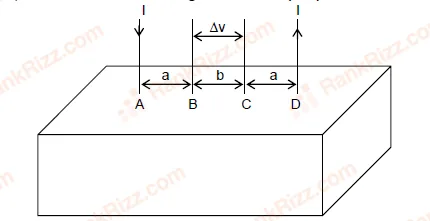
Paragraph: Consider a block of conducting material of resistivity 'ρ\rho' shown in the figure. Current 'II' enters at 'AA' and leaves from 'DD'. We apply superposition principle to find voltage 'ΔV\Delta V' developed between 'BB' and 'CC'. The calculation is done in the following steps: (i) Take current 'II' entering from 'AA' and assume it to spread over a hemispherical surface in the block. (ii) Calculate field E(r)E(r) at distance 'rr' from AA by using Ohm's law E=ρjE = \rho j, where jj is the current per unit area at 'rr'. (iii) From the 'rr' dependence of E(r)E(r), obtain the potential V(r)V(r) at rr. (iv) Repeat (i), (ii) and (iii) for current 'II' leaving 'DD' and superpose results for 'AA' and 'DD'.Figure for JEE Main 2008 Physics question on Ohm's law, resistance, resistivity and colour code
Question: ΔV\Delta V measured between BB and CC is

  1. A

    ρIπa−ρIπ(a+b)\frac{\rho I}{\pi a} - \frac{\rho I}{\pi (a+b)}

  2. B

    ρIa−ρI(a+b)\frac{\rho I}{a} - \frac{\rho I}{(a+b)}

  3. C

    ρI2πa−ρI2π(a+b)\frac{\rho I}{2\pi a} - \frac{\rho I}{2\pi (a+b)}

  4. D

    ρI2π(a−b)\frac{\rho I}{2\pi (a-b)}

JEE MAIN 2008Electric current, current density and drift velocity

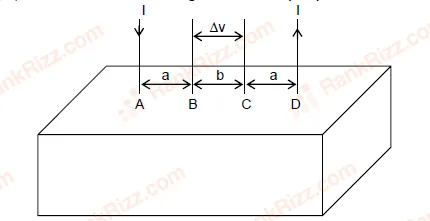
Paragraph: Consider a block of conducting material of resistivity 'ρ\rho' shown in the figure. Current 'II' enters at 'AA' and leaves from 'DD'. We apply superposition principle to find voltage 'ΔV\Delta V' developed between 'BB' and 'CC'. The calculation is done in the following steps: (i) Take current 'II' entering from 'AA' and assume it to spread over a hemispherical surface in the block. (ii) Calculate field E(r)E(r) at distance 'rr' from AA by using Ohm's law E=ρjE = \rho j, where jj is the current per unit area at 'rr'. (iii) From the 'rr' dependence of E(r)E(r), obtain the potential V(r)V(r) at rr. (iv) Repeat (i), (ii) and (iii) for current 'II' leaving 'DD' and superpose results for 'AA' and 'DD'.Figure for JEE Main 2008 Physics question on Electric current, current density and drift velocity
Question: For current entering at AA, the electric field at a distance 'rr' from AA is

  1. A

    ρI8πr2\frac{\rho I}{8\pi r^2}

  2. B

    ρIr2\frac{\rho I}{r^2}

  3. C

    ρI2πr2\frac{\rho I}{2\pi r^2}

  4. D

    ρI4πr2\frac{\rho I}{4\pi r^2}

JEE MAIN 2008Kirchhoff's laws and circuit analysis

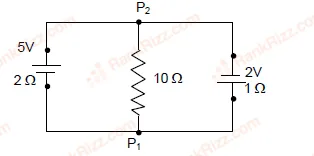
A 5 V battery with internal resistance 2Ω2\Omega and a 2 V battery with internal resistance 1Ω1\Omega are connected to a 10Ω10\Omega resistor as shown in the figure. The current in the 10Ω10\Omega resistor is

Figure for JEE Main 2008 Physics question on Kirchhoff's laws and circuit analysis
  1. A

    0.27 A, P20.27\ A,\ P_2 to P1P_1

  2. B

    0.03 A, P10.03\ A,\ P_1 to P2P_2

  3. C

    0.03 A, P20.03\ A,\ P_2 to P1P_1

  4. D

    0.27 A, P10.27\ A,\ P_1 to P2P_2

JEE MAIN 2008Meter bridge

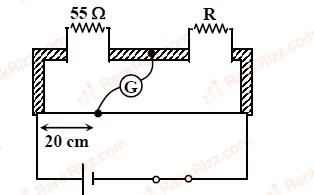
Shown in the figure below is a meter-bridge set up with null deflection in the galvanometer.Figure for JEE Main 2008 Physics question on Meter bridge
The value of the unknown resistor RR is

  1. A

    13.75 Ω13.75\ \Omega

  2. B

    220 Ω220\ \Omega

  3. C

    110 Ω110\ \Omega

  4. D

    55 Ω55\ \Omega

JEE MAIN 2007Ohm's law, resistance, resistivity and colour code

The resistance of a wire is 5 ohm at 50∘C50^\circ C and 6 ohm at 100∘C100^\circ C. The resistance of the wire at 0∘C0^\circ C will be

  1. A

    2 ohm

  2. B

    1 ohm

  3. C

    4 ohm

  4. D

    3 ohm

JEE MAIN 2006Ohm's law, resistance, resistivity and colour code

A material 'BB' has twice the specific resistance of 'AA'. A circular wire made of 'BB' has twice the diameter of a wire made of 'AA'. Then for the two wires to have the same resistance, the ratio ℓA/ℓB\ell_A/\ell_B of their respective lengths must be

  1. A

    2

  2. B

    1

  3. C

    12\dfrac{1}{2}

  4. D

    14\dfrac{1}{4}

JEE MAIN 2006Kirchhoff's laws and circuit analysis

The Kirchhoff's first law (∑i=0)\left(\sum i = 0\right) and second law (∑iR=∑E)\left(\sum iR = \sum E\right), where the symbols have their usual meanings, are respectively based on

  1. A

    conservation of charge, conservation of energy

  2. B

    conservation of charge, conservation of momentum

  3. C

    conservation of energy, conservation of charge

  4. D

    conservation of momentum, conservation of charge

JEE MAIN 2006Wheatstone bridge

In a Wheatstone's bridge, there resistances P,QP, Q and RR connected in the three arms and the fourth arm is formed by two resistances S1S_1 and S2S_2 connected in parallel. The condition for bridge to be balanced will be

  1. A

    PQ=RS1+S2\dfrac{P}{Q} = \dfrac{R}{S_1 + S_2}

  2. B

    PQ=2RS1+S2\dfrac{P}{Q} = \dfrac{2R}{S_1 + S_2}

  3. C

    PQ=R(S1+S2)S1S2\dfrac{P}{Q} = \dfrac{R(S_1 + S_2)}{S_1 S_2}

  4. D

    PQ=R(S1+S2)2S1S2\dfrac{P}{Q} = \dfrac{R(S_1 + S_2)}{2 S_1 S_2}

JEE MAIN 2006Combination of resistors and equivalent resistance

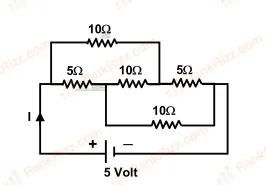
Consider the circuit shown below. The current II drawn from the 5 volt source will beFigure for JEE Main 2006 Physics question on Combination of resistors and equivalent resistance

  1. A

    0.17 A

  2. B

    0.33 A

  3. C

    0.5 A

  4. D

    0.67 A

JEE MAIN 2006Ohm's law, resistance, resistivity and colour code

The resistance of a bulb filament is 100 Ω100\,\Omega at a temperature of 100∘C100^\circ C. If its temperature coefficient of resistance be 0.0050.005 per ∘C^\circ C, its resistance will become 200 Ω200\,\Omega at a temperature of

  1. A

    200∘C200^\circ C

  2. B

    300∘C300^\circ C

  3. C

    400∘C400^\circ C

  4. D

    500∘C500^\circ C

JEE MAIN 2006Cells: emf, internal resistance and combinations

A thermocouple is made from two metals, Antimony and Bismuth. If one junction of the couple is kept hot and the other is kept cold then, an electric current will

  1. A

    flow from Antimony to Bismuth at the cold junction

  2. B

    flow from Antimony to Bismuth at the hot junction

  3. C

    flow from Bismuth to Antimony at the cold junction

  4. D

    not flow through the thermocouple

JEE MAIN 2006Electric power and heating effect of current

An electric bulb is rated 220220 volt −100- 100 watt. The power consumed by it when operated on 110110 volt will be

  1. A

    50 watt

  2. B

    75 watt

  3. C

    40 watt

  4. D

    25 watt

JEE MAIN 2005Galvanometer conversion to ammeter and voltmeter

A moving coil galvanometer has 150150 equal divisions. Its current sensitivity is 1010 divisions per milliampere and voltage sensitivity is 22 divisions per millivolt. In order that each division reads 11 volt, the resistance in ohms needed to be connected in series with the coil will be

  1. A

    10310^3

  2. B

    10510^5

  3. C

    9999599995

  4. D

    99959995

JEE MAIN 2005Kirchhoff's laws and circuit analysis

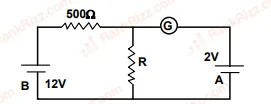
In the circuit, the galvanometer GG shows zero deflection. If the batteries AA and BB have negligible resistance, the value of the resistor RR will be

Figure for JEE Main 2005 Physics question on Kirchhoff's laws and circuit analysis
  1. A

    200Ω200 \Omega

  2. B

    100Ω100 \Omega

  3. C

    500Ω500 \Omega

  4. D

    1000Ω1000 \Omega

JEE MAIN 2005Cells: emf, internal resistance and combinations

Two sources of equal emf are connected to an external resistance RR. The internal resistance of the two sources are R1R_1 and R2R_2 (R2>R1R_2 > R_1). If the potential difference across the source having internal resistance R2R_2 is zero, then

  1. A

    R=R2×(R1+R2)/(R2−R1)R = R_2 \times (R_1 + R_2)/(R_2 - R_1)

  2. B

    R=R2−R1R = R_2 - R_1

  3. C

    R=R1R2/(R1+R2)R = R_1 R_2/(R_1 + R_2)

  4. D

    R=R1R2/(R2−R1)R = R_1 R_2/(R_2 - R_1)

JEE MAIN 2005Electric power and heating effect of current

A heater coil is cut into two equal parts and only one part is now used in the heater. The heat generated will now be

  1. A

    doubled

  2. B

    four times

  3. C

    one fourth

  4. D

    halved

JEE MAIN 2005Cells: emf, internal resistance and combinations

An energy source will supply a constant current into the load if its internal resistance is

  1. A

    equal to the resistance of the load.

  2. B

    very large as compared to the load resistance.

  3. C

    zero.

  4. D

    non-zero but less than the resistance of the load.

JEE MAIN 2005Potentiometer

In a potentiometer experiment the balancing with a cell is at length 240240 cm. On shunting the cell with a resistance of 2Ω2 \Omega the balancing length becomes 120120 cm. The internal resistance of the cell is

  1. A

    1Ω1 \Omega

  2. B

    0.5Ω0.5 \Omega

  3. C

    4Ω4 \Omega

  4. D

    2Ω2 \Omega