JEE Main 2019 Physics question — Meter bridge
In a meter bridge experiment, the circuit diagram and the corresponding observation table are shown in figure.
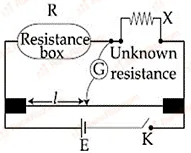
S. No. R(Ω) l(cm)
1. 1000 60
2. 100 13
3. 10 1.5
4. 1 1.0
Which of the reading is inconsistent?
SOLUTION
Step-by-Step Solution
1. Understanding the Meter Bridge Principle
A meter bridge works on the principle of a balanced Wheatstone bridge. When the galvanometer shows zero deflection (null point), the ratio of the resistances in opposite arms is equal:
Where:
- = Known resistance from the resistance box
- = Unknown resistance
- = Balancing length from the left end (in )
- For Reading 1: (, )
- For Reading 2: (, )
- For Reading 3: (, )
- For Reading 4: (, )
Rearranging this formula to express the unknown resistance gives:
2. Testing Each Observation Row
Since the unknown resistance remains constant throughout the entire experiment, calculating its value for each row will reveal which reading is incorrect.
3. Identifying the Inconsistent Reading
Comparing the calculated values of :
The values from observations 1, 2, and 3 are close to each other (), whereas the value from observation 4 () is completely out of line. Therefore, reading 4 is inconsistent.
Final Answer
The inconsistent reading is 4.
The correct option matching this is (D).
Topic: Meter bridge