JEE MAIN 2024 · 08 APR S1Group 17: halogens and hydrogen halides
Among the following halogens and . Which can undergo disproportionation reactions?
- A
and
- B
and
- C
Only
- D
and
Every p-Block Elements: Groups 15 to 18 question JEE Main has set from 2004–2026, grouped by the idea it tests rather than the order of the syllabus. 173 questions across 8 distinct ideas. Free to read, answer key on every one.
DATA UPDATED
Questions
173
Distinct ideas
8
Share of marks
2%
Difficulty
EASY
A chapter is not one subject — it is a handful of procedures the examiner reuses. These are the ones p-Block Elements: Groups 15 to 18 questions actually test.
21–40 OF 173 · NEWEST FIRST
Among the following halogens and . Which can undergo disproportionation reactions?
and
and
Only
and
Identify the correct statements about p-block elements and their compounds. (A) Non metals have higher electronegativity than metals. (B) Non metals have lower ionisation enthalpy than metals. (C) Compounds formed between highly reactive nonmetals and highly reactive metals are generally ionic. (D) The non-metal oxides are generally basic in nature. (E) The metal oxides are generally acidic or neutral in nature. Choose the correct answer from the options given below :
(B) and (D) only
(A) and (C) only
(D) and (E) only
(B) and (E) only
Identify the incorrect statements about group 15 elements : (A) Dinitrogen is a diatomic gas which acts like an inert gas at room temperature. (B) The common oxidation states of these elements are and . (C) Nitrogen has unique ability to form multiple bonds. (D) The stability of oxidation states increases down the group. (E) Nitrogen shows a maximum covalency of 6. Choose the correct answer from the options given below :
(A), (C), (E) only
(B), (D), (E) only
(D) and (E) only
(A), (B), (D) only
Among the following oxides of p-block elements: , , , , , , , , , the number of amphoteric oxides is:
The strongest reducing agent among the following is:
Give below are two statements:
Statement-I: Noble gases have very high boiling points.
Statement-II: Noble gases are monoatomic gases. They are held together by strong dispersion forces. Because of this they are liquefied at very low temperature. Hence, they have very high boiling points.
In the light of the above statements, choose the correct answer from the options given below:
Statement I is false but Statement II is true
Both Statement I and Statement II are true
Statement I is true but Statement II is false
Both Statement I and Statement II are false
Choose the correct statements from the following:
A. All group 16 elements form oxides of general formula and where and . Both the types of oxides are acidic in nature.
B. is an oxidising agent while is reducing in nature.
C. The reducing property decreases from to down the group.
D. The ozone molecule contains five lone pairs of electrons.
Choose the correct answer from the options given below:
A and D only
B and C only
C and D only
A and B only
Match List - I with List-II
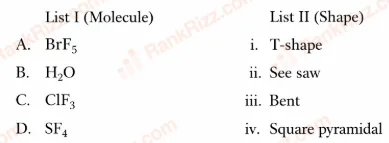
(A)-I, (B)-II, (C)-IV, (D)-III
(A)-II, (B)-I, (C)-III, (D)-IV
(A)-III, (B)-IV, (C)-I, (D)-II
(A)-IV, (B)-III, (C)-I, (D)-II
Given below are two statements: One is labelled as Assertion A and the other is labelled as Reason R.
Assertion A: is more acidic than .
Reason R: Bond dissociation enthalpy of is lower than .
In the light of the above statements, choose the most appropriate from the options given below.
Both A and R are true but R is NOT the correct explanation of A.
Both A and R are true and R is the correct explanation of A.
A is false but R is true.
A is true but R is false.
Choose the correct statements about the hydrides of group 15 elements.
A. The stability of the hydrides decreases in the order
B. The reducing ability of the hydrides increases in the order
C. Among the hydrides, is strong reducing agent while is mild reducing agent.
D. The basicity of the hydrides increases in the order
Choose the most appropriate from the options given below:
B and C only
C and D only
A and B only
A and D only
Identify the incorrect pair from the following :
Fluorspar —
Cryolite —
Fluoroapatite —
Carnallite —
Anomalous behaviour of oxygen is due to its
Large size and high electronegativity
Small size and low electronegativity
Small size and high electronegativity
Large size and low electronegativity
Element not showing variable oxidation state is :
Bromine
Iodine
Chlorine
Fluorine
From the given list, the number of compounds with oxidation state of Sulphur:
Given below are two statements:
Statement (I) : Oxygen being the first member of group 16 exhibits only -2 oxidation state.
Statement (II) : Down the group 16 stability of +4 oxidation state decreases and +6 oxidation state increases.
In the light of the above statements, choose the most appropriate answer from the options given below:
Statement I is correct but Statement II is incorrect
Both Statement I and Statement II are correct
Both Statement I and Statement II are incorrect
Statement I is incorrect but Statement II is correct
1 mole of PbS is oxidised by X moles of to get Y moles of . X + Y =
The number of P O P bonds in HPO, (HPO), and PO are respectively
The correct group of halide ions which can be oxidised by oxygen in acidic medium is
Br and I only
Br only
I only
Cl, Br and I only
Given below are two statements:
Statement I: SbCl is more covalent than SbCl
Statement II: The higher oxides of halogens also tend to be more stable than the lower ones.
In the light of the above statements, choose the most appropriate answer from the options given below.
Statement I is incorrect but statement II is correct
Both Statement I and Statement II are incorrect
Both Statement I and Statement II are correct
Statement I is correct but statement II is incorrect
One mole of P reacts with 8 moles of SOCl to give 4 moles of A, x mole of SO and 2 moles of B. A, B and x respectively are
POCl, SCl and 2
PCl, SCl and 4
PCl, SCl and 2
POCl, SCl and 4
JEE Advanced has set 54 p-Block Elements: Groups 15 to 18 questions too. p-Block Elements: Groups 15 to 18 JEE Advanced PYQs →
OTHER CHEMISTRY CHAPTERS