JEE MAIN 2025 · 23 JAN S1Modern periodic table and classification of elements
The element that does not belong to the same period of the remaining elements (modern periodic table) is:
- A
Iridium
- B
Platinum
- C
Osmium
- D
Palladium
Every Classification of Elements and Periodicity question JEE Main has set from 2004–2026, grouped by the idea it tests rather than the order of the syllabus. 201 questions across 6 distinct ideas. Free to read, answer key on every one.
DATA UPDATED
Questions
201
Distinct ideas
6
Share of marks
4.2%
Difficulty
EASY
A chapter is not one subject — it is a handful of procedures the examiner reuses. These are the ones Classification of Elements and Periodicity questions actually test.
41–60 OF 201 · NEWEST FIRST
The element that does not belong to the same period of the remaining elements (modern periodic table) is:
Iridium
Platinum
Osmium
Palladium
Which of the following electronegativity order is incorrect?
Mg < Be < B < N
S < Cl < O < F
Al < Si < C < N
Al < Mg < B < N
Match List-I with List-II.
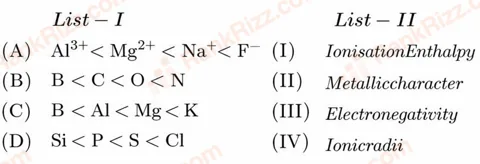
Choose the correct answer from the options given below :
(A)-(IV), (B)-(I), (C)-(II), (D)-(III)
(A)-(IV), (B)-(I), (C)- (III), (D)-(II)
(A)-(III), (B)-(IV), (C)- (II), (D)-(I)
(A)-(II), (B)-(III), (C)-(IV), (D)-(I)
Given below are two statements : Statement (I) : An element in the extreme left of the periodic table forms acidic oxides. Statement (II) : Acid is formed during the reaction between water and oxide of a reactive element present in the extreme right of the periodic table. In the light of the above statements, choose the correct answer from the options given below :
Statement I is true but Statement II is false
Both Statement I and Statement II are true
Both Statement I and Statement II are false
Statement I is false but Statement II is true
Given below are two statements : Statement (I) : The oxidation state of an element in a particular compound is the charge acquired by its atom on the basis of electron gain enthalpy consideration from other atoms in the molecule. Statement (II) : bond formation is more prevalent in second period elements over other periods. In the light of the above statements, choose the most appropriate answer from the options given below :
Both Statement I and Statement II are correct
Both Statement I and Statement II are incorrect
Statement I is incorrect but Statement II is correct
Statement I is correct but Statement II is incorrect
Match List I with List II:
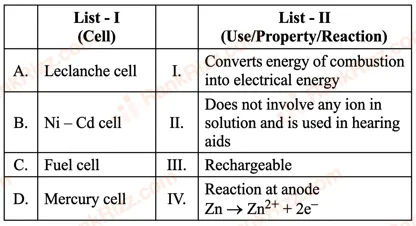
Choose the correct answer from the options given below:
A-II, B-III, C-IV, D-I
A-I, B-II, C-III, D-IV
A-III, B-I, C-IV, D-II
A-IV, B-III, C-I, D-II
Match List I with List II
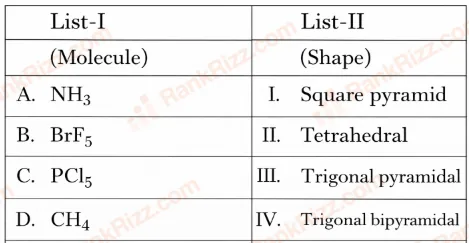
Choose the correct answer from the options given below:
A-II, B-IV, C-I, D-III
A-III, B-I, C-IV, D-II
A-IV, B-III, C-I, D-II
A-III, B-IV, C-I, D-II
The electron affinity values are negative for A. B. C. D. E. . Choose the most appropriate answer from the options given below :
D and E only
A, B and C only
A and D only
A, B, D and E only
The statement(s) that are correct about the species and . (A) All are isoelectronic (B) All have the same nuclear charge (C) has the largest ionic radii (D) has the smallest ionic radii. Choose the most appropriate answer from the options given below :
(B), (C) and (D) only
(C) and (D) only
(A), (C) and (D) only
(A), (B), (C) and (D)
Given below are two statements : Statement I : The metallic radius of Na is Å and the ionic radius of is lesser than Å. Statement II : Ions are always smaller in size than the corresponding elements. In the light of the above statements, choose the correct answer from the options given below :
Both Statement I and Statement II are false
Statement I is incorrect but Statement II is true
Both Statement I and Statement II are true
Statement I is correct but Statement II is false
Number of elements from the following that CANNOT form compounds with valencies which match with their respective group valencies is ______. B, C, N, S, O, F, P, Al, Si
The correct order of first ionization enthalpy values of the following elements is: (A) O (B) N (C) Be (D) F (E) B. Choose the correct answer from the options given below :
E < C < A < B < D
C < E < A < B < D
B < D < C < E < A
A < B < D < C < E
The correct order of the first ionization enthalpy is
Given below are two statements: Statement I: The correct order of first ionization enthalpy values of Li, Na, F and Cl is . Statement II: The correct order of negative electron gain enthalpy values of Li, Na, F and Cl is . In the light of the above statements, choose the correct answer from the options given below:
Statement I is true but Statement II is false
Statement I is false but Statement II is true
Both Statement I and Statement II are false
Both Statement I and Statement II are true
In case of isoelectronic species the size of , and is affected by:
Principal quantum number
None of the factors because their size is the same
Electron-electron interaction in the outer orbitals
Nuclear charge
Given below are two statements:
Statement (I): Both metal and non-metal exist in p and d-block elements.
Statement (II): Non-metals have higher ionisation enthalpy and higher electronegativity than the metals.
In the light of the above statements, choose the most appropriate answer from the options given below:
Both Statement I and Statement II are false
Statement I is false but Statement II is true
Statement I is true but Statement II is false
Both Statement I and Statement II are true
The transition metal having highest 3rd ionisation enthalpy is:
Cr
Mn
V
Fe
The correct sequence of electron gain enthalpy of the elements listed below is A. Ar B. Br C. F D. S. Choose the most appropriate from the options given below:
Consider the following elements.
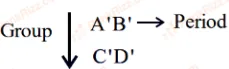
Which of the following is/are true about A', B', C' and D'?
A. Order of atomic radii:
B. Order of metallic character:
C. Size of the element:
D. Order of ionic radii:
Choose the correct answer from the options given below:
A only
A, B and D only
A and B only
B, C and D only
Given below are the two statements: one is labeled as Assertion (A) and the other is labeled as Reason (R).
Assertion (A): There is a considerable increase in covalent radius from to . However from to only a small increase in covalent radius is observed.
Reason (R): covalent and ionic radii in a particular oxidation state increases down the group.
In the light of the above statement, choose the most appropriate answer from the options given below:
(A) is false but (R) is true
Both (A) and (R) are true but (R) is not the correct explanation of (A)
(A) is true but (R) is false
Both (A) and (R) are true and (R) is the correct explanation of (A)
OTHER CHEMISTRY CHAPTERS