States of Matter: Gases and Liquids JEE Advanced PYQs with answer key
CHEMISTRY · 19 PAST QUESTIONS · 4 TOPICS · 2007–2026
HOW TO USE THIS SHEET
Every JEE Advanced States of Matter: Gases and Liquids question we hold, grouped by topic, most-asked topic first and newest first inside each. The answer key is at the end (16 of 19 questions have a checked key); the worked solution is on each question’s page, printed beside it.
Real gases, compressibility factor and van der Waals equation 7
Molar volume () of a van der Waals gas can be calculated by expressing the van der Waals equation as a cubic equation with as the variable. The ratio (in mol dm) of the coefficient of to the coefficient of for a gas having van der Waals constants dm atm mol and dm mol at 300 K and 300 atm is ________.
Use: Universal gas constant (R) = 0.082 dm atm mol K
Answer: ____________
rr2.rankrizz.com/jee-advanced/chemistry/states-of-matter/q/2025-paper-1-q42
A gas has a compressibility factor of 0.5 and a molar volume of 0.4 dm mol at a temperature of 800 K and pressure x atm. If it shows ideal gas behaviour at the same temperature and pressure, the molar volume will be y dm mol. The value of x/y is ____.
[Use: Gas constant, R = L atm K mol]
Answer: ____________
rr2.rankrizz.com/jee-advanced/chemistry/states-of-matter/q/2023-paper-1-q43
One mole of a monoatomic real gas satisfies the equation where b is a constant. The relationship of interatomic potential V(r) and interatomic distance r for the gas is given by
- (A)
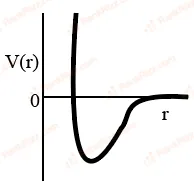
- (B)
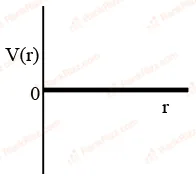
- (C)
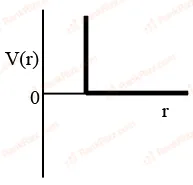
- (D)
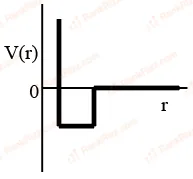
rr2.rankrizz.com/jee-advanced/chemistry/states-of-matter/q/2015-paper-2-q36
- (A)
For one mole of a van der Waals gas when b= 0 and T= 300 K, the PV vs. 1/V plot is shown below. The value of the van der Waals constant a is
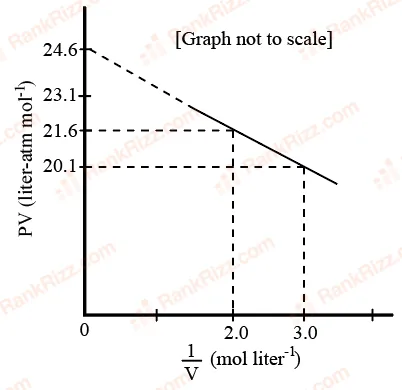
- (A)
1.0
- (B)
4.5
- (C)
1.5
- (D)
3.0
rr2.rankrizz.com/jee-advanced/chemistry/states-of-matter/q/2012-paper-1-q22
- (A)
The term that correct for the attractive forces present in a real gas in the van der Waals equation is
- (A)
- (B)
- (C)
- (D)
rr2.rankrizz.com/jee-advanced/chemistry/states-of-matter/q/2009-paper-1-q1
- (A)
A gas described by van der Waals equation
- (A)
behaves similar to an ideal gasin the limit of large molar volumes
- (B)
behaves similar to an ideal gas in the limit of large pressures
- (C)
is characterised by van der Waals coefficients that are dependent on the identity of the gas but are independent of the temperature
- (D)
has the pressure that is lower than the pressure exerted by the same gas behaving ideally
rr2.rankrizz.com/jee-advanced/chemistry/states-of-matter/q/2008-paper-1-q56
- (A)
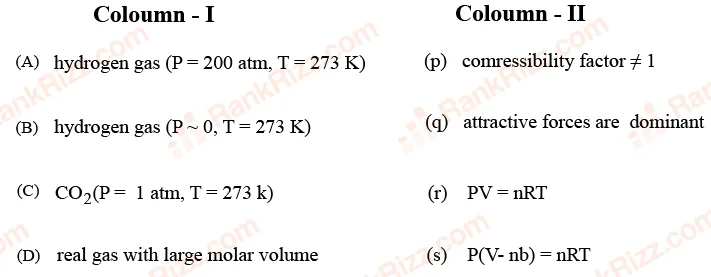
Match gases under specified conditions listed in Column I with their properties/laws in Column II. Indicate your answer by darkening the appropriate bubbles of the matrix given in the ORS.
rr2.rankrizz.com/jee-advanced/chemistry/states-of-matter/q/2007-paper-1-q44
Gas laws and ideal gas equation 5
Two cylinders, both fitted with frictionless pistons, are filled with mixtures of and gases. In the first cylinder, the masses of and are and , respectively. In the second cylinder, the masses of and are and , respectively. The molar mass of is times the molar mass of . The external pressure applied by the piston on the first cylinder needs to be times that on the second cylinder so that the volume of the gas mixtures in both the cylinders are equal at the same temperature. Assuming and behave like ideal gases, the value of is ___.
Answer: ____________
rr2.rankrizz.com/jee-advanced/chemistry/states-of-matter/q/2026-paper-1-q25
A closed vessel contains 10 g of an ideal gas X at 300 K, which exerts 2 atm pressure. At the same temperature, 80 g of another ideal gas Y is added to it and the pressure becomes 6 atm. The ratio of root mean square velocities of X and Y at 300 K is
- (A)
- (B)
- (C)
- (D)
rr2.rankrizz.com/jee-advanced/chemistry/states-of-matter/q/2024-paper-1-q35
- (A)
Aluminium reacts with sulfuric acid to form aluminium sulfate and hydrogen. What is the volume of hydrogen gas in liters (L) produced at 300 K and 1.0 atm pressure, when 5.4 g of aluminium and 50.0 mL of 5.0 M sulfuric acid are combined for the reaction?
(Use molar mass of aluminium as )Answer: ____________
rr2.rankrizz.com/jee-advanced/chemistry/states-of-matter/q/2020-paper-1-q34
A closed tank has two compartments A and B, both filled with oxygen (assumed to be ideal gas). The partition separating the two compartments is fixed and is a perfect heat insulator (Figure 1). If the old partition is replaced by a new partition which can slide and conduct heat but does NOT allow the gas to leak across (Figure 2), the volume (in ) of the compartment A after the system attains equilibrium is ____.
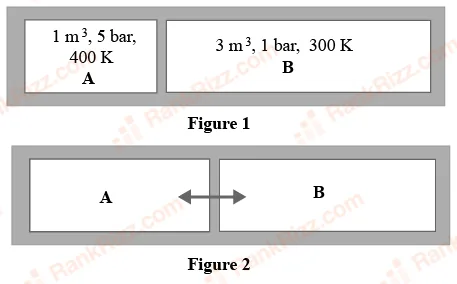
Answer: ____________
rr2.rankrizz.com/jee-advanced/chemistry/states-of-matter/q/2018-paper-1-q29
To an evacuated vessel with movable piston under external pressure of 1 atm., 0.1 mol of He and 1.0 mol of an unknown compound (vapour pressure 0.68 atm, at ) are introduced. Considering the ideal gas behaviour, the total volume (in litre) of the gases at 0ºC is close to.
Answer: ____________
rr2.rankrizz.com/jee-advanced/chemistry/states-of-matter/q/2011-paper-1-q21
Kinetic theory of gases and molecular speeds 5
If the distribution of molecular speeds of a gas is as per the figure shown below, then the ratio of the most probable, the average, and the root mean square speeds, respectively, is
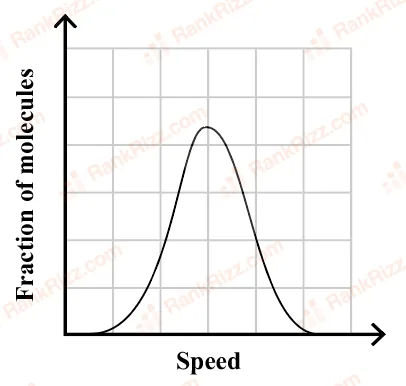
- (A)
1 : 1 : 1
- (B)
1 : 1 : 1.224
- (C)
1 : 1.128 : 1.224
- (D)
1 : 1.128 : 1
rr2.rankrizz.com/jee-advanced/chemistry/states-of-matter/q/2020-paper-1-q19
- (A)
Which of the following statement(s) is (are) correct regarding the root mean square speed and average translational kinetic energy of a molecule in a gas at equilibrium ?
- (A)
is doubled when its temperature is increased four times
- (B)
is doubled when its temperature is increased four times
- (C)
at a given temperature does not depend on its molecular mass
- (D)
is inversely proportional to the square rootof its molecular mass
rr2.rankrizz.com/jee-advanced/chemistry/states-of-matter/q/2019-paper-1-q26
- (A)
The experimental value of d is found to be smaller than the estimate obtained using Graham’s law. This is due to
- (A)
larger mean free path for X as compared to that of Y.
- (B)
larger mean free path for Y as compared to that of X.
- (C)
increased collision frequency of Y with the inert gas as compared to that of X with the inert gas.
- (D)
increased collision frequency of X with the inert gas as compared to that of Y with the inert gas.
rr2.rankrizz.com/jee-advanced/chemistry/states-of-matter/q/2014-paper-2-q36
- (A)
According to kinetic theory of gases -
- (A)
collisions are always elastic
- (B)
heavier molecules transfer more momentum to the wall of the container
- (C)
only a small number of molecules have very high velocity
- (D)
between collisions, the molecules move in straight lines with constant velocities
rr2.rankrizz.com/jee-advanced/chemistry/states-of-matter/q/2011-paper-1-q11
- (A)
At 400 K, the root mean square (rms) speed of a gas X (molecular weight = 40) is equal to the most probable speed of gas Y at 60K. The molecular weight of the gas Y is
Answer: ____________
rr2.rankrizz.com/jee-advanced/chemistry/states-of-matter/q/2009-paper-2-q13
Graham's law of diffusion and effusion 2
The diffusion coefficient of an ideal gas is proportional to its mean free path and meanspeed. The absolute temperature of an ideal gas is increased 4 times and its pressure is increased 2 times. As a result, the diffusion coefficient of this gas increases x times. The value of x is
Answer: ____________
rr2.rankrizz.com/jee-advanced/chemistry/states-of-matter/q/2016-paper-1-q33
The value of d in cm (shown in the figure), as estimated from Graham’s law, is
- (A)
8
- (B)
12
- (C)
16
- (D)
20
rr2.rankrizz.com/jee-advanced/chemistry/states-of-matter/q/2014-paper-2-q35
- (A)
Answer key
- 01 —
- 02 100
- 03 C
- 04 C
- 05 B
- 06 A
- 07 A-PS, B-R, C-PQ, D-PS
- 08 9.80
- 09 D
- 10 6.15
- 11 —
- 12 7
- 13 A
- 14 A, B, D
- 15 D
- 16 A, C, D
- 17 —
- 18 4
- 19 C
“—” marks a question whose key we have not checked yet; its page shows the latest on it.
Past questions are reproduced with their sitting. Not affiliated with NTA or the IITs. Every question, online and free: rr2.rankrizz.com/jee-advanced/chemistry/states-of-matter