JEE ADVANCED 2012 · PAPER 2+4HARD
JEE Advanced 2012 Chemistry question — Magnetic moment, colour and catalytic properties of transition metals
For the given aqueous reaction which of the statement(s) is (are) true ?
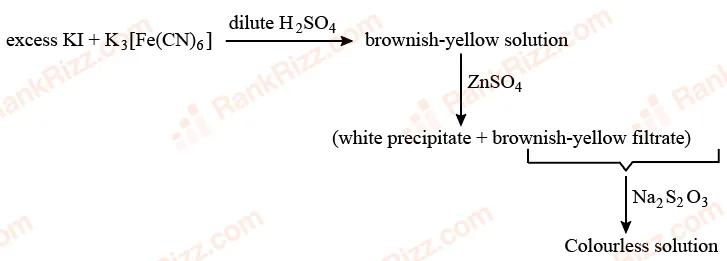
SOLUTION
Key idea: Ferricyanide oxidises iodide to iodine. The ferrocyanide formed gives a white zinc salt, and the iodine stays in the filtrate.
- . Fe goes from +3 to +2 and I from −1 to 0, so this is a redox reaction: (A) true. The brownish-yellow colour is .
- gives the white precipitate (zinc ferrocyanide). is a ferricyanide, so (B) is false.
- The filtrate still contains (decolourised by ), so it turns starch blue: (C) true.
- The zinc salt dissolves in NaOH as zincate, : (D) true.
Answer: (A), (C), (D)
Topic: Magnetic moment, colour and catalytic properties of transition metals