RankRizz

Oscillations — JEE Main Previous Year Questions

Every Oscillations question JEE Main has set from 2004–2026, grouped by the idea it tests rather than the order of the syllabus. 182 questions across 7 distinct ideas. Free to read, answer key on every one.

DATA UPDATED

Questions

182

Distinct ideas

7

Share of marks

2.8%

Difficulty

MEDIUM

The ideas inside Oscillations

A chapter is not one subject — it is a handful of procedures the examiner reuses. These are the ones Oscillations questions actually test.

Every Oscillations question

161–180 OF 182 · NEWEST FIRST

JEE MAIN 2012Damped and forced oscillations and resonance

If a simple pendulum has significant amplitude (up to a factor of 1/e1/e of original) only in the period between t=0st = 0s to t=τst = \tau s, then τ\tau may be called the average life of the pendulum. When the spherical bob of the pendulum suffers a retardation (due to viscous drag) proportional to its velocity, with bb as the constant of proportionality, the average life time of the pendulum is (assuming damping is small) in seconds:

  1. A

    0.693b\frac{0.693}{b}

  2. B

    bb

  3. C

    1b\frac{1}{b}

  4. D

    2b\frac{2}{b}

JEE MAIN 2012SHM: equation, phase, velocity and acceleration

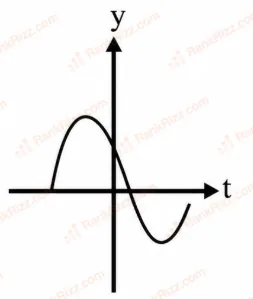
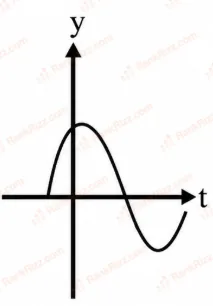
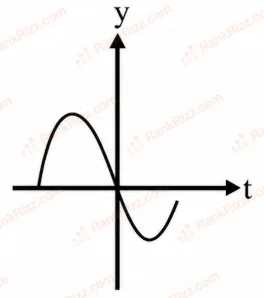
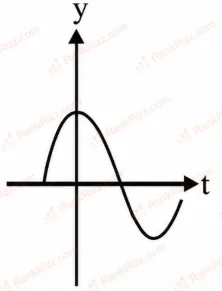
The displacement y(t)=Asin⁡(ωt+ϕ)y(t) = A\sin(\omega t + \phi) of a pendulum for ϕ=2π3\phi = \frac{2\pi}{3} is correctly represented by

  1. A
    Figure for JEE Main 2012 Physics question on SHM: equation, phase, velocity and acceleration
  2. B
    Figure for JEE Main 2012 Physics question on SHM: equation, phase, velocity and acceleration
  3. C
    Figure for JEE Main 2012 Physics question on SHM: equation, phase, velocity and acceleration
  4. D
    Figure for JEE Main 2012 Physics question on SHM: equation, phase, velocity and acceleration
JEE MAIN 2012Simple, compound and torsional pendulums

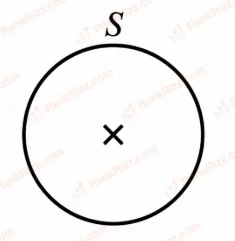
A ring is suspended from a point SS on its rim as shown in the figure. When displaced from equilibrium, it oscillates with time period of 11 second. The radius of the ring is (take g=π2g = \pi^2 )

Figure for JEE Main 2012 Physics question on Simple, compound and torsional pendulums
  1. A

    0.1250.125 m

  2. B

    1.51.5 m

  3. C

    1.01.0 m

  4. D

    0.50.5 m

JEE MAIN 2011SHM: equation, phase, velocity and acceleration

Two particles are executing simple harmonic motion of the same amplitude AA and frequency ω\omega along the xx-axis. Their mean position is separated by distance X0 (X0>A)X_0 \, (X_0 > A). If the maximum separation between them is (X0+A)(X_0 + A), the phase difference between their motion is:

  1. A

    π3\dfrac{\pi}{3}

  2. B

    π4\dfrac{\pi}{4}

  3. C

    π6\dfrac{\pi}{6}

  4. D

    π2\dfrac{\pi}{2}

JEE MAIN 2011Spring-block oscillations

A mass MM, attached to a horizontal spring, executes S.H.M. with amplitude A1A_1. When the mass MM passes through its mean position then a smaller mass mm is placed over it and both of them move together with amplitude A2A_2. The ratio of (A1A2)\left(\dfrac{A_1}{A_2}\right) is:

  1. A

    M+mM\dfrac{M+m}{M}

  2. B

    (MM+m)1/2\left(\dfrac{M}{M+m}\right)^{1/2}

  3. C

    (M+mM)1/2\left(\dfrac{M+m}{M}\right)^{1/2}

  4. D

    MM+m\dfrac{M}{M+m}

JEE MAIN 2009SHM: equation, phase, velocity and acceleration

If x,vx, v and aa denote the displacement, the velocity and the acceleration of a particle executing simple harmonic motion of time period TT, then, which of the following does not change with time?

  1. A

    a2T2+4π2v2a^2T^2 + 4\pi^2v^2

  2. B

    aTx\frac{aT}{x}

  3. C

    aT+2πvaT + 2\pi v

  4. D

    aTv\frac{aT}{v}

JEE MAIN 2007SHM: equation, phase, velocity and acceleration

The displacement of an object attached to a spring and executing simple harmonic motion is given by x=2×10⁻²cos⁡πtx = 2 \times 10^{-2} \cos \pi t metres. The time at which the maximum speed first occurs is

  1. A

    0.5 s

  2. B

    0.75 s

  3. C

    0.125 s

  4. D

    0.25 s

JEE MAIN 2007SHM: equation, phase, velocity and acceleration

A point mass oscillates along the xx-axis according to the law x=x0cos⁡(ωt−π/4)x = x_0 \cos(\omega t - \pi/4). If the acceleration of the particle is written as a=Acos⁡(ωt+δ)a = A \cos(\omega t + \delta)

  1. A

    A=x0,δ=−π/4A = x_0, \delta = -\pi/4

  2. B

    A=x0ω2,δ=−π/4A = x_0 \omega^2, \delta = -\pi/4

  3. C

    A=x0/ω2,δ=−π/4A = x_0/\omega^2, \delta = -\pi/4

  4. D

    A=x0ω2,δ=3π/4A = x_0 \omega^2, \delta = 3\pi/4

JEE MAIN 2007Spring-block oscillations

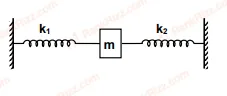
Two springs, of force constants k1k_1 and k2k_2, are connected to a mass mm as shown. The frequency of oscillation of the mass is ff. If both k1k_1 and k2k_2 are made four times their original values, the frequency of oscillation becomes

Figure for JEE Main 2007 Physics question on Spring-block oscillations
  1. A

    f/2f/2

  2. B

    f/4f/4

  3. C

    4f4f

  4. D

    2f2f

JEE MAIN 2007Energy in simple harmonic motion

A particle of mass mm executes simple harmonic motion with amplitude 'aa' and frequency 'vv'. The average kinetic energy during its motion from the position of equilibrium to the end is

  1. A

    π2ma2v2\pi^2 m a^2 v^2

  2. B

    14π2ma2v2\frac{1}{4} \pi^2 m a^2 v^2

  3. C

    4π2ma2v24 \pi^2 m a^2 v^2

  4. D

    2π2ma2v22 \pi^2 m a^2 v^2

JEE MAIN 2006Energy in simple harmonic motion

Starting from the origin, a body oscillates simple harmonically with a period of 2 s2\,s. After what time will its kinetic energy be 75% of the total energy?

  1. A

    112 s\dfrac{1}{12}\,s

  2. B

    16 s\dfrac{1}{6}\,s

  3. C

    14 s\dfrac{1}{4}\,s

  4. D

    13 s\dfrac{1}{3}\,s

JEE MAIN 2006SHM: equation, phase, velocity and acceleration

The maximum velocity of a particle, executing simple harmonic motion with an amplitude 7 mm7\,mm, is 4.4 m/s4.4\,m/s. The period of oscillation is

  1. A

    100 s

  2. B

    0.01 s

  3. C

    10 s

  4. D

    0.1 s

JEE MAIN 2006SHM: equation, phase, velocity and acceleration

A coin is placed on a horizontal platform which undergoes vertical simple harmonic motion of angular frequency ω\omega. The amplitude of oscillation is gradually increased. The coin will leave contact with the platform for the first time

  1. A

    at the highest position of the platform

  2. B

    at the mean position of the platform

  3. C

    for an amplitude of gω2\dfrac{g}{\omega^2}

  4. D

    for an amplitude of g2ω2\dfrac{g^2}{\omega^2}

JEE MAIN 2005SHM: equation, phase, velocity and acceleration

The function sin⁡2(ωt)\sin^2(\omega t) represents

  1. A

    a periodic, but not simple harmonic motion with a period 2π/ω2\pi/\omega

  2. B

    a periodic, but not simple harmonic motion with a period π/ω\pi/\omega

  3. C

    a simple harmonic motion with a period 2π/ω2\pi/\omega

  4. D

    a simple harmonic motion with a period π/ω\pi/\omega

JEE MAIN 2005SHM: equation, phase, velocity and acceleration

Two simple harmonic motions are represented by the equation y1=0.1sin⁡(100πt+π3)y_1 = 0.1 \sin\left(100\pi t + \frac{\pi}{3}\right) and y2=0.1cos⁡πty_2 = 0.1 \cos \pi t. The phase difference of the velocity of particle 1 w.r.t. the velocity of the particle 2 is

  1. A

    −π/6-\pi/6

  2. B

    π/3\pi/3

  3. C

    −π/3-\pi/3

  4. D

    π/6\pi/6

JEE MAIN 2005SHM: equation, phase, velocity and acceleration

If a simple harmonic motion is represented by d2xdt2+αx=0\frac{d^2 x}{dt^2} + \alpha x = 0, its time period is

  1. A

    2πα\frac{2\pi}{\alpha}

  2. B

    2πα\frac{2\pi}{\sqrt{\alpha}}

  3. C

    2πα2\pi \alpha

  4. D

    2πα2\pi \sqrt{\alpha}

JEE MAIN 2005Simple, compound and torsional pendulums

The bob of a simple pendulum is a spherical hollow ball filled with water. A plugged hole near the bottom of the oscillation bob gets suddenly unplugged. During observation, till water is coming out, the time period of oscillation would

  1. A

    first increase and then decrease to the original value.

  2. B

    first decreased then increase to the original value.

  3. C

    remain unchanged.

  4. D

    increase towards a saturation value.

JEE MAIN 2004Simple, compound and torsional pendulums

The bob of a simple pendulum executes simple harmonic motion in water with a period tt, while the period of oscillation of the bob is t0t_0 in air. Neglecting frictional force of water and given that the density of the bob is (43)×1000 kg/m3\left(\frac{4}{3}\right) \times 1000 \text{ kg/m}^3. What relationship between tt and t0t_0 is true?

  1. A

    t=t0t = t_0

  2. B

    t=t0/2t = t_0/2

  3. C

    t=2t0t = 2t_0

  4. D

    t=4t0t = 4t_0

JEE MAIN 2004Spring-block oscillations

A particle at the end of a spring executes simple harmonic motion with a period t1t_1, while the corresponding period for another spring is t2t_2. If the period of oscillation with the two springs in series is tt, then

  1. A

    T=t1+t2T = t_1 + t_2

  2. B

    T2=t12+t22T^2 = t_1^2 + t_2^2

  3. C

    T−1=t1−1+t2−1T^{-1} = t_1^{-1} + t_2^{-1}

  4. D

    T−2=t1−2+t2−2T^{-2} = t_1^{-2} + t_2^{-2}

JEE MAIN 2004Energy in simple harmonic motion

The total energy of particle, executing simple harmonic motion is

  1. A

    ∝x\propto x

  2. B

    ∝x2\propto x^2

  3. C

    independent of xx

  4. D

    ∝x1/2\propto x^{1/2}