RankRizz

Oscillations — JEE Main Previous Year Questions

Every Oscillations question JEE Main has set from 2004–2026, grouped by the idea it tests rather than the order of the syllabus. 182 questions across 7 distinct ideas. Free to read, answer key on every one.

DATA UPDATED

Questions

182

Distinct ideas

7

Share of marks

2.8%

Difficulty

MEDIUM

The ideas inside Oscillations

A chapter is not one subject — it is a handful of procedures the examiner reuses. These are the ones Oscillations questions actually test.

Every Oscillations question

81–100 OF 182 · NEWEST FIRST

JEE MAIN 2021 · 31 AUG S1SHM: equation, phase, velocity and acceleration

A particle of mass 1 kg is hanging from a spring of force constant 100 N m−1^{-1}. The mass is pulled slightly downward and released so that it executes free simple harmonic motion with time period TT. The time when the kinetic energy and potential energy of the system will become equal, is Tn\frac{T}{n}. The value of nn is _________.

JEE MAIN 2021 · 31 AUG S2Spring-block oscillations

A bob of mass mm suspended by a thread of length ℓ\ell undergoes simple harmonic oscillations with time period TT. If the bob is immersed in a liquid that has density 14\frac{1}{4} times that of the bob and the length of the thread is increased by 13\frac{1}{3}rd of the original length, then the time period of the simple harmonic oscillations will be:

  1. A

    34T\frac{3}{4}T

  2. B

    43T\frac{4}{3}T

  3. C

    TT

  4. D

    32T\frac{3}{2}T

JEE MAIN 2021 · 31 AUG S2Energy in simple harmonic motion

For a body executing S.H.M.:
(a) Potential energy is always equal to its K.E.
(b) Average potential and kinetic energy over any given time interval are always equal.
(c) Sum of the kinetic and potential energy at any point of time is constant.
(d) Average K.E. in one time period is equal to average potential energy in one time period.
Choose the most appropriate option from the options given below:

  1. A

    (c) and (d)

  2. B

    only (c)

  3. C

    only (b)

  4. D

    (b) and (c)

JEE MAIN 2021 · 27 AUG S1Energy in simple harmonic motion

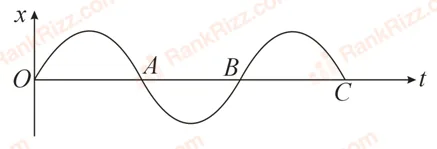
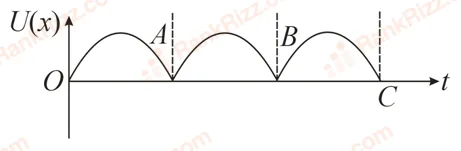
The variation of displacement with time of a particle executing free simple harmonic motion is shown in the figure.

Figure for JEE Main 2021 Physics question on Energy in simple harmonic motion


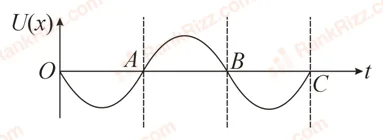
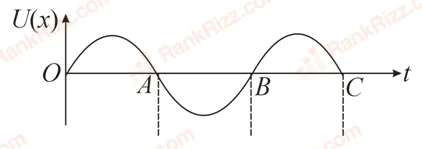
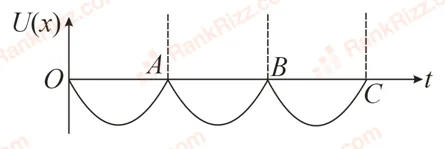
The potential energy U(x)U(x) versus time (t)(t) plot of the particle is correctly shown in figure:

  1. A
    Figure for JEE Main 2021 Physics question on Energy in simple harmonic motion
  2. B
    Figure for JEE Main 2021 Physics question on Energy in simple harmonic motion
  3. C
    Figure for JEE Main 2021 Physics question on Energy in simple harmonic motion
  4. D
    Figure for JEE Main 2021 Physics question on Energy in simple harmonic motion
JEE MAIN 2021 · 27 AUG S2Superposition of SHMs

Two simple harmonic motion, are represented by the equations
y1=10sin⁡(3πt+π3)y_1 = 10\sin\left(3\pi t + \frac{\pi}{3}\right); y2=5(sin⁡3πt+3cos⁡3πt)y_2 = 5\left(\sin 3\pi t + \sqrt{3}\cos 3\pi t\right)
Ratio of amplitude of y1y_1 to y2y_2 = xx : 1. The value of xx is _________.

JEE MAIN 2021 · 26 AUG S2SHM: equation, phase, velocity and acceleration

Two simple harmonic motions are represented by the equations x1=5sin⁡(2πt+π4)x_1 = 5\sin\left(2\pi t + \frac{\pi}{4}\right) and x2=52(sin⁡2πt+cos⁡2πt)x_2 = 5\sqrt{2}(\sin 2\pi t + \cos 2\pi t). The amplitude of the second motion is _________ times the amplitude in the first motion.

JEE MAIN 2021 · 27 JUL S1SHM: equation, phase, velocity and acceleration

A particle starts executing simple harmonic motion (SHM) of amplitude aa and total energy EE. At any instant, its kinetic energy is 3E4\frac{3E}{4}, then its displacement yy is given by:

  1. A

    y=ay = a

  2. B

    y=a2y = \frac{a}{\sqrt{2}}

  3. C

    y=a32y = \frac{a\sqrt{3}}{2}

  4. D

    y=a2y = \frac{a}{2}

JEE MAIN 2021 · 27 JUL S2SHM: equation, phase, velocity and acceleration

An object of mass 0.5 kg is executing simple harmonic motion. It amplitude is 5 cm and time period (T) is 0.2 s. What will be the potential energy of the object at an instant t=T4t = \frac{T}{4} s starting from mean position. Assume that the initial phase of the oscillation is zero.

  1. A

    0.62 J

  2. B

    6.2×10−36.2 \times 10^{-3} J

  3. C

    1.2×1031.2 \times 10^3 J

  4. D

    6.2×1036.2 \times 10^3 J

JEE MAIN 2021 · 27 JUL S2SHM: equation, phase, velocity and acceleration

A particle executes simple harmonic motion represented by displacement function as x(t)=Asin⁡(ωt+ϕ)x(t) = A\sin(\omega t + \phi). If the position and velocity of the particle at t=0t = 0 s are 2 cm and 2ω\omega cm s−1^{-1} respectively, then its amplitude is x2x\sqrt{2} cm where the value of xx is _________

JEE MAIN 2021 · 25 JUL S1Spring-block oscillations

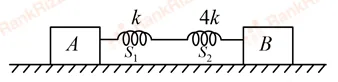
In the reported figure, two bodies A and B of masses 200 g and 800 g are attached with the system of springs. Springs are kept in a stretched position with some extension when the system is released. The horizontal surface is assumed to be frictionless. The angular frequency will be ___ rad s−1^{-1} when k=20k = 20 N m−1^{-1}.

Figure for JEE Main 2021 Physics question on Spring-block oscillations
JEE MAIN 2021 · 25 JUL S2Energy in simple harmonic motion

In a simple harmonic oscillation, what fraction of total mechanical energy is in the form of kinetic energy, when the particle is midway between mean and extreme position.

  1. A

    12\frac{1}{2}

  2. B

    34\frac{3}{4}

  3. C

    13\frac{1}{3}

  4. D

    14\frac{1}{4}

JEE MAIN 2021 · 22 JUL S1SHM: equation, phase, velocity and acceleration

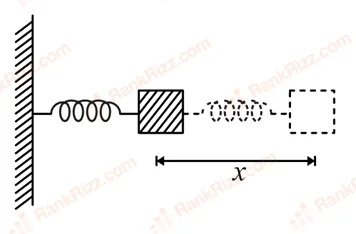
The motion of a mass on a spring, with spring constant KK is as shown in figure.

Figure for JEE Main 2021 Physics question on SHM: equation, phase, velocity and acceleration


The equation of motion is given by, x(t)=Asin⁡ωt+Bcos⁡ωtx(t) = A\sin\omega t + B\cos\omega t with ω=Km\omega = \sqrt{\frac{K}{m}}. Suppose that at time t=0t = 0, the position of mass is x(0)x(0) and velocity v(0)v(0), then its displacement can also be represented as x(t)=Ccos⁡(ωt−ϕ)x(t) = C\cos(\omega t - \phi), where CC and ϕ\phi are:

  1. A

    C=2v(0)2ω2+x(0)2C = \sqrt{\frac{2v(0)^2}{\omega^2} + x(0)^2}, ϕ=tan⁡−1(v(0)x(0)ω)\phi = \tan^{-1}\left(\frac{v(0)}{x(0)\omega}\right)

  2. B

    C=2v(0)2ω2+x(0)2C = \sqrt{\frac{2v(0)^2}{\omega^2} + x(0)^2}, ϕ=tan⁡−1(x(0)ω2v(0))\phi = \tan^{-1}\left(\frac{x(0)\omega}{2v(0)}\right)

  3. C

    C=v(0)2ω2+x(0)2C = \sqrt{\frac{v(0)^2}{\omega^2} + x(0)^2}, ϕ=tan⁡−1(x(0)ωv(0))\phi = \tan^{-1}\left(\frac{x(0)\omega}{v(0)}\right)

  4. D

    C=v(0)2ω2+x(0)2C = \sqrt{\frac{v(0)^2}{\omega^2} + x(0)^2}, ϕ=tan⁡−1(v(0)x(0)ω)\phi = \tan^{-1}\left(\frac{v(0)}{x(0)\omega}\right)

JEE MAIN 2021 · 22 JUL S1Spring-block oscillations

T0T_0 is the time period of a simple pendulum at a place. If the length of the pendulum is reduced to 116\frac{1}{16} times of its initial value, the modified time period is

  1. A

    T0T_0

  2. B

    8πT08\pi T_0

  3. C

    4T04T_0

  4. D

    14T0\frac{1}{4}T_0

JEE MAIN 2021 · 20 JUL S2Energy in simple harmonic motion

A particle is making simple harmonic motion along the X-axis. If at distances x1x_1 and x2x_2 from the mean position the velocities of the particle are v1v_1 and v2v_2, respectively. The time period of its oscillation is given as:

  1. A

    T=2πx22+x12v12−v22T = 2\pi\sqrt{\frac{x_2^2 + x_1^2}{v_1^2 - v_2^2}}

  2. B

    T=2πx22+x12v12+v22T = 2\pi\sqrt{\frac{x_2^2 + x_1^2}{v_1^2 + v_2^2}}

  3. C

    T=2πx22−x12v12+v22T = 2\pi\sqrt{\frac{x_2^2 - x_1^2}{v_1^2 + v_2^2}}

  4. D

    T=2πx22−x12v12−v22T = 2\pi\sqrt{\frac{x_2^2 - x_1^2}{v_1^2 - v_2^2}}

JEE MAIN 2021 · 18 MAR S2SHM: equation, phase, velocity and acceleration

The function of time representing a simple harmonic motion with a period of πω\frac{\pi}{\omega} is :

  1. A

    sin⁡(ωt)+cos⁡(ωt)\sin(\omega t) + \cos(\omega t)

  2. B

    cos⁡(ωt)+cos⁡(2ωt)+cos⁡(3ωt)\cos(\omega t) + \cos(2\omega t) + \cos(3\omega t)

  3. C

    sin⁡2(ωt)\sin^2(\omega t)

  4. D

    3cos⁡(π4−2ωt)3\cos\left(\frac{\pi}{4} - 2\omega t\right)

JEE MAIN 2021 · 17 MAR S1Energy in simple harmonic motion

For what value of displacement the kinetic energy and potential energy of a simple harmonic oscillation become equal?

  1. A

    x=0x = 0

  2. B

    x=±Ax = \pm A

  3. C

    x=±A2x = \pm \frac{A}{\sqrt{2}}

  4. D

    x=A2x = \frac{A}{2}

JEE MAIN 2021 · 17 MAR S1Spring-block oscillations

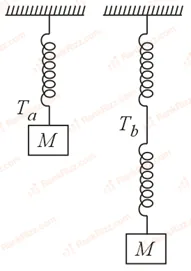
Consider two identical springs each of spring constant kk and negligible mass compared to the mass MM as shown. Fig. 1 shows one of them and Fig. 2 shows their series combination. The ratios of time period of oscillation of the two SHM is TbTa=x\frac{T_b}{T_a} = \sqrt{x}, where value of xx is ________. (Round off to the Nearest Integer)

Figure for JEE Main 2021 Physics question on Spring-block oscillations
JEE MAIN 2021 · 17 MAR S2Damped and forced oscillations and resonance

A block of mass 1 kg attached to a spring is made to oscillate with an initial amplitude of 12 cm. After 2 minutes the amplitude decreases to 6 cm. Determine the value of the damping constant for this motion. (take ln⁡2=0.693\ln 2 = 0.693)

  1. A

    1.16×10−21.16 \times 10^{-2} kg s−1^{-1}

  2. B

    3.3×1023.3 \times 10^{2} kg s−1^{-1}

  3. C

    1.16×1021.16 \times 10^{2} kg s−1^{-1}

  4. D

    5.7×10−35.7 \times 10^{-3} kg s−1^{-1}

JEE MAIN 2021 · 17 MAR S2Spring-block oscillations

Two particles AA and BB of equal masses are suspended from two massless springs of spring constants K1K_1 and K2K_2 respectively. If the maximum velocities during oscillations are equal, the ratio of the amplitude of AA and BB is:

  1. A

    K2K1\frac{K_2}{K_1}

  2. B

    K1K2\frac{K_1}{K_2}

  3. C

    K1K2\sqrt{\frac{K_1}{K_2}}

  4. D

    K2K1\sqrt{\frac{K_2}{K_1}}

JEE MAIN 2021 · 16 MAR S1Spring-block oscillations

Time period of a simple pendulum is TT inside a lift when the lift is stationary. If the lift moves upwards with an acceleration g2\frac{g}{2}, the time period of pendulum will be:

  1. A

    3 T\sqrt{3}\,T

  2. B

    T3\frac{T}{\sqrt{3}}

  3. C

    32 T\sqrt{\frac{3}{2}}\,T

  4. D

    23 T\sqrt{\frac{2}{3}}\,T