Oscillations JEE Main PYQs with answer key
PHYSICS · 182 PAST QUESTIONS · 7 TOPICS · 2004–2026
HOW TO USE THIS SHEET
Every JEE Main Oscillations question we hold, grouped by topic, most-asked topic first and newest first inside each. The answer key is at the end (179 of 182 questions have a checked key); the worked solution is on each question’s page, printed beside it.
SHM: equation, phase, velocity and acceleration 78
A particle is executing simple harmonic motion. Its amplitude is and time period is 5 sec. The time required by it to move from to is _______ sec.
- (A)
1/4
- (B)
5/4
- (C)
5/8
- (D)
3/8
rr2.rankrizz.com/jee-main/physics/oscillations/q/6-apr-2026-s1-q37
- (A)
Match the List I with List II:
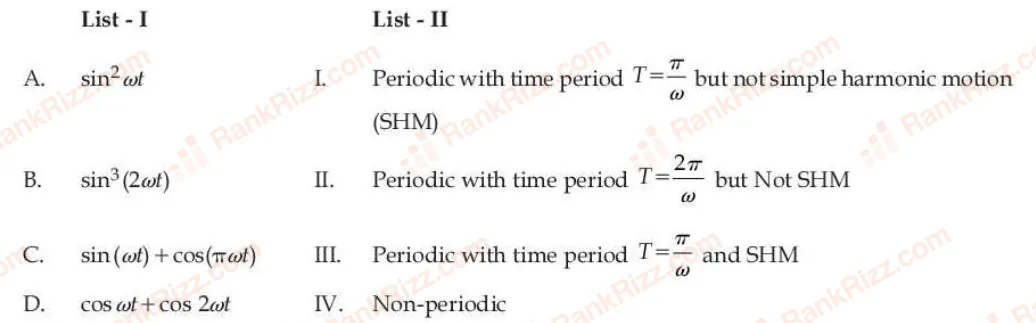
Choose the correct answer from the options given below:
- (A)
A-III, B-I, C-IV, D-II
- (B)
A-II, B-I, C-III, D-IV
- (C)
A-III, B-II, C-IV, D-I
- (D)
A-II, B-I, C-IV, D-III
rr2.rankrizz.com/jee-main/physics/oscillations/q/5-apr-2026-s2-q35
- (A)
The velocity of a particle executing simple harmonic motion along -axis is described as , where represents displacement. If the time period of motion is s, the value of is _____.
Answer: ____________
rr2.rankrizz.com/jee-main/physics/oscillations/q/4-apr-2026-s1-q48
The equation of motion of a particle is given by cm. The particle will come to rest at time and it will have zero acceleration at time . The and respectively are _____.
- (A)
s, s
- (B)
s, s
- (C)
s, s
- (D)
s, s
rr2.rankrizz.com/jee-main/physics/oscillations/q/2-apr-2026-s2-q45
- (A)
The displacement of a particle, executing simple harmonic motion with time period T, is expressed as , where A is the amplitude. The maximum value of potential energy of this oscillator is found at . The value of is_____.
Answer: ____________
rr2.rankrizz.com/jee-main/physics/oscillations/q/28-jan-2026-s1-q47
A particle is subjected to two simple harmonic motions as:
cm
and cm
where x is displacement and is time in seconds. The maximum acceleration of the particle is ms. The value of x is:- (A)
175
- (B)
- (C)
- (D)
125
rr2.rankrizz.com/jee-main/physics/oscillations/q/2025-apr-02-s1-q34
- (A)
Given below are two statements : one is labelled as Assertion (A) and the other is labelled as Reason (R). Assertion (A) : Time period of a simple pendulum is longer at the top of a mountain than that at the base of the mountain. Reason (R): Time period of a simple pendulum decreases with increasing value of acceleration due to gravity and vice-versa. In the light of the above statements, choose the most appropriate answer from the options given below :
- (A)
Both (A) and (R) are true and (R) is the correct explanation of (A)
- (B)
(A) is true but (R) is false
- (C)
(A) is false but (R) is true
- (D)
Both (A) and (R) are true but (R) is not the correct explanation of (A)
rr2.rankrizz.com/jee-main/physics/oscillations/q/29-jan-2025-s1-q44
- (A)
Two bodies A and B of equal mass are suspended from two massless springs of spring constant and , respectively. If the bodies oscillate vertically such that their amplitudes are equal, the ratio of the maximum velocity of A to the maximum velocity of B is
- (A)
- (B)
- (C)
- (D)
rr2.rankrizz.com/jee-main/physics/oscillations/q/29-jan-2025-s2-q28
- (A)
A particle is executing simple harmonic motion with time period and amplitude If and are the total distance and displacement covered by the particle in then is:
- (A)
- (B)
10
- (C)
- (D)
25
rr2.rankrizz.com/jee-main/physics/oscillations/q/24-jan-2025-s1-q36
- (A)
The position, velocity and acceleration of a particle executing simple harmonic motion are found to have magnitudes of m, ms and ms at a certain instant. The amplitude of the motion is m, where is ________
Answer: ____________
rr2.rankrizz.com/jee-main/physics/oscillations/q/9-apr-2024-s1-q24
A particle of mass executes simple harmonic motion under force . The time period of oscillation is s. The value of is ______ (Given )
Answer: ____________
rr2.rankrizz.com/jee-main/physics/oscillations/q/9-apr-2024-s2-q25
A particle is doing simple harmonic motion of amplitude and time period . The maximum velocity of the particle is _______ cm/s.
Answer: ____________
rr2.rankrizz.com/jee-main/physics/oscillations/q/6-apr-2024-s1-q24
The displacement of a particle executing SHM is given by m. The time period of motion is s. The velocity of the particle at is _____ m/s.
Answer: ____________
rr2.rankrizz.com/jee-main/physics/oscillations/q/04-apr-2024-s2-q24
A mass is suspended from a spring of negligible mass and the system oscillates with a frequency . The frequency of oscillations if a mass is suspended from the same spring is . The value of is ______.
Answer: ____________
rr2.rankrizz.com/jee-main/physics/oscillations/q/01-feb-2024-s2-q24
A particle performs simple harmonic motion with amplitude . Its speed is increased to three times at an instant when its displacement is . The new amplitude of motion is . The value of is _____.
Answer: ____________
rr2.rankrizz.com/jee-main/physics/oscillations/q/31-jan-2024-s1-q24
A simple harmonic oscillator has an amplitude and time period second. Assuming the oscillation starts from its mean position, the time required by it to travel from to will be s, where ______.
Answer: ____________
rr2.rankrizz.com/jee-main/physics/oscillations/q/29-jan-2024-s2-q24
A particle executes simple harmonic motion with an amplitude of cm. At the mean position, velocity of the particle is . The distance of the particle from the mean position when its speed becomes is cm, where ______.
Answer: ____________
rr2.rankrizz.com/jee-main/physics/oscillations/q/27-jan-2024-s1-q24
In a linear Simple Harmonic Motion (SHM)
(A) Restoring force is directly proportional to the displacement.
(B) The acceleration and displacement are opposite in direction.
(C) The velocity is maximum at mean position.
(D) The acceleration is minimum at extreme points.
Choose the correct answer from the options given below:- (A)
(C) and (D) only
- (B)
(A), (C) and (D) only
- (C)
(A), (B) and (C) only
- (D)
(A), (B) and (D) only
rr2.rankrizz.com/jee-main/physics/oscillations/q/15-apr-2023-s1-q10
- (A)
Which graph represents the difference between total energy and potential energy of a particle executing SHM vs its distance from mean position?
- (A)
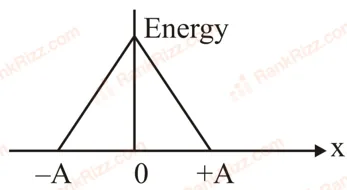
- (B)
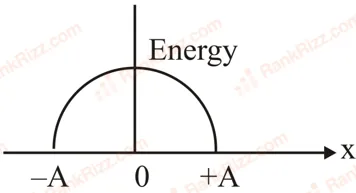
- (C)
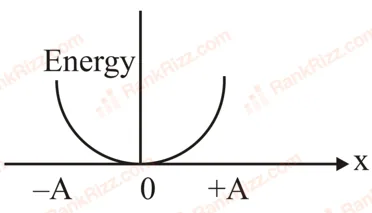
- (D)
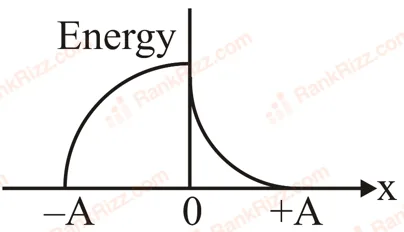
rr2.rankrizz.com/jee-main/physics/oscillations/q/13-apr-2023-s1-q11
- (A)
At a given point of time the value of displacement of a simple harmonic oscillator is given as . If amplitude is cm and kinetic energy at that time is J, the value of force constant is N m. The value of is _____.
Answer: ____________
rr2.rankrizz.com/jee-main/physics/oscillations/q/13-apr-2023-s1-q23
A particle executes SHM of amplitude . The distance from the mean position when its kinetic energy becomes equal to its potential energy is:
- (A)
- (B)
- (C)
- (D)
rr2.rankrizz.com/jee-main/physics/oscillations/q/13-apr-2023-s2-q10
- (A)
A particle is executing simple harmonic motion (SHM). The ratio of potential energy and kinetic energy of the particle when its displacement is half of its amplitude will be
- (A)
- (B)
- (C)
- (D)
rr2.rankrizz.com/jee-main/physics/oscillations/q/12-apr-2023-s1-q10
- (A)
The variation of kinetic energy (KE) of a particle executing simple harmonic motion with the displacement (x) starting from mean position to extreme position (A) is given by
- (A)
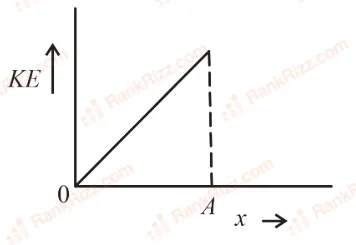
- (B)
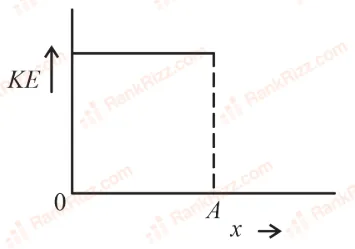
- (C)
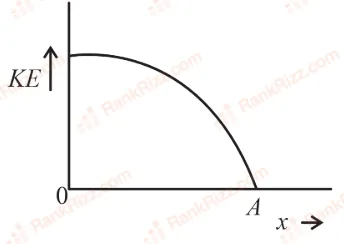
- (D)
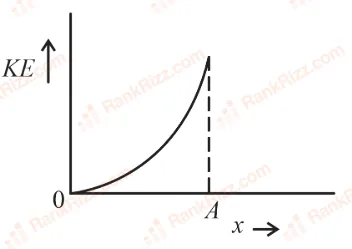
rr2.rankrizz.com/jee-main/physics/oscillations/q/11-apr-2023-s1-q9
- (A)
A particle executes S.H.M. of amplitude along -axis. At , the position of the particle is and it moves along positive -axis. The displacement of particle in time is , then the value will be
- (A)
- (B)
- (C)
- (D)
rr2.rankrizz.com/jee-main/physics/oscillations/q/10-apr-2023-s1-q10
- (A)
For a periodic motion represented by the equation the amplitude of the motion is
- (A)
1
- (B)
0.5
- (C)
2
- (D)
rr2.rankrizz.com/jee-main/physics/oscillations/q/10-apr-2023-s2-q9
- (A)
For particle revolving round the centre with radius of circular path and angular velocity , as shown in below figure, the projection of on the -axis at time is
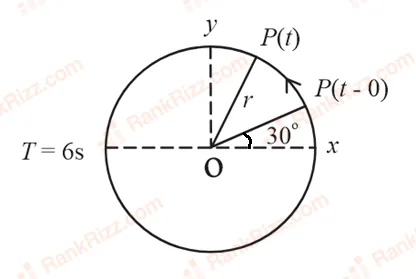
- (A)
- (B)
- (C)
- (D)
rr2.rankrizz.com/jee-main/physics/oscillations/q/08-apr-2023-s2-q10
- (A)
A simple pendulum with length 100 cm and bob of mass 250 g is executing S.H.M of amplitude 10 cm. The maximum tension in the string is found to be N. The value of is ______.
Answer: ____________
rr2.rankrizz.com/jee-main/physics/oscillations/q/6-apr-2023-s2-q24
The amplitude of a particle executing SHM is 3 cm. The displacement at which its kinetic energy will be 25% more than the potential energy is: _____ cm.
Answer: ____________
rr2.rankrizz.com/jee-main/physics/oscillations/q/01-feb-2023-s1-q24
The maximum potential energy of a block executing simple harmonic motion is 25 J. A is amplitude of oscillation. At , the kinetic energy of the block is
- (A)
37.5 J
- (B)
9.75 J
- (C)
18.75 J
- (D)
12.5 J
rr2.rankrizz.com/jee-main/physics/oscillations/q/31-jan-2023-s1-q10
- (A)
The general displacement of a simple harmonic oscillator is . Let be its time period. The slope of its potential energy - time curve will be maximum when . The value of is ______.
Answer: ____________
rr2.rankrizz.com/jee-main/physics/oscillations/q/30-jan-2023-s1-q23
The velocity of a particle executing SHM varies with displacement as . The time period of oscillations is s. The value of is ______. [Take ]
Answer: ____________
rr2.rankrizz.com/jee-main/physics/oscillations/q/30-jan-2023-s2-q24
A particle of mass g executes a simple harmonic motion under a periodic force N. The particle attains a maximum speed of m s during its oscillation. The amplitude of the motion is ______ cm.
Answer: ____________
rr2.rankrizz.com/jee-main/physics/oscillations/q/29-jan-2023-s2-q24
A particle executes simple harmonic motion between and . If time taken by particle to go from to is 2 s; then time taken by particle in going from to is:
- (A)
3 s
- (B)
2 s
- (C)
1.5 s
- (D)
4 s
rr2.rankrizz.com/jee-main/physics/oscillations/q/25-jan-2023-s2-q10
- (A)
A mass , attached to free end of a spring executes SHM with a period of 1 s. If the mass is increased by 3 kg, the period of oscillation increases by one second. The value of mass is _____ kg.
Answer: ____________
rr2.rankrizz.com/jee-main/physics/oscillations/q/24-jan-2023-s2-q24
When a particle executes simple Harmonic motion, the nature of graph of velocity as function of displacement will be
- (A)
Circular
- (B)
Elliptical
- (C)
Sinusoidal
- (D)
Straight line
rr2.rankrizz.com/jee-main/physics/oscillations/q/26-jul-2022-s1-q9
- (A)
A body is performing simple harmonic with an amplitude of 10 cm. The velocity of the body was tripled by air Jet when it is at 5 cm from its mean position. The new amplitude of vibration is cm. The value of is ______.
Answer: ____________
rr2.rankrizz.com/jee-main/physics/oscillations/q/29-jun-2022-s1-q23
The motion of a simple pendulum executing S.H.M. is represented by the following equation , where time is measured in second. The length of pendulum is
- (A)
97.23 cm
- (B)
25.3 cm
- (C)
99.4 cm
- (D)
406.1 cm
rr2.rankrizz.com/jee-main/physics/oscillations/q/29-jun-2022-s2-q10
- (A)
Motion of a particle in plane is described by a set of following equations m and m. The path of the particle will be
- (A)
circular
- (B)
helical
- (C)
parabolic
- (D)
elliptical
rr2.rankrizz.com/jee-main/physics/oscillations/q/28-jun-2022-s1-q2
- (A)
The displacement of simple harmonic oscillator after seconds starting from its mean position is equal to half of its amplitude. The time period of harmonic motion is
- (A)
s
- (B)
s
- (C)
s
- (D)
s
rr2.rankrizz.com/jee-main/physics/oscillations/q/27-jun-2022-s1-q10
- (A)
The equation of a particle executing simple harmonic motion is given by m. At s, the speed of particle will be (Given: )
- (A)
cm s
- (B)
cm s
- (C)
cm s
- (D)
cm s
rr2.rankrizz.com/jee-main/physics/oscillations/q/27-jun-2022-s2-q11
- (A)
A particle executes simple harmonic motion. Its amplitude is cm and time period is s. The time it will take to travel from its position of maximum displacement to the point corresponding to half of its amplitude, is ______ s.
Answer: ____________
rr2.rankrizz.com/jee-main/physics/oscillations/q/27-jun-2022-s2-q24
A particle of mass 1 kg is hanging from a spring of force constant 100 N m. The mass is pulled slightly downward and released so that it executes free simple harmonic motion with time period . The time when the kinetic energy and potential energy of the system will become equal, is . The value of is _________.
Answer: ____________
rr2.rankrizz.com/jee-main/physics/oscillations/q/31-aug-2021-s1-q24
Two simple harmonic motions are represented by the equations and . The amplitude of the second motion is _________ times the amplitude in the first motion.
Answer: ____________
rr2.rankrizz.com/jee-main/physics/oscillations/q/26-aug-2021-s2-q23
A particle starts executing simple harmonic motion (SHM) of amplitude and total energy . At any instant, its kinetic energy is , then its displacement is given by:
- (A)
- (B)
- (C)
- (D)
rr2.rankrizz.com/jee-main/physics/oscillations/q/27-jul-2021-s1-q10
- (A)
An object of mass 0.5 kg is executing simple harmonic motion. It amplitude is 5 cm and time period (T) is 0.2 s. What will be the potential energy of the object at an instant s starting from mean position. Assume that the initial phase of the oscillation is zero.
- (A)
0.62 J
- (B)
J
- (C)
J
- (D)
J
rr2.rankrizz.com/jee-main/physics/oscillations/q/27-jul-2021-s2-q11
- (A)
A particle executes simple harmonic motion represented by displacement function as . If the position and velocity of the particle at s are 2 cm and 2 cm s respectively, then its amplitude is cm where the value of is _________
Answer: ____________
rr2.rankrizz.com/jee-main/physics/oscillations/q/27-jul-2021-s2-q25
The motion of a mass on a spring, with spring constant is as shown in figure.
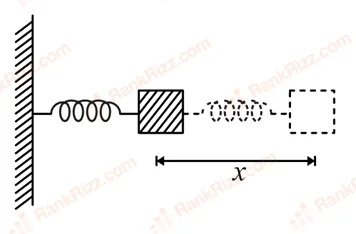
The equation of motion is given by, with . Suppose that at time , the position of mass is and velocity , then its displacement can also be represented as , where and are:- (A)
,
- (B)
,
- (C)
,
- (D)
,
rr2.rankrizz.com/jee-main/physics/oscillations/q/22-jul-2021-s1-q3
- (A)
The function of time representing a simple harmonic motion with a period of is :
- (A)
- (B)
- (C)
- (D)
rr2.rankrizz.com/jee-main/physics/oscillations/q/18-mar-2021-s2-q11
- (A)
A particle executes S.H.M., the graph of velocity as a function of displacement is:
- (A)
a circle
- (B)
a helix
- (C)
a parabola
- (D)
an ellipse
rr2.rankrizz.com/jee-main/physics/oscillations/q/26-feb-2021-s2-q11
- (A)
A particle executes S.H.M. with amplitude and time period . The displacement of the particle when its speed is half of maximum speed is . The value of is
Answer: ____________
rr2.rankrizz.com/jee-main/physics/oscillations/q/26-feb-2021-s2-q24
Time period of a simple pendulum is . The time taken to complete oscillations starting from mean position is . The value of is ______.
Answer: ____________
rr2.rankrizz.com/jee-main/physics/oscillations/q/26-feb-2021-s2-q25
The point moves with a uniform speed along the circumference of a circle of radius 0.36 m and covers 30° in 0.1 s. The perpendicular projection from on the diameter represents the simple harmonic motion of . The restoration force per unit mass when touches will be:
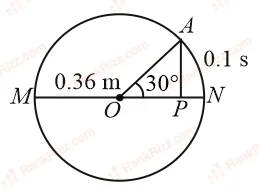
- (A)
0.49 N
- (B)
9.87 N
- (C)
50 N
- (D)
100 N
rr2.rankrizz.com/jee-main/physics/oscillations/q/25-feb-2021-s2-q7
- (A)
is the time-displacement equation of a SHM. At the displacement of the particle is and it is moving along negative -direction. Then the initial phase angle will be:
- (A)
- (B)
- (C)
- (D)
rr2.rankrizz.com/jee-main/physics/oscillations/q/25-feb-2021-s2-q8
- (A)
When a particle executes SHM, the nature of graphical representation of velocity as a function of displacement is:
- (A)
straight line
- (B)
elliptical
- (C)
circular
- (D)
parabolic
rr2.rankrizz.com/jee-main/physics/oscillations/q/24-feb-2021-s2-q8
- (A)
A particle executes simple harmonic motion with an amplitude of 5 cm. When the particle is at 4 cm from the mean position, the magnitude of its velocity in SI units is equal to that of its acceleration. Then, its periodic time in seconds is:
- (A)
- (B)
- (C)
- (D)
rr2.rankrizz.com/jee-main/physics/oscillations/q/10-jan-2019-s2-q13
- (A)
A particle executes simple harmonic motion and it is located at x = a, b and c at time t, 2t and 3t respectively. The frequency of the oscillation is:
- (A)
- (B)
- (C)
- (D)
rr2.rankrizz.com/jee-main/physics/oscillations/q/16-apr-2018-online-q12
- (A)
Two simple harmonic motions, as shown, are at right angles. They are combined to form Lissajous figures. , . Identify the correct match below.
- (A)
Parameters: A = B, a = 2b; ; Curve: Circle
- (B)
Parameters: A = B, a = b; ; Curve: Line
- (C)
Parameters: A B, a = b; ; Curve: Ellipse
- (D)
Parameters: A B, a = b; ; Curve: Parabola
rr2.rankrizz.com/jee-main/physics/oscillations/q/15-apr-2018-s2-q13
- (A)
A silver atom in a solid oscillates in simple harmonic motion in some direction with a frequency of s. What is the force constant of the bonds connecting one atom with the other? (Mole wt. of silver = 108 g mol and Avogadro number = )
- (A)
5.5 N m
- (B)
6.4 N m
- (C)
7.1 N m
- (D)
2.2 N m
rr2.rankrizz.com/jee-main/physics/oscillations/q/8-apr-2018-offline-q13
- (A)
The ratio of maximum acceleration to maximum velocity in a simple harmonic motion is 10 s. At, the displacement is 5 m. What is the maximum acceleration? The initial phase is .
- (A)
500 m s
- (B)
m s
- (C)
750 m s
- (D)
m s
rr2.rankrizz.com/jee-main/physics/oscillations/q/8-apr-2017-online-q12
- (A)
A particle is executing simple harmonic motion with a time period . At time , it is at its position of equilibrium. The kinetic energy - time graph of the particle will look like:
- (A)
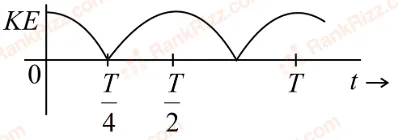
- (B)
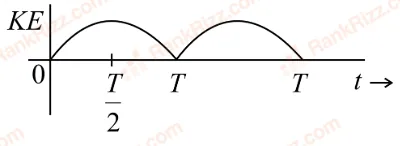
- (C)
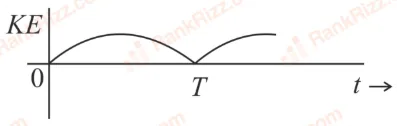
- (D)
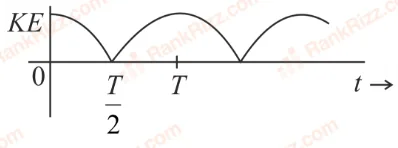
rr2.rankrizz.com/jee-main/physics/oscillations/q/2-apr-2017-offline-q13
- (A)
In an engine the piston undergoes vertical simple harmonic motion with amplitude 7 cm. A washer rests on top of the piston and moves with it. The motor speed is slowly increased. The frequency of the piston at which the washer no longer stays in contact with the piston, is close to:
- (A)
0.7 Hz
- (B)
1.9 Hz
- (C)
1.2 Hz
- (D)
0.1 Hz
rr2.rankrizz.com/jee-main/physics/oscillations/q/10-apr-2016-online-q12
- (A)
Two particles are performing simple harmonic motion in a straight line about the same equilibrium point. The amplitude and time period for both particles are same and equal to A and T, respectively. At time one particle has displacement A while the other one has displacement and they are moving towards each other. If they cross each other at time t, then t is:
- (A)
- (B)
- (C)
- (D)
rr2.rankrizz.com/jee-main/physics/oscillations/q/9-apr-2016-online-q12
- (A)
A particle performs simple harmonic motion with amplitude A. Its speed is tripled at the instant that it is at a distance from equilibrium position. The new amplitude of the motion is:
- (A)
- (B)
- (C)
- (D)
3A
rr2.rankrizz.com/jee-main/physics/oscillations/q/3-apr-2016-offline-q10
- (A)
and are displacements of a particle are given as and . Its trajectory will look like:
- (A)
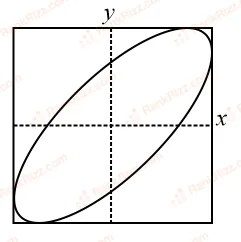
- (B)
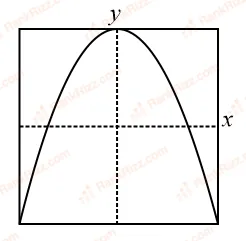
- (C)
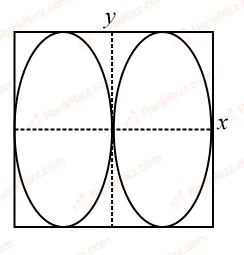
- (D)
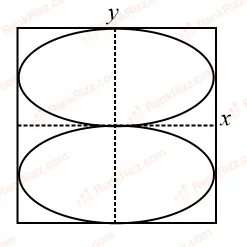
rr2.rankrizz.com/jee-main/physics/oscillations/q/10-apr-2015-online-q12
- (A)
A body is in simple harmonic motion with time period s and amplitude cm. Find the average velocity in the interval in which it moves from equilibrium position to half of its amplitude.
- (A)
16 cm/s
- (B)
6 cm/s
- (C)
4 cm/s
- (D)
12 cm/s
rr2.rankrizz.com/jee-main/physics/oscillations/q/19-apr-2014-online-q14
- (A)
Which of the following expressions corresponds to simple harmonic motion along a straight line, where x is the displacement and a, b, c are positive constants?
- (A)
- (B)
- (C)
- (D)
rr2.rankrizz.com/jee-main/physics/oscillations/q/12-apr-2014-online-q14
- (A)
A particle which is simultaneously subjected to two perpendicular simple harmonic motions represented by; and traces a curve given by:
- (A)
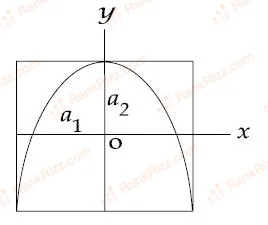
- (B)
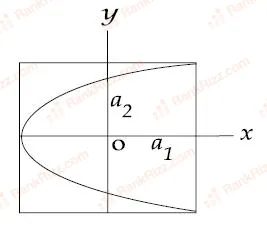
- (C)
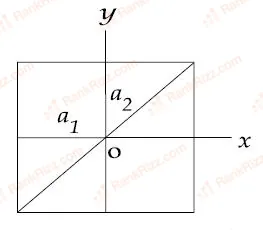
- (D)
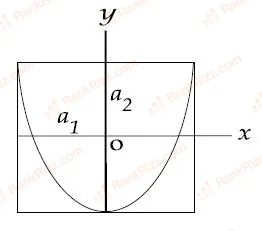
rr2.rankrizz.com/jee-main/physics/oscillations/q/9-apr-2014-online-q14
- (A)
A particle moves with simple harmonic motion in a straight line. In first s, after starting from rest it travels a distance a, and in next s it travels 2a, in same direction, then:
- (A)
Amplitude of motion is 3a
- (B)
Time period of oscillations is
- (C)
Amplitude of motion is 4a
- (D)
Time period of oscillations is
rr2.rankrizz.com/jee-main/physics/oscillations/q/6-apr-2014-offline-q14
- (A)
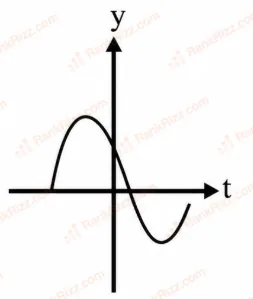
The displacement of a pendulum for is correctly represented by
- (A)
- (B)
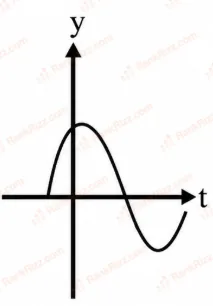
- (C)
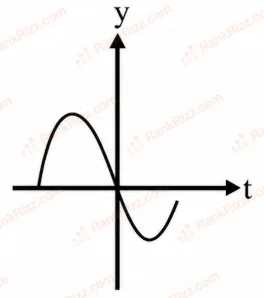
- (D)
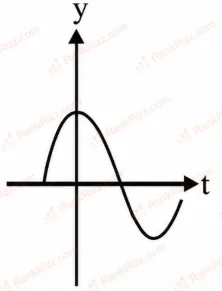
rr2.rankrizz.com/jee-main/physics/oscillations/q/2012-physics-499276
- (A)
Two particles are executing simple harmonic motion of the same amplitude and frequency along the -axis. Their mean position is separated by distance . If the maximum separation between them is , the phase difference between their motion is:
- (A)
- (B)
- (C)
- (D)
rr2.rankrizz.com/jee-main/physics/oscillations/q/2011-physics-499482
- (A)
If and denote the displacement, the velocity and the acceleration of a particle executing simple harmonic motion of time period , then, which of the following does not change with time?
- (A)
- (B)
- (C)
- (D)
rr2.rankrizz.com/jee-main/physics/oscillations/q/2009-physics-499569
- (A)
The displacement of an object attached to a spring and executing simple harmonic motion is given by metres. The time at which the maximum speed first occurs is
- (A)
0.5 s
- (B)
0.75 s
- (C)
0.125 s
- (D)
0.25 s
rr2.rankrizz.com/jee-main/physics/oscillations/q/2007-physics-499754
- (A)
A point mass oscillates along the -axis according to the law . If the acceleration of the particle is written as
- (A)
- (B)
- (C)
- (D)
rr2.rankrizz.com/jee-main/physics/oscillations/q/2007-physics-499755
- (A)
The maximum velocity of a particle, executing simple harmonic motion with an amplitude , is . The period of oscillation is
- (A)
100 s
- (B)
0.01 s
- (C)
10 s
- (D)
0.1 s
rr2.rankrizz.com/jee-main/physics/oscillations/q/2006-physics-499987
- (A)
A coin is placed on a horizontal platform which undergoes vertical simple harmonic motion of angular frequency . The amplitude of oscillation is gradually increased. The coin will leave contact with the platform for the first time
- (A)
at the highest position of the platform
- (B)
at the mean position of the platform
- (C)
for an amplitude of
- (D)
for an amplitude of
rr2.rankrizz.com/jee-main/physics/oscillations/q/2006-physics-499988
- (A)
The function represents
- (A)
a periodic, but not simple harmonic motion with a period
- (B)
a periodic, but not simple harmonic motion with a period
- (C)
a simple harmonic motion with a period
- (D)
a simple harmonic motion with a period
rr2.rankrizz.com/jee-main/physics/oscillations/q/2005-physics-500164
- (A)
Two simple harmonic motions are represented by the equation and . The phase difference of the velocity of particle 1 w.r.t. the velocity of the particle 2 is
- (A)
- (B)
- (C)
- (D)
rr2.rankrizz.com/jee-main/physics/oscillations/q/2005-physics-500166
- (A)
If a simple harmonic motion is represented by , its time period is
- (A)
- (B)
- (C)
- (D)
rr2.rankrizz.com/jee-main/physics/oscillations/q/2005-physics-500168
- (A)
Spring-block oscillations 51
The frequency of oscillation of a mass suspended by a spring is . If the length of the spring is cut to half, the same mass oscillates with frequency . The value of is __________.
- (A)
1
- (B)
2
- (C)
- (D)
rr2.rankrizz.com/jee-main/physics/oscillations/q/8-apr-2026-s2-q37
- (A)
A spring stretches by 2 mm when it is loaded with a mass of 200 g. From equilibrium position the mass is further pulled down by 2 mm and released. The frequency associated with the system and maximum energy in the spring are __________ Hz and __________ J, respectively. (Take m/s)
- (A)
and
- (B)
and 8
- (C)
and
- (D)
and
rr2.rankrizz.com/jee-main/physics/oscillations/q/6-apr-2026-s2-q36
- (A)
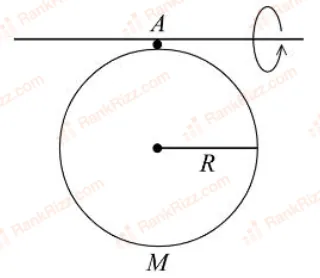
A uniform disc of radius R and mass M is free to oscillate about the axis A as shown in the figure. For small oscillations the time period is ______. ( g is acceleration due to gravity)
- (A)
- (B)
- (C)
- (D)
rr2.rankrizz.com/jee-main/physics/oscillations/q/4-apr-2026-s2-q35
- (A)
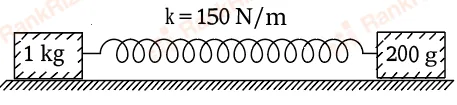
As shown in the figure, a spring is kept in a stretched position with some extension by holding the masses 1 kg and 0.2 kg with a separation more than spring natural length and are released. Assuming the horizontal serface to be frictionless, the angular frequency (in SI unit) of the system is:
- (A)
5
- (B)
20
- (C)
27
- (D)
30
rr2.rankrizz.com/jee-main/physics/oscillations/q/28-jan-2026-s2-q29
- (A)
A spring of force constant 15 N/m is cut into two pieces. If the ratio of their length is 1:3, then the force constant of smaller piece is __ /m.
- (A)
45
- (B)
15
- (C)
60
- (D)
20
rr2.rankrizz.com/jee-main/physics/oscillations/q/24-jan-2026-s1-q35
- (A)
A simple pendulum of string length 30 cm performs 20 oscillations in 10 s. The length of the string required for the pendulum to perfo rm 40 oscillations in the same time duration is _________cm. [Assume that the mass of the pendulum remains same.]
- (A)
120
- (B)
15
- (C)
0.75
- (D)
7.5
rr2.rankrizz.com/jee-main/physics/oscillations/q/23-jan-2026-s1-q32
- (A)
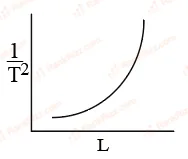
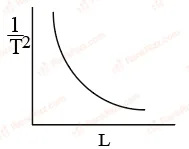
Using a simple pendulum experiment g is determind by measuring its time period T. Which of the following plots represent the correct relation between the pendulum length L and time period T?
- (A)
- (B)
- (C)
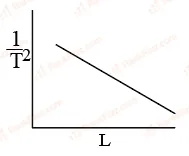
- (D)
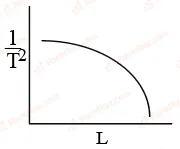
rr2.rankrizz.com/jee-main/physics/oscillations/q/22-jan-2026-s2-q35
- (A)
Two simple pendulums having lengths and with negligible string mass undergo angular displacements and , from their mean positions, respectively. If the angular accelerations of both pendulums are same, then which expression is correct?
- (A)
- (B)
- (C)
- (D)
rr2.rankrizz.com/jee-main/physics/oscillations/q/2025-apr-4-s1-q42
- (A)
Two blocks of masses m and M, , are placed on a frictionless table as shown in figure. A massless spring with spring constant k is attached with the lower block. If the system is slightly displaced and released then ( = coefficient of friction between the two blocks)
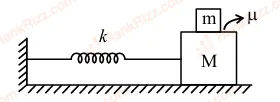
(A) The time period of small oscillation of the two blocks is
(B) The acceleration of the blocks is
(C) The magnitude of the frictional force on upper block is
(D) The maximum amplitude of the upper block, if it does not slip, is
(E) Maximum frictional force can be .
Choose the correct answer from the options given below :- (A)
A, B, D Only
- (B)
B, C, D Only
- (C)
C, D, E Only
- (D)
A, B, C Only
rr2.rankrizz.com/jee-main/physics/oscillations/q/2025-apr-03-s1-q31
- (A)
The time period of simple harmonic motion of mass in the given figure is , where the value of is
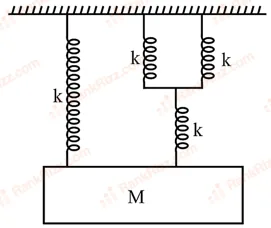
Answer: ____________
rr2.rankrizz.com/jee-main/physics/oscillations/q/31-jan-2024-s2-q24
A rectangular block of mass 5 kg attached to a horizontal spiral spring executes simple harmonic motion of amplitude 1 m and time period 3.14 s. The maximum force exerted by spring on block is _______ N.
Answer: ____________
rr2.rankrizz.com/jee-main/physics/oscillations/q/10-apr-2023-s2-q24
A mass is attached to two springs as shown in figure. The spring constants of two springs are and . For the frictionless surface, the time period of oscillation of mass is
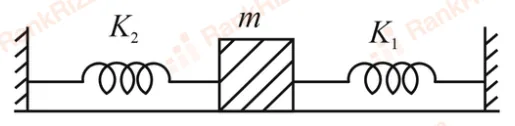
- (A)
- (B)
- (C)
- (D)
rr2.rankrizz.com/jee-main/physics/oscillations/q/6-apr-2023-s1-q4
- (A)
Choose the correct length () versus square of time period () graph for a simple pendulum executing simple harmonic motion.
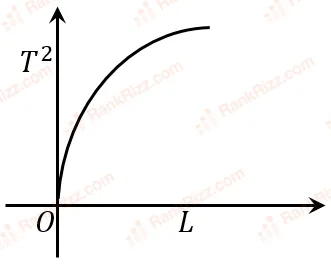
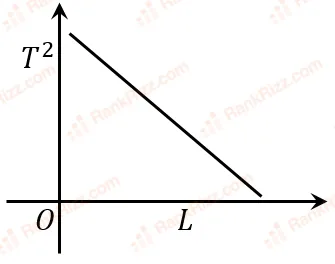
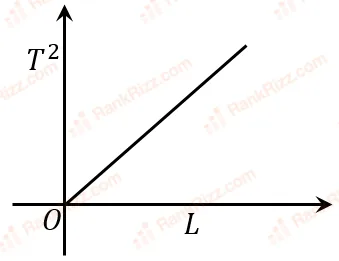
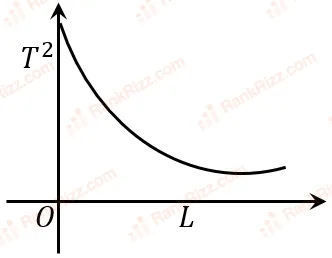
- (A)
Option (1)
- (B)
Option (2)
- (C)
Option (3)
- (D)
Option (4)
rr2.rankrizz.com/jee-main/physics/oscillations/q/01-feb-2023-s2-q9
- (A)
In the figure given below, a block of mass g placed on a frictionless table is connected with two springs having same spring constant ( N m). If the block is horizontally displaced through m then the number of complete oscillations it will make in seconds will be ______.
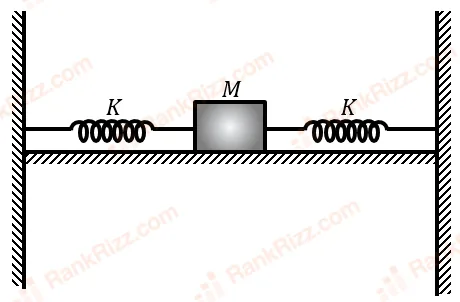
Answer: ____________
rr2.rankrizz.com/jee-main/physics/oscillations/q/31-jan-2023-s1-q25
For a simple harmonic motion in a mass spring system shown, the surface is frictionless. When the mass of the block is kg, the angular frequency is . When the mass block is kg the angular frequency is . The ratio is:

- (A)
- (B)
- (C)
- (D)
rr2.rankrizz.com/jee-main/physics/oscillations/q/30-jan-2023-s2-q9
- (A)
A block of mass 2 kg is attached with two identical springs of spring constant 20 each. The block is placed on a frictionless surface and the ends of the springs are attached to rigid supports (see figure). When the mass is displaced from its equilibrium position, it executes a simple harmonic motion. The time period of oscillation is in SI unit. The value of is _____.
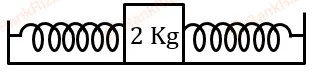
Answer: ____________
rr2.rankrizz.com/jee-main/physics/oscillations/q/24-jan-2023-s1-q25
A block of mass 2 kg is attached with two identical springs of spring constant 20 N m each. The block is placed on a frictionless surface and the ends of the springs are attached to rigid supports (see figure). When the mass is displaced from its equilibrium position, it executes a simple harmonic motion. The time period of oscillation is in SI unit. The value of is _____.
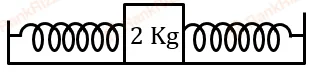
Answer: ____________
rr2.rankrizz.com/jee-main/physics/oscillations/q/24-jan-2023-s1-q25-494040
The time period of oscillation of a simple pendulum of length L suspended from the roof of a vehicle, which moves without friction down an inclined plane of inclination , is given by:
- (A)
- (B)
- (C)
- (D)
rr2.rankrizz.com/jee-main/physics/oscillations/q/29-jul-2022-s1-q10
- (A)
The metallic bob of simple pendulum has the relative density 5. The time period of this pendulum is 10 s. If the metallic bob is immersed in water, then the new time period becomes s. The value of x will be _____
Answer: ____________
rr2.rankrizz.com/jee-main/physics/oscillations/q/29-jul-2022-s2-q25
The potential energy of a particle of mass 4 kg in motion along the x-axis is given by J. The time period of the particle for small oscillation is s. The value of is _____
Answer: ____________
rr2.rankrizz.com/jee-main/physics/oscillations/q/28-jul-2022-s2-q26
A mass , attached to a horizontal spring, executes SHM with an amplitude . When this mass passes through its mean position, then a smaller mass of is placed over it and both masses move together with amplitude . If the ratio is , then the value of will be ______.
Answer: ____________
rr2.rankrizz.com/jee-main/physics/oscillations/q/27-jul-2022-s1-q24
As per given figures, two springs of spring constants and are connected to mass . If the period of oscillation in figure (a) is , then the period of oscillation in figure (b) will be . The value of is ______.
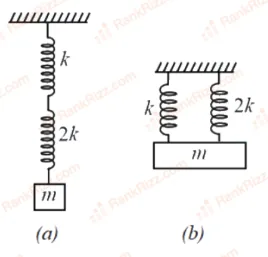
Answer: ____________
rr2.rankrizz.com/jee-main/physics/oscillations/q/26-jul-2022-s2-q24
In figure (A), mass is fixed on mass which is attached to two springs of spring constant . In figure (B), mass is attached to two springs of spring constant and . If mass in (A) and (B) are displaced by distance horizontally and then released, then time period and corresponding to (A) and (B) respectively follow the relation.
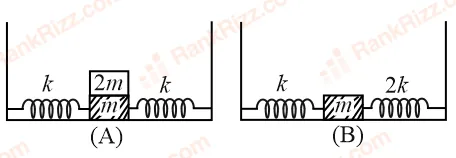
- (A)
- (B)
- (C)
- (D)
rr2.rankrizz.com/jee-main/physics/oscillations/q/25-jul-2022-s1-q9
- (A)
Time period of a simple pendulum in a stationary lift is . If the lift accelerates with vertically upwards then the time period will be
(Where = acceleration due to gravity)- (A)
- (B)
- (C)
- (D)
rr2.rankrizz.com/jee-main/physics/oscillations/q/26-jun-2022-s1-q9
- (A)
Two massless springs with spring constants and , carry g and g masses at their free ends. These two masses oscillate vertically such that their maximum velocities are equal. Then, the ratio of their respective amplitudes will be :
- (A)
- (B)
- (C)
- (D)
rr2.rankrizz.com/jee-main/physics/oscillations/q/24-jun-2022-s2-q9
- (A)
A mass of 5 kg is connected to a spring. The potential energy curve of the simple harmonic motion executed by the system is shown in the figure. A simple pendulum of length 4 m has the same period of oscillation as the spring system. What is the value of acceleration due to gravity on the planet where these experiments are performed?
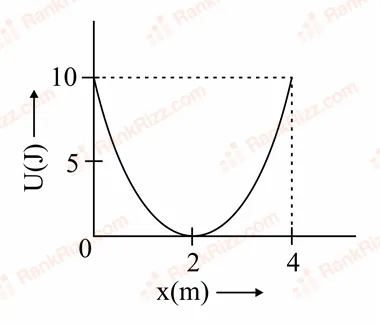
- (A)
4 m s
- (B)
8 m s
- (C)
5 m s
- (D)
10 m s
rr2.rankrizz.com/jee-main/physics/oscillations/q/1-sep-2021-s2-q10
- (A)
A bob of mass suspended by a thread of length undergoes simple harmonic oscillations with time period . If the bob is immersed in a liquid that has density times that of the bob and the length of the thread is increased by rd of the original length, then the time period of the simple harmonic oscillations will be:
- (A)
- (B)
- (C)
- (D)
rr2.rankrizz.com/jee-main/physics/oscillations/q/31-aug-2021-s2-q10
- (A)
In the reported figure, two bodies A and B of masses 200 g and 800 g are attached with the system of springs. Springs are kept in a stretched position with some extension when the system is released. The horizontal surface is assumed to be frictionless. The angular frequency will be ___ rad s when N m.
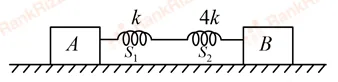
Answer: ____________
rr2.rankrizz.com/jee-main/physics/oscillations/q/25-jul-2021-s1-q23
is the time period of a simple pendulum at a place. If the length of the pendulum is reduced to times of its initial value, the modified time period is
- (A)
- (B)
- (C)
- (D)
rr2.rankrizz.com/jee-main/physics/oscillations/q/22-jul-2021-s1-q8
- (A)
Consider two identical springs each of spring constant and negligible mass compared to the mass as shown. Fig. 1 shows one of them and Fig. 2 shows their series combination. The ratios of time period of oscillation of the two SHM is , where value of is ________. (Round off to the Nearest Integer)
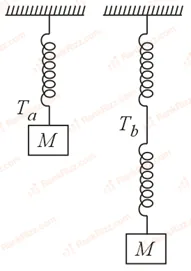
Answer: ____________
rr2.rankrizz.com/jee-main/physics/oscillations/q/17-mar-2021-s1-q25
Two particles and of equal masses are suspended from two massless springs of spring constants and respectively. If the maximum velocities during oscillations are equal, the ratio of the amplitude of and is:
- (A)
- (B)
- (C)
- (D)
rr2.rankrizz.com/jee-main/physics/oscillations/q/17-mar-2021-s2-q10
- (A)
Time period of a simple pendulum is inside a lift when the lift is stationary. If the lift moves upwards with an acceleration , the time period of pendulum will be:
- (A)
- (B)
- (C)
- (D)
rr2.rankrizz.com/jee-main/physics/oscillations/q/16-mar-2021-s1-q9
- (A)
Given below are two statements:
Statement I: A second's pendulum has a time period of 1 second.
Statement II: It takes precisely one second to move between the two extreme positions.
In the light of the above statements, choose the correct answer from the options given below- (A)
Statement I is false but Statement II is true
- (B)
Both Statement I and Statement II are true
- (C)
Both Statement I and Statement II are False
- (D)
Statement I is true but Statement II is false
rr2.rankrizz.com/jee-main/physics/oscillations/q/26-feb-2021-s2-q10
- (A)
If the time period of a two meter long simple pendulum is 2 s, the acceleration due to gravity at the place where pendulum is executing S.H.M. is:
- (A)
m s
- (B)
16 m s
- (C)
m s
- (D)
9.8 m s
rr2.rankrizz.com/jee-main/physics/oscillations/q/25-feb-2021-s1-q9
- (A)
Two identical springs of spring constant are attached to a block of mass and to fixed support (see figure). When the mass is displaced from equilibrium position on either side, it executes simple harmonic motion. The time period of oscillations of this system is:
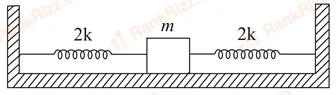
- (A)
- (B)
- (C)
- (D)
rr2.rankrizz.com/jee-main/physics/oscillations/q/25-feb-2021-s2-q6
- (A)
In the given figure, a mass is attached to a horizontal spring which is fixed on one side to a rigid support. The spring constant of the spring is . The mass oscillates on a frictionless surface with time period and amplitude . When the mass is in equilibrium position, as shown in the figure, another mass is gently fixed upon it. The new amplitude of oscillation will be:
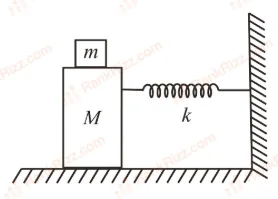
- (A)
- (B)
- (C)
- (D)
rr2.rankrizz.com/jee-main/physics/oscillations/q/24-feb-2021-s1-q11
- (A)
In the given figure, a body of mass is held between two massless springs, on a smooth inclined plane. The free ends of the springs are attached to firm supports. If each spring has spring constant , the frequency of oscillation of given body is:
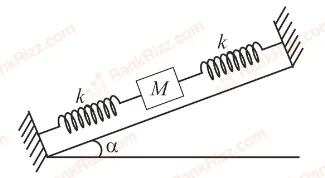
- (A)
- (B)
- (C)
- (D)
rr2.rankrizz.com/jee-main/physics/oscillations/q/24-feb-2021-s2-q7
- (A)
When a particle of mass is attached to a vertical spring of spring constant and released, its motion is described by , where 'y' is measured from the lower end of unstretched spring. Then is:
- (A)
- (B)
- (C)
- (D)
rr2.rankrizz.com/jee-main/physics/oscillations/q/6-sep-2020-s2-q10
- (A)
A block of mass m attached to a massless spring is performing oscillatory motion of amplitude 'A' on a frictionless horizontal plane. If half of the mass of the block breaks off when it is passing through its equilibrium point, the amplitude of oscillation for the remaining system become . The value of is:
- (A)
- (B)
- (C)
- (D)
rr2.rankrizz.com/jee-main/physics/oscillations/q/3-sep-2020-s2-q10
- (A)
A pendulum is executing simple harmonic motion and its maximum kinetic energy is . If the length of the pendulum is doubled and it performs simple harmonic motion with the same amplitude as in the first case, its maximum kinetic energy is
- (A)
- (B)
- (C)
- (D)
rr2.rankrizz.com/jee-main/physics/oscillations/q/11-jan-2019-s2-q13
- (A)
An oscillator of mass M is at rest in its equilibrium position in a potential, . A particle of mass m comes from the right with speed u and collides completely inelastic with M and sticks to it. This process repeats every time the oscillator crosses its equilibrium position. The amplitude of oscillations after 13 collisions is: (M = 10, m = 5, u = 1, k = 1)
- (A)
- (B)
- (C)
- (D)
rr2.rankrizz.com/jee-main/physics/oscillations/q/16-apr-2018-online-q11
- (A)
In an experiment to determine the period of a simple pendulum of length 1 m, it is attached to different spherical bobs of radii and . The two spherical bobs have uniform mass distribution. If the relative difference in the periods, is found to be s, the difference in radii, is best-given by
- (A)
0.01 cm
- (B)
0.05 cm
- (C)
0.5 cm
- (D)
1 cm
rr2.rankrizz.com/jee-main/physics/oscillations/q/9-apr-2017-online-q13
- (A)
A 1 kg block attached to a spring vibrates with a frequency of 1 Hz on a frictionless horizontal table. Two springs identical to the original spring are attached in parallel to a 8 kg block placed on the same table. So, the frequency of vibration of the 8 kg block is:
- (A)
2 Hz
- (B)
Hz
- (C)
Hz
- (D)
Hz
rr2.rankrizz.com/jee-main/physics/oscillations/q/8-apr-2017-online-q13
- (A)
For a simple pendulum, a graph is plotted between its kinetic energy (K.E.) and potential energy (P.E.) against its displacement d. Which one of the following represents these correctly? (graphs are schematic and not drawn to scale)
- (A)
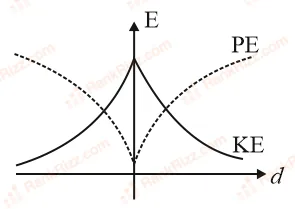
- (B)
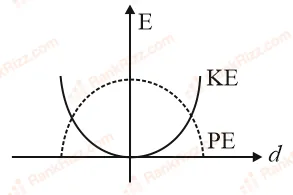
- (C)
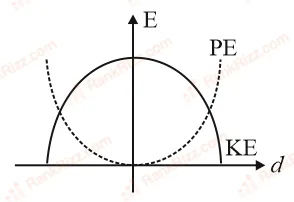
- (D)
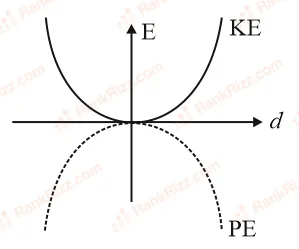
rr2.rankrizz.com/jee-main/physics/oscillations/q/4-apr-2015-offline-q12
- (A)
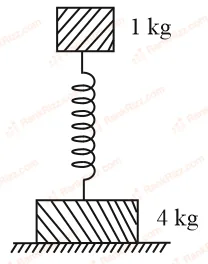
Two bodies of masses 1 kg and 4 kg are connected to a vertical spring, as shown in the figure. The smaller mass executes simple harmonic motion of angular frequency 25 rad s, and amplitude 1.6 cm while the bigger mass remains stationary on the ground. The maximum force exerted by the system on the floor is (take m s).
- (A)
20 N
- (B)
60 N
- (C)
40 N
- (D)
10 N
rr2.rankrizz.com/jee-main/physics/oscillations/q/9-apr-2014-online-q12
- (A)
A uniform cylinder of length L and mass M having cross-sectional area A is suspended, with its length vertical, from a fixed point by a massless spring, such that it is half submerged in a liquid of density at equilibrium position. When the cylinder is given a downward push and released, it starts oscillating vertically with a small amplitude. The time period T of the oscillations of the cylinder will be :
- (A)
Smaller than
- (B)
- (C)
Larger than
- (D)
rr2.rankrizz.com/jee-main/physics/oscillations/q/25-apr-2013-online-q10
- (A)
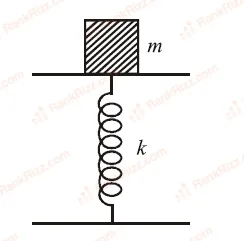
A mass kg is put on a flat pan attached to a vertical spring fixed on the ground. The mass of the spring and the pan is negligible. When pressed slightly and released, the mass executes simple harmonic motion. The spring constant is 500 N/m. What is the amplitude A of the motion, so that the mass m tends to get detached from the pan? (Take m/s). The spring is stiff enough so that it does not get distorted during the motion.
- (A)
A 2.0 cm
- (B)
A = 2.0 cm
- (C)
A < 2.0 cm
- (D)
A = 1.5 cm
rr2.rankrizz.com/jee-main/physics/oscillations/q/22-apr-2013-online-q12
- (A)
Two simple pendulums of length 1 m and 4 m respectively are both given small displacement in the same direction at the same instant. They will be again in phase after the shorter pendulum has completed number of oscillations equal to:
- (A)
2
- (B)
7
- (C)
5
- (D)
3
rr2.rankrizz.com/jee-main/physics/oscillations/q/9-apr-2013-online-q11
- (A)
A mass , attached to a horizontal spring, executes S.H.M. with amplitude . When the mass passes through its mean position then a smaller mass is placed over it and both of them move together with amplitude . The ratio of is:
- (A)
- (B)
- (C)
- (D)
rr2.rankrizz.com/jee-main/physics/oscillations/q/2011-physics-499483
- (A)
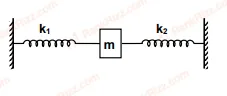
Two springs, of force constants and , are connected to a mass as shown. The frequency of oscillation of the mass is . If both and are made four times their original values, the frequency of oscillation becomes
- (A)
- (B)
- (C)
- (D)
rr2.rankrizz.com/jee-main/physics/oscillations/q/2007-physics-499756
- (A)
A particle at the end of a spring executes simple harmonic motion with a period , while the corresponding period for another spring is . If the period of oscillation with the two springs in series is , then
- (A)
- (B)
- (C)
- (D)
rr2.rankrizz.com/jee-main/physics/oscillations/q/2004-physics-500207
- (A)
Energy in simple harmonic motion 17
The kinetic energy of a simple harmonic oscillator is oscillating with angular frequency of 176 rad/ s. The frequency of this simple harmonic oscillator is _____Hz. [take ]
- (A)
28
- (B)
88
- (C)
176
- (D)
14
rr2.rankrizz.com/jee-main/physics/oscillations/q/21-jan-2026-s2-q26
- (A)
Given below are two statements. One is labelled as Assertion (A) and the other is labelled as Reason (R). Assertion (A) : Knowing initial position and initial momentum is enough to determine the position and momentum at any time for a simple harmonic motion with a given angular frequency . Reason (R): The amplitude and phase can be expressed in terms of and . In the light of the above statements, choose the correct answer from the options given below :
- (A)
(A) is false but (R) is true
- (B)
(A) is true but (R) is false
- (C)
Both (A) and (R) are true but (R) is NOT the correct explanation of (A)
- (D)
Both (A) and (R) are true and (R) is the correct explanation of (A)
rr2.rankrizz.com/jee-main/physics/oscillations/q/28-jan-2025-s2-q35
- (A)
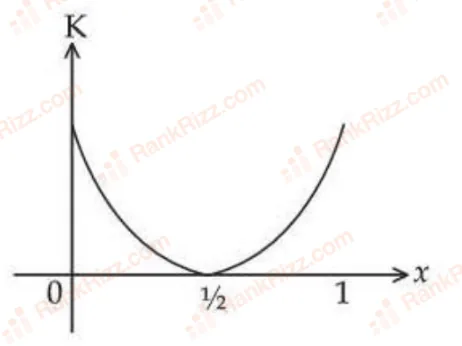
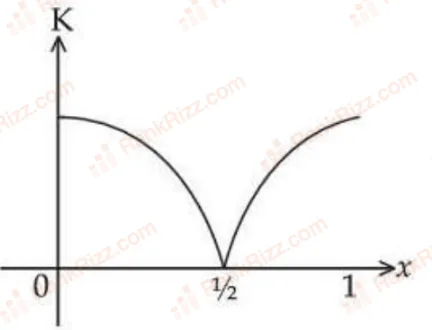
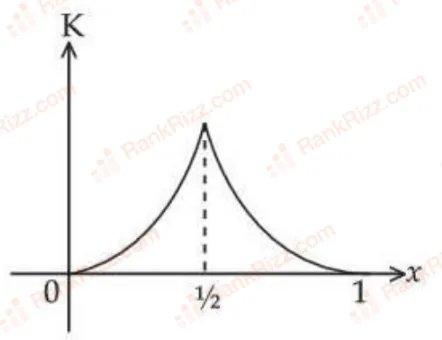
A particle oscillates along the -axis according to the law, where . The kinetic energy of the particle as a function of is correctly represented by the graph
- (A)
- (B)
- (C)
- (D)
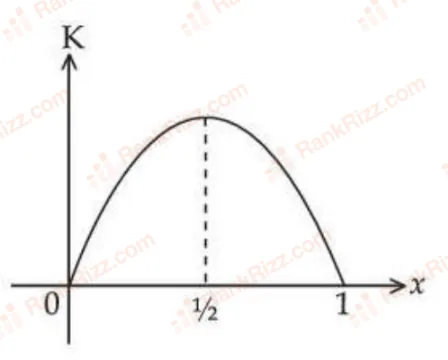
rr2.rankrizz.com/jee-main/physics/oscillations/q/24-jan-2025-s2-q36
- (A)
An object of mass 0.2 kg executes simple harmonic motion along x axis with frequency of Hz. At the position m the object has kinetic energy 0.5 J and potential energy 0.4 J. The amplitude of oscillation is _____ cm.
Answer: ____________
rr2.rankrizz.com/jee-main/physics/oscillations/q/8-apr-2024-s2-q24
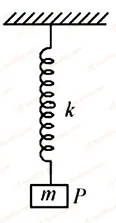
In simple harmonic motion, the total mechanical energy of given system is . If mass of oscillating particle is doubled then the new energy of the system for same amplitude is
- (A)
- (B)
- (C)
- (D)
rr2.rankrizz.com/jee-main/physics/oscillations/q/04-apr-2024-s2-q10
- (A)
When the displacement of a simple harmonic oscillator is one third of its amplitude, the ratio of total energy to the kinetic energy is , where _______.
Answer: ____________
rr2.rankrizz.com/jee-main/physics/oscillations/q/29-jan-2024-s1-q24
For a body executing S.H.M.:
(a) Potential energy is always equal to its K.E.
(b) Average potential and kinetic energy over any given time interval are always equal.
(c) Sum of the kinetic and potential energy at any point of time is constant.
(d) Average K.E. in one time period is equal to average potential energy in one time period.
Choose the most appropriate option from the options given below:- (A)
(c) and (d)
- (B)
only (c)
- (C)
only (b)
- (D)
(b) and (c)
rr2.rankrizz.com/jee-main/physics/oscillations/q/31-aug-2021-s2-q11
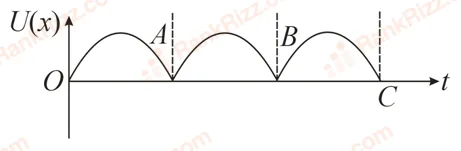
- (A)
The variation of displacement with time of a particle executing free simple harmonic motion is shown in the figure.
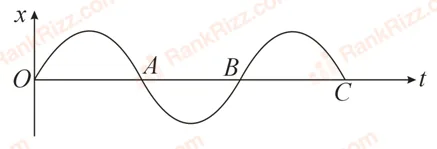
The potential energy versus time plot of the particle is correctly shown in figure:- (A)
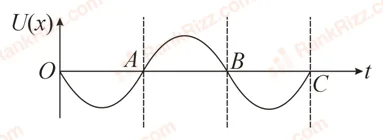
- (B)
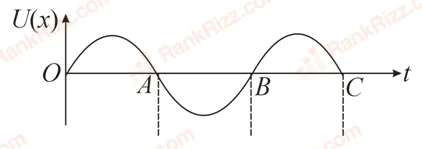
- (C)
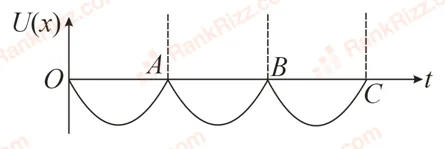
- (D)
rr2.rankrizz.com/jee-main/physics/oscillations/q/27-aug-2021-s1-q9
- (A)
In a simple harmonic oscillation, what fraction of total mechanical energy is in the form of kinetic energy, when the particle is midway between mean and extreme position.
- (A)
- (B)
- (C)
- (D)
rr2.rankrizz.com/jee-main/physics/oscillations/q/25-jul-2021-s2-q10
- (A)
A particle is making simple harmonic motion along the X-axis. If at distances and from the mean position the velocities of the particle are and , respectively. The time period of its oscillation is given as:
- (A)
- (B)
- (C)
- (D)
rr2.rankrizz.com/jee-main/physics/oscillations/q/20-jul-2021-s2-q13
- (A)
For what value of displacement the kinetic energy and potential energy of a simple harmonic oscillation become equal?
- (A)
- (B)
- (C)
- (D)
rr2.rankrizz.com/jee-main/physics/oscillations/q/17-mar-2021-s1-q11
- (A)
The displacement time graph of a particle executing SHM is given in figure: (sketch is schematic and not to scale)
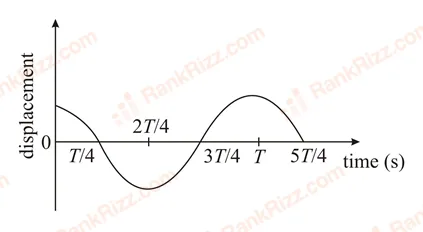
Which of the following statements is/are true for this motion?
(A) The force is zero at
(B) The magnitude of acceleration is maximum at
(C) The speed is maximum at
(D) The P.E. is equal to K.E. of the oscillation at- (A)
(A), (B) and (C)
- (B)
(B), (C) and (D)
- (C)
(A), (B) and (D)
- (D)
(A) and (D)
rr2.rankrizz.com/jee-main/physics/oscillations/q/2-sep-2020-s2-q8
- (A)
A particle undergoing simple harmonic motion has time dependent displacement given by . The ratio of kinetic to potential energy of this particle at s will be
- (A)
- (B)
1
- (C)
2
- (D)
rr2.rankrizz.com/jee-main/physics/oscillations/q/11-jan-2019-s1-q12
- (A)
A particle is executing simple harmonic motion (SHM) of amplitude , along the -axis, about . When its potential Energy (PE) equal kinetic energy (KE), the position of the particle will be:
- (A)
- (B)
- (C)
- (D)
rr2.rankrizz.com/jee-main/physics/oscillations/q/9-jan-2019-s2-q11
- (A)
A particle of mass executes simple harmonic motion with amplitude '' and frequency ''. The average kinetic energy during its motion from the position of equilibrium to the end is
- (A)
- (B)
- (C)
- (D)
rr2.rankrizz.com/jee-main/physics/oscillations/q/2007-physics-499757
- (A)
Starting from the origin, a body oscillates simple harmonically with a period of . After what time will its kinetic energy be 75% of the total energy?
- (A)
- (B)
- (C)
- (D)
rr2.rankrizz.com/jee-main/physics/oscillations/q/2006-physics-499986
- (A)
The total energy of particle, executing simple harmonic motion is
- (A)
- (B)
- (C)
independent of
- (D)
rr2.rankrizz.com/jee-main/physics/oscillations/q/2004-physics-500209
- (A)
Simple, compound and torsional pendulums 14
Given below are two statements. One is labelled as Assertion (A) and the other is labelled as Reason (R). Assertion (A) : A simple pendulum is taken to a planet of mass and radius, 4 times and 2 times, respectively, than the Earth. The time period of the pendulum remains same on earth and the planet. Reason (R): The mass of the pendulum remains unchanged at Earth and the other planet. In the light of the above statements, choose the correct answer from the options given below :
- (A)
(A)is false but (R) is true
- (B)
(A) is true but (R) is false
- (C)
Both (A) and (R) are true but (R) is the correct explanation of (A)
- (D)
Both (A) and (R) are true but (R) is NOT the correct explanation of (A)
rr2.rankrizz.com/jee-main/physics/oscillations/q/22-jan-2025-s2-q38
- (A)
A simple pendulum doing small oscillations at a place R height above earth surface has time period of . would be its time period if it is brought to a point which is at a height from earth surface. Choose the correct relation :
- (A)
- (B)
- (C)
- (D)
rr2.rankrizz.com/jee-main/physics/oscillations/q/5-apr-2024-s1-q7
- (A)
is the time period of simple pendulum on the earth's surface. If time period becomes when taken to a height (equal to earth's radius) above the earth's surface. Then, the value of will be:
- (A)
4
- (B)
2
- (C)
- (D)
rr2.rankrizz.com/jee-main/physics/oscillations/q/25-jan-2023-s1-q6
- (A)
Assume there are two identical simple pendulum Clocks-1 is placed on the earth and Clock-2 is placed on a space station located at a height h above the earth surface. Clock-1 and Clock-2 operate at time periods 4 s and 6 s respectively. Then the value of h is (consider radius of earth km and on earth )
- (A)
1200 km
- (B)
1600 km
- (C)
3200 km
- (D)
4800 km
rr2.rankrizz.com/jee-main/physics/oscillations/q/28-jul-2022-s2-q5
- (A)
A ring is hung on a nail. It can oscillate, without slipping or sliding (i) in its plane with a time period and (ii) back and forth in a direction perpendicular to its plane, with a period . The ratio will be:
- (A)
- (B)
- (C)
- (D)
rr2.rankrizz.com/jee-main/physics/oscillations/q/5-sep-2020-s2-q8
- (A)
A simple pendulum oscillating in air has period T. The bob of the pendulum is completely immersed in a non-viscous liquid. The density of the liquid is th of the material of the bob. If the bob is inside liquid all the time, its period of oscillation in this liquid is:
- (A)
- (B)
- (C)
- (D)
rr2.rankrizz.com/jee-main/physics/oscillations/q/9-apr-2019-s1-q13
- (A)
Two light identical springs of spring constant k are attached horizontally at the two ends of a uniform horizontal rod AB of length l and mass m. The rod is pivoted at its center 'O' and can rotate freely in horizontal plane. The other ends of the two springs are fixed to rigid supports as shown in figure. The rod is gently pushed through a small angle and released. The frequency of resulting oscillation is:
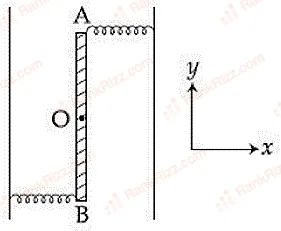
- (A)
- (B)
- (C)
- (D)
rr2.rankrizz.com/jee-main/physics/oscillations/q/12-jan-2019-s1-q11
- (A)
The mass and the diameter of a planet are three times the respective values for the Earth. The period of oscillation of a simple pendulum on the Earth is 2 s. The period of oscillation of the same pendulum on the planet would be:
- (A)
s
- (B)
s
- (C)
s
- (D)
s
rr2.rankrizz.com/jee-main/physics/oscillations/q/11-jan-2019-s2-q7
- (A)
A rod of mass and length is suspended at its middle by a wire. It exhibits torsional oscillations. If two masses, each of mass , are attached at a distance from its centre on both sides, it reduces the oscillation frequency by 20%. The value of ratio is close to:
- (A)
0.17
- (B)
0.77
- (C)
0.57
- (D)
0.37
rr2.rankrizz.com/jee-main/physics/oscillations/q/9-jan-2019-s2-q12
- (A)
A pendulum made of a uniform wire of cross sectional area A has time period T. When an additional mass M is added to its bob, the time period changes to . If the Young's modulus of the material of the wire is , then is equal to: ( = gravitational acceleration)
- (A)
- (B)
- (C)
- (D)
rr2.rankrizz.com/jee-main/physics/oscillations/q/4-apr-2015-offline-q8
- (A)
Bob of a simple pendulum of length is made of iron. The pendulum is oscillating over a horizontal coil carrying direct current. If the time period of the pendulum is T then :
- (A)
and damping is smaller than in air alone.
- (B)
and damping is larger than in air alone.
- (C)
and damping is smaller than in air alone.
- (D)
and damping is larger than in air alone.
rr2.rankrizz.com/jee-main/physics/oscillations/q/23-apr-2013-online-q13
- (A)
A ring is suspended from a point on its rim as shown in the figure. When displaced from equilibrium, it oscillates with time period of second. The radius of the ring is (take )
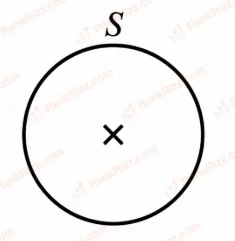
- (A)
m
- (B)
m
- (C)
m
- (D)
m
rr2.rankrizz.com/jee-main/physics/oscillations/q/2012-physics-499278
- (A)
The bob of a simple pendulum is a spherical hollow ball filled with water. A plugged hole near the bottom of the oscillation bob gets suddenly unplugged. During observation, till water is coming out, the time period of oscillation would
- (A)
first increase and then decrease to the original value.
- (B)
first decreased then increase to the original value.
- (C)
remain unchanged.
- (D)
increase towards a saturation value.
rr2.rankrizz.com/jee-main/physics/oscillations/q/2005-physics-500170
- (A)
The bob of a simple pendulum executes simple harmonic motion in water with a period , while the period of oscillation of the bob is in air. Neglecting frictional force of water and given that the density of the bob is . What relationship between and is true?
- (A)
- (B)
- (C)
- (D)
rr2.rankrizz.com/jee-main/physics/oscillations/q/2004-physics-500205
- (A)
Damped and forced oscillations and resonance 14
A block of mass 1 kg attached to a spring is made to oscillate with an initial amplitude of 12 cm. After 2 minutes the amplitude decreases to 6 cm. Determine the value of the damping constant for this motion. (take )
- (A)
kg s
- (B)
kg s
- (C)
kg s
- (D)
kg s
rr2.rankrizz.com/jee-main/physics/oscillations/q/17-mar-2021-s2-q9
- (A)
The amplitude of a mass-spring system, which is executing simple harmonic motion decreases with time. If mass = 500 g, Decay constant = 20 g s then how much time is required for the amplitude of the system to drop to half of its initial value? ()
- (A)
34.65 s
- (B)
17.32 s
- (C)
0.034 s
- (D)
15.1 s
rr2.rankrizz.com/jee-main/physics/oscillations/q/16-mar-2021-s2-q8
- (A)
The displacement of a damped harmonic oscillator is given by . Here t is in seconds. The time taken for its amplitude of vibration to drop to half of its initial value is close to:
- (A)
27 s
- (B)
4 s
- (C)
13 s
- (D)
7 s
rr2.rankrizz.com/jee-main/physics/oscillations/q/10-apr-2019-s1-q11
- (A)
A damped harmonic oscillator has a frequency of 5 oscillations per second. The amplitude drops to half its value for every 10 oscillations. The time it will take to drop to of the original amplitude is close to:
- (A)
50 s
- (B)
100 s
- (C)
20 s
- (D)
10 s
rr2.rankrizz.com/jee-main/physics/oscillations/q/8-apr-2019-s2-q13
- (A)
A simple pendulum of length 1 m is oscillating with an angular frequency 10 rad/s. The support of the pendulum starts oscillating up and down with a small angular frequency of 1 rad/s and an amplitude of m. The relative change in the angular frequency of the pendulum is best given by:
- (A)
rad/s
- (B)
1 rad/s
- (C)
rad/s
- (D)
rad/s
rr2.rankrizz.com/jee-main/physics/oscillations/q/11-jan-2019-s2-q14
- (A)
A block of mass 0.1 kg is connected to an elastic spring of spring constant 640 N m and oscillates in a damping medium of damping constant kg s. The system dissipates its energy gradually. The time taken for its mechanical energy of vibration to drop to half of its initial value, is closest to-
- (A)
2 s
- (B)
5 s
- (C)
3 s
- (D)
7 s
rr2.rankrizz.com/jee-main/physics/oscillations/q/9-apr-2017-online-q12
- (A)
A pendulum with the time period of 1 s is losing energy due to damping. At a certain time, its energy is 45 J. If after completing 15 oscillations its energy has become 15 J, then its damping constant (in s) will be
- (A)
- (B)
- (C)
- (D)
2
rr2.rankrizz.com/jee-main/physics/oscillations/q/11-apr-2015-online-q12
- (A)
A simple harmonic oscillator of angular frequency 2 rad s is acted upon by an external force N. If the oscillator is at rest in its equilibrium position at , its position at later times is proportional to:
- (A)
- (B)
- (C)
- (D)
rr2.rankrizz.com/jee-main/physics/oscillations/q/10-apr-2015-online-q13
- (A)
The angular frequency of the damped oscillator is given by, where k is the spring constant, m is the mass of the oscillator and r is the damping constant. If the ratio is 8%, the change in time period compared to the undamped oscillator is approximately as follows:
- (A)
increases by 1%
- (B)
increases by 8%
- (C)
decreases by 1%
- (D)
decreases by 8%
rr2.rankrizz.com/jee-main/physics/oscillations/q/11-apr-2014-online-q14
- (A)
The amplitude of a simple pendulum, oscillating in air with a small spherical bob, decreases from 10 cm to 8 cm in 40 seconds. Assuming that Stokes law is valid, and ratio of the coefficient of viscosity of air to that of carbon dioxide is 1.3, the time in which amplitude of this pendulum will reduce from 10 cm to 5 cm in carbondioxide will be close to (ln 5 = 1.601, ln 2 = 0.693).
- (A)
231 s
- (B)
142 s
- (C)
208 s
- (D)
161 s
rr2.rankrizz.com/jee-main/physics/oscillations/q/9-apr-2014-online-q13
- (A)
The amplitude of a damped oscillator decreases to 0.9 times its original magnitude in 5s. In another 10s it will decrease to times its original magnitude, where equals :
- (A)
0.729
- (B)
0.6
- (C)
0.7
- (D)
0.81
rr2.rankrizz.com/jee-main/physics/oscillations/q/7-apr-2013-offline-q21
- (A)
If a simple pendulum has significant amplitude (up to a factor of of original) only in the period between to , then may be called the average life of the pendulum. When the spherical bob of the pendulum suffers a retardation (due to viscous drag) proportional to its velocity, with as the constant of proportionality, the average life time of the pendulum is (assuming damping is small) in seconds:
- (A)
- (B)
- (C)
- (D)
rr2.rankrizz.com/jee-main/physics/oscillations/q/2012-physics-499030
- (A)
A particle of mass is attached to a spring (of spring constant ) and has a natural angular frequency . An external force proportional to is applied to the oscillator. The time displacement of the oscillator will be proportional to
- (A)
- (B)
- (C)
- (D)
rr2.rankrizz.com/jee-main/physics/oscillations/q/2004-physics-500211
- (A)
In forced oscillation of a particle the amplitude is maximum for a frequency of the force, while the energy is maximum for a frequency of the force, then
- (A)
- (B)
- (C)
when damping is small and when damping is large
- (D)
rr2.rankrizz.com/jee-main/physics/oscillations/q/2004-physics-500213
- (A)
SHM of floating bodies, liquids, gases and charged systems 5
A cylindrical block of mass M and area of cross section A is floating in a liquid of density and with its axis vertical. When depressed a little and released the block starts oscillating. The period of oscillation is ___
- (A)
- (B)
- (C)
- (D)
rr2.rankrizz.com/jee-main/physics/oscillations/q/24-jan-2026-s1-q30
- (A)
A light hollow cube of side length 10 cm and mass 10 g , is floating in water. It is pushed down and released to execute simple harmonic oscillations. The time period of oscillations is , where the value of y is (Acceleration due to gravity, , density of water
- (A)
6
- (B)
2
- (C)
4
- (D)
1
rr2.rankrizz.com/jee-main/physics/oscillations/q/23-jan-2025-s1-q41
- (A)
A cylindrical plastic bottle of negligible mass is filled with 310 ml of water and left floating in a pond with still water. If pressed downward slightly and released, it starts performing simple harmonic motion at angular frequency . If the radius of the bottle is 2.5 cm then is close to: (density of water kg/m)
- (A)
5.00 rad sec
- (B)
2.50 rad sec
- (C)
7.9 rad sec
- (D)
3.75 rad sec
rr2.rankrizz.com/jee-main/physics/oscillations/q/10-jan-2019-s2-q14
- (A)
A cylindrical block of wood (density = 650 kg m), of base area 30 cm and height 54 cm, floats in a liquid of density 900 kg m. The block is depressed slightly and then released. The time period of the resulting oscillations of the block would be equal to that of a simple pendulum of length (nearly):
- (A)
52 cm
- (B)
26 cm
- (C)
39 cm
- (D)
65 cm
rr2.rankrizz.com/jee-main/physics/oscillations/q/11-apr-2015-online-q13
- (A)
An ideal gas enclosed in a vertical cylindrical container supports a freely moving piston of mass M. The piston and the cylinder have equal cross-sectional area A. When the piston is in equilibrium, the volume of the gas is and its pressure is . The piston is slightly displaced from the equilibrium position and released. Assuming that the system is completely isolated from its surrounding, the piston executes a simple harmonic motion with frequency
[Assume the system is in space.]- (A)
- (B)
- (C)
- (D)
rr2.rankrizz.com/jee-main/physics/oscillations/q/7-apr-2013-offline-q11
- (A)
Superposition of SHMs 3
The amplitude of the vibrating particle due to superposition of two SHMs
and
.
- (A)
- (B)
- (C)
- (D)
rr2.rankrizz.com/jee-main/physics/oscillations/q/2026-physics-515783
- (A)
Two simple harmonic motion, are represented by the equations
;
Ratio of amplitude of to = : 1. The value of is _________.Answer: ____________
rr2.rankrizz.com/jee-main/physics/oscillations/q/27-aug-2021-s2-q24
A simple harmonic motion is represented by: cm. The amplitude and time period of the motion are:
- (A)
5 cm, s
- (B)
10 cm, s
- (C)
5 cm, s
- (D)
10 cm, s
rr2.rankrizz.com/jee-main/physics/oscillations/q/12-jan-2019-s2-q12
- (A)
Answer key
- 01 C
- 02 A
- 03 44
- 04 A
- 05 2
- 06 A
- 07 A
- 08 B
- 09 D
- 10 17
- 11 —
- 12 12
- 13 10
- 14 3
- 15 7
- 16 2
- 17 12
- 18 C
- 19 C
- 20 4
- 21 A
- 22 B
- 23 C
- 24 B
- 25 D
- 26 B
- 27 —
- 28 2
- 29 C
- 30 8
- 31 88
- 32 40
- 33 D
- 34 1
- 35 B
- 36 700
- 37 C
- 38 A
- 39 C
- 40 A
- 41 1
- 42 8
- 43 2
- 44 D
- 45 A
- 46 2
- 47 D
- 48 D
- 49 D
- 50 3
- 51 7
- 52 B
- 53 C
- 54 B
- 55 A
- 56 A
- 57 C
- 58 C
- 59 D
- 60 A
- 61 B
- 62 D
- 63 B
- 64 C
- 65 D
- 66 D
- 67 D
- 68 D
- 69 A
- 70 D
- 71 B
- 72 A
- 73 D
- 74 B
- 75 C
- 76 D
- 77 A
- 78 B
- 79 C
- 80 A
- 81 A
- 82 D
- 83 C
- 84 D
- 85 B
- 86 D
- 87 A
- 88 12
- 89 20
- 90 A
- 91 C
- 92 20
- 93 B
- 94 5
- 95 5
- 96 A
- 97 5
- 98 2
- 99 16
- 100 2
- 101 A
- 102 C
- 103 A
- 104 A
- 105 B
- 106 10
- 107 D
- 108 2
- 109 D
- 110 D
- 111 A
- 112 A
- 113 A
- 114 D
- 115 D
- 116 C
- 117 A
- 118 A
- 119 B
- 120 —
- 121 D
- 122 C
- 123 B
- 124 C
- 125 A
- 126 A
- 127 C
- 128 D
- 129 B
- 130 D
- 131 D
- 132 D
- 133 6
- 134 A
- 135 9
- 136 A
- 137 D
- 138 B
- 139 D
- 140 C
- 141 A
- 142 D
- 143 D
- 144 A
- 145 B
- 146 C
- 147 D
- 148 D
- 149 B
- 150 C
- 151 A
- 152 C
- 153 C
- 154 D
- 155 D
- 156 B
- 157 D
- 158 A
- 159 A
- 160 C
- 161 A
- 162 A
- 163 D
- 164 C
- 165 A
- 166 D
- 167 C
- 168 C
- 169 A
- 170 D
- 171 A
- 172 D
- 173 B
- 174 A
- 175 A
- 176 B
- 177 C
- 178 C
- 179 A
- 180 B
- 181 1
- 182 B
“—” marks a question whose key we have not checked yet; its page shows the latest on it.
Past questions are reproduced with their sitting. Not affiliated with NTA or the IITs. Every question, online and free: rr2.rankrizz.com/jee-main/physics/oscillations