Every Oscillations question JEE Main has set from 2004–2026, grouped by the idea it tests rather than the order of the syllabus. 182 questions across 7 distinct ideas. Free to read, answer key on every one.
JEE MAIN 2023 · 13 APR S1SHM: equation, phase, velocity and acceleration
At a given point of time the value of displacement of a simple harmonic oscillator is given as y=Acos(30°). If amplitude is 40 cm and kinetic energy at that time is 200 J, the value of force constant is 1.0×10x N m−1. The value of x is _____.
JEE MAIN 2023 · 12 APR S1SHM: equation, phase, velocity and acceleration
A particle is executing simple harmonic motion (SHM). The ratio of potential energy and kinetic energy of the particle when its displacement is half of its amplitude will be
JEE MAIN 2023 · 11 APR S1SHM: equation, phase, velocity and acceleration
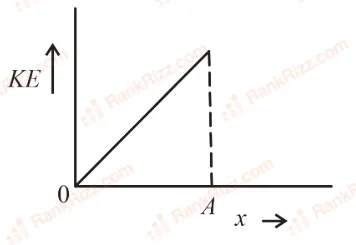
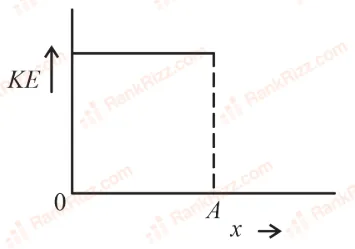
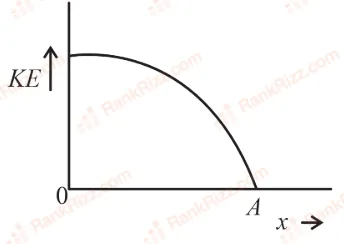
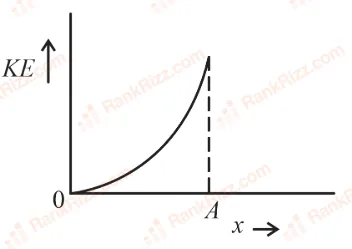
The variation of kinetic energy (KE) of a particle executing simple harmonic motion with the displacement (x) starting from mean position to extreme position (A) is given by
JEE MAIN 2023 · 10 APR S1SHM: equation, phase, velocity and acceleration
A particle executes S.H.M. of amplitude A along x-axis. At t=0, the position of the particle is x=2A and it moves along positive x-axis. The displacement of particle in time t is x=Asin(ωt+δ), then the value δ will be
JEE MAIN 2023 · 10 APR S2Spring-block oscillations
A rectangular block of mass 5 kg attached to a horizontal spiral spring executes simple harmonic motion of amplitude 1 m and time period 3.14 s. The maximum force exerted by spring on block is _______ N.
JEE MAIN 2023 · 08 APR S2SHM: equation, phase, velocity and acceleration
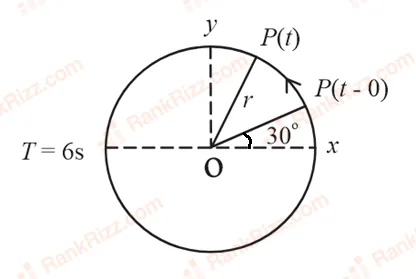
For particle P revolving round the centre O with radius of circular path r and angular velocity ω, as shown in below figure, the projection of OP on the x-axis at time t is
JEE MAIN 2023 · 06 APR S1Spring-block oscillations
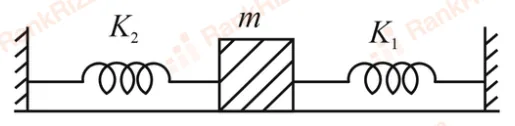
A mass m is attached to two springs as shown in figure. The spring constants of two springs are K1 and K2. For the frictionless surface, the time period of oscillation of mass m is
JEE MAIN 2023 · 06 APR S2SHM: equation, phase, velocity and acceleration
A simple pendulum with length 100 cm and bob of mass 250 g is executing S.H.M of amplitude 10 cm. The maximum tension in the string is found to be 40x N. The value of x is ______.
JEE MAIN 2023 · 01 FEB S1SHM: equation, phase, velocity and acceleration
The amplitude of a particle executing SHM is 3 cm. The displacement at which its kinetic energy will be 25% more than the potential energy is: _____ cm.
JEE MAIN 2023 · 31 JAN S1SHM: equation, phase, velocity and acceleration
The maximum potential energy of a block executing simple harmonic motion is 25 J. A is amplitude of oscillation. At 2A, the kinetic energy of the block is
JEE MAIN 2023 · 31 JAN S1Spring-block oscillations
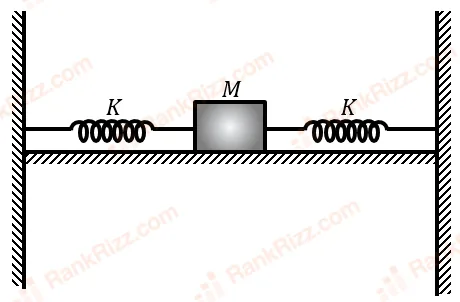
In the figure given below, a block of mass M=490 g placed on a frictionless table is connected with two springs having same spring constant (K=2 N m−1). If the block is horizontally displaced through X m then the number of complete oscillations it will make in 14π seconds will be ______.
JEE MAIN 2023 · 30 JAN S1SHM: equation, phase, velocity and acceleration
The general displacement of a simple harmonic oscillator is x=Asinωt. Let T be its time period. The slope of its potential energy (U) - time (t) curve will be maximum when t=βT. The value of β is ______.
JEE MAIN 2023 · 30 JAN S2Spring-block oscillations
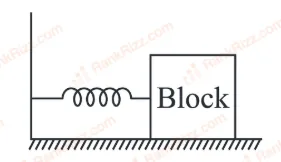
For a simple harmonic motion in a mass spring system shown, the surface is frictionless. When the mass of the block is 1 kg, the angular frequency is ω1. When the mass block is 2 kg the angular frequency is ω2. The ratio ω1ω2 is:
JEE MAIN 2023 · 30 JAN S2SHM: equation, phase, velocity and acceleration
The velocity of a particle executing SHM varies with displacement (x) as 4v2=50−x2. The time period of oscillations is 7x s. The value of x is ______. [Take π=722]
JEE MAIN 2023 · 29 JAN S2SHM: equation, phase, velocity and acceleration
A particle of mass 250 g executes a simple harmonic motion under a periodic force F=(−25x) N. The particle attains a maximum speed of 4 m s−1 during its oscillation. The amplitude of the motion is ______ cm.
JEE MAIN 2023 · 25 JAN S1Simple, compound and torsional pendulums
T is the time period of simple pendulum on the earth's surface. If time period becomes xT when taken to a height R (equal to earth's radius) above the earth's surface. Then, the value of x will be:
JEE MAIN 2023 · 25 JAN S2SHM: equation, phase, velocity and acceleration
A particle executes simple harmonic motion between x=−A and x=+A. If time taken by particle to go from x=0 to 2A is 2 s; then time taken by particle in going from x=2A to A is: