RankRizz

Oscillations — JEE Advanced Previous Year Questions

Oscillations has been asked in 13 of the 20 JEE Advanced years from 2007 to 2026: 27 questions in all. In 2026 it averaged 0.5 questions per paper (1 across 2 papers), 2.9% of Physics questions, down from 9.4% in 2025. Across the last 20 papers it carried 3.1% of Physics questions. By type: 14 single-correct, 8 numerical, 4 multiple-correct and 1 match-the-list. Of the 27 with a difficulty tag, 11% are easy, 63% medium and 26% hard. Most asked: Spring-block oscillations (22, 81%), SHM: equation, phase, velocity and acceleration (2, 7%) and Superposition of SHMs (1, 4%).

DATA UPDATED

Questions

27

Distinct ideas

5

Share of marks

3.1%

Difficulty

MEDIUM

Oscillations weightage, year by year

The share of each year’s Physics questions that came from Oscillations, counted from the 19 papers we hold for the last 10 years, and paper by paper inside a year.

Rising: 7.0% of Physics questions in 2024–2026, up from 1.3% in 2017–2023. Its heaviest year was 2025, at 9.4%. Not asked at all in 2017, 2019, 2020, 2021, 2023.

Oscillations questions per year, per paper, and as a share of Physics questions
YEARQSPER PAPERSHARE OF PHYSICSCHANGE
20261 / 340.52.9%−6.5 pts
20253 / 321.59.4%+0.6 pts
20243 / 341.58.8%+8.8 pts
20230 / 340.00.0%−5.6 pts
20222 / 361.05.6%+5.6 pts
20210 / 380.00.0%level
20200 / 360.00.0%level
20190 / 360.00.0%−5.6 pts
20181 / 181.05.6%+5.6 pts
20170 / 360.00.0%—

“QS” is Oscillations questions out of all Physics questions that year; “per paper” is that count over the year’s papers, and “change” is the share against the year before. A year with more sittings asks more questions, which is why the share, not the count, is the number to compare.

The ideas inside Oscillations

A chapter is not one subject — it is a handful of procedures the examiner reuses. These are the ones Oscillations questions actually test.

01SHM: equation, phase, velocity and accelerationset 2×
02Energy in simple harmonic motionNot set in Advanced
03Superposition of SHMsset 1×
04Spring-block oscillationsset 22×
05Simple, compound and torsional pendulumsNot set in Advanced
06SHM of floating bodies, liquids, gases and charged systemsset 1×
07Damped and forced oscillations and resonanceset 1×

All 27 Oscillations questions, by topic

Every JEE Advanced Oscillations question we hold, newest first inside each topic. Open one for its options, answer key and solution.

Spring-block oscillations22 QUESTIONS

  1. The center of a disk of radius r and mass m is attached to a spring of spring constant k, inside a ring of radius R > r as shown in the…2025 · PAPER 1
  2. As shown in the figures, a uniform rod OO' of length l is hinged at the point O and held in place vertically between two walls using two…2025 · PAPER 2
  3. If the collision occurs at time t₀ = 0, the value of v_(cm)/(aω) will be ________.2024 · PAPER 2
  4. If the collision occurs at time t₀ = π/(2ω), then the value of 4b²/a² will be ________.2024 · PAPER 2
  5. On a frictionless horizontal plane, a bob of mass m = 0.1 kg is attached to a spring with natural length l₀ = 0.1 m. The spring constant is…2022 · PAPER 2
  6. A spring-block system is resting on a friction less floor as shown in the figure. The spring constant is 2.0 Nm⁻¹ and the mass of the block…2018 · PAPER 1
  7. A block with mass M is connected by a massless spring with stiffness constant k to a rigid wall and moves without friction on a horizontal…2016 · PAPER 2
  8. Two independent harmonic oscillators of equal mass are oscillating about the origin with angular frequencies ω₁ and ω₂ and have total…2015 · PAPER 1
  9. A particle of mass mis attached to one end of a mass-less spring of force constant k, lying on a frictionless horizontal plane. The other…2013 · PAPER 2
  10. A small block is connected to one end of a massless spring of un-stretched length 4.9 m. The other end of the spring (See thefigure)is…2012 · PAPER 1
  11. A point mass is subjected to two simultaneous sinusoidal displacements in x-direction, x₁(t) = A sin ω t and x₂(t) = A sin (ω t + (2 π)/3)…2011 · PAPER 2
  12. A wooden block performs SHM on a frictionless surface with frequency, v₀. The block carries a charge +Q on its surface. If now a uniform…2011 · PAPER 2
  13. The phase space diagram for a ball thrown vertically up from ground is-2011 · PAPER 1
  14. The phase space diagram for simple harmonic motion is a circle centered at the origin. In the figure, the two circles represent the same…2011 · PAPER 1
  15. Consider the spring-mass system, with the mass submerged in water, as shown in figure. The phase space diagram for one cycle of this system…2011 · PAPER 1
  16. If the total energy of the particle is E, it will perform periodic motion only if2010 · PAPER 1
  17. For periodic motion of small amplitude A, the time period T of this particle is proportional to2010 · PAPER 1
  18. A 0.1 kg mass is suspended from a wire of negligible mass. The length of the wire is 1m and its cross-sectional area is 4.9 × 10⁻⁷ m². If…2010 · PAPER 1
  19. The mass M shown in the figure oscillates in simple harmonic motion with amplitude A. The amplitude of the point P is2009 · PAPER 2
  20. A uniform rod of length L and mass M is pivoted at the centre. Its two ends are attached to two springs of equal spring constants k. The…2009 · PAPER 2
  21. The x-t graph of a particle undergoing simple harmonic is shown below. The acceleration of the particle at t = 4/3s is-2009 · PAPER 1
  22. Column I gives a list of possible set of parameters measured in some experiments. The variations of the parameters in the form of graphs…2008 · PAPER 2

Damped and forced oscillations and resonance1 QUESTION

  1. The acceleration of this particle for x > X₀ is2010 · PAPER 1

FREE PDF

Oscillations JEE Advanced PYQs with answer key

All 27 questions on A4, by topic, with the answer key at the end. No sign-up, no email: your browser saves it as a PDF.

Download free PDF

UNIQUE CONCEPTS

Oscillations: one question per idea

7 ideas, each with the latest past question that tested it, drawn from 208 JEE Main and Advanced questions.

Oscillations Unique Concepts sheet →

JEE MAIN

Oscillations in JEE Main

JEE Main has set 182 Oscillations questions, 2004–2026.

Oscillations JEE Main PYQs →

Oscillations: quick answers

Is Oscillations asked every year in JEE Advanced?

Not every year. It has been asked in 13 of the 20 JEE Advanced years from 2007 to 2026; the years without a Oscillations question were 2007, 2014, 2017, 2019, 2020, 2021 and 2023.

Which Oscillations topic is asked most in JEE Advanced?

Spring-block oscillations: 22 of the 27 questions (81%). Next come SHM: equation, phase, velocity and acceleration (2) and Superposition of SHMs (1).

What share of Physics questions does Oscillations carry in JEE Advanced?

About 3.1% of Physics questions across the last 20 papers. In 2026 it was 2.9% (1 of 34 Physics questions).

When was Oscillations last asked in JEE Advanced?

In JEE Advanced 2026 Paper 1, the latest sitting with a Oscillations question.

How many Oscillations questions has JEE Advanced asked?

27 from 2008 to 2026, across 5 topics. Every one is listed on this page by topic and links to its own page, with the answer key and solution wherever we have them. Free, no sign-up.

Every Oscillations question

1–20 OF 27 · NEWEST FIRST

JEE ADVANCED 2026 · PAPER 1SHM of floating bodies, liquids, gases and charged systems

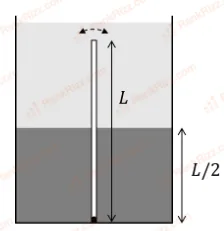
A tank contains two immiscible liquids of densities 6ρ6\rho and 2ρ2\rho. The higher density liquid is filled up to a height L/2L/2 from the bottom. A thin rod of density ρ\rho and length LL is fully immersed and hinged at the bottom so that it can oscillate freely, as shown in the figure. If the rod is slightly disturbed from its equilibrium, the time period of small oscillations is 2πnLg\dfrac{2\pi}{n}\sqrt{\dfrac{L}{g}}, where gg is the acceleration due to gravity. The value of nn is:

Figure for JEE Advanced 2026 Physics question on SHM of floating bodies, liquids, gases and charged systems
JEE ADVANCED 2025 · PAPER 1Spring-block oscillations

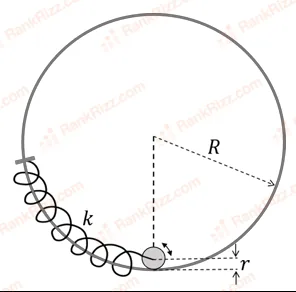
The center of a disk of radius rr and mass mm is attached to a spring of spring constant kk, inside a ring of radius R>rR > r as shown in the figure. The other end of the spring is attached on the periphery of the ring. Both the ring and the disk are in the same vertical plane. The disk can only roll along the inside periphery of the ring, without slipping. The spring can only be stretched or compressed along the periphery of the ring, following the Hooke's law. In equilibrium, the disk is at the bottom of the ring. Assuming small displacement of the disc, the time period of oscillation of center of mass of the disk is written as T=2πωT = \frac{2\pi}{\omega}. The correct expression for ω\omega is (gg is the acceleration due to gravity):

Figure for JEE Advanced 2025 Physics question on Spring-block oscillations
  1. A

    23(gR−r+km)\sqrt{\frac{2}{3}\left(\frac{g}{R-r} + \frac{k}{m}\right)}

  2. B

    2g3(R−r)+km\sqrt{\frac{2g}{3(R-r)} + \frac{k}{m}}

  3. C

    16(gR−r+km)\sqrt{\frac{1}{6}\left(\frac{g}{R-r} + \frac{k}{m}\right)}

  4. D

    14(gR−r+km)\sqrt{\frac{1}{4}\left(\frac{g}{R-r} + \frac{k}{m}\right)}

JEE ADVANCED 2025 · PAPER 2Spring-block oscillations

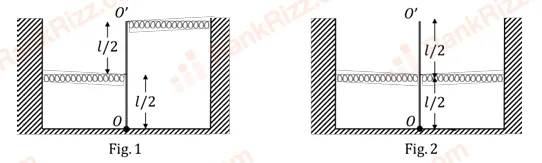
As shown in the figures, a uniform rod OO′OO' of length ll is hinged at the point OO and held in place vertically between two walls using two massless springs of same spring constant. The springs are connected at the midpoint and at the top-end (O′O') of the rod, as shown in Fig. 1 and the rod is made to oscillate by a small angular displacement. The frequency of oscillation of the rod is f1f_1. On the other hand, if both the springs are connected at the midpoint of the rod, as shown in Fig. 2 and the rod is made to oscillate by a small angular displacement, then the frequency of oscillation is f2f_2.

Ignoring gravity and assuming motion only in the plane of the diagram, the value of f1f2\frac{f_1}{f_2} is:

Figure for JEE Advanced 2025 Physics question on Spring-block oscillations
  1. A

    22

  2. B

    2\sqrt{2}

  3. C

    52\sqrt{\frac{5}{2}}

  4. D

    25\sqrt{\frac{2}{5}}

JEE ADVANCED 2025 · PAPER 1SHM: equation, phase, velocity and acceleration

A person sitting inside an elevator performs a weighing experiment with an object of mass 50 kg. Suppose that the variation of the height yy (in m) of the elevator, from the ground, with time tt (in s) is given by y=8[1+sin⁡(2πtT)]y = 8\left[1 + \sin\left(\frac{2\pi t}{T}\right)\right], where T=40πT = 40\pi s. Taking acceleration due to gravity, g=10g = 10 m/s2^2, the maximum variation of the object's weight (in N) as observed in the experiment is ________.

JEE ADVANCED 2024 · PAPER 1SHM: equation, phase, velocity and acceleration

A block of mass 5 kg moves along the x-direction subject to the force F=(−20x+10)F = (-20x + 10) N, with the value of xx in metre. At time t=0t = 0 s, it is at rest at position x=1x = 1 m. The position and momentum of the block at t=(π/4)t = (\pi/4) s are

  1. A

    −0.5-0.5 m, 55 kg m/s

  2. B

    0.50.5 m, 00 kg m/s

  3. C

    0.50.5 m, −5-5 kg m/s

  4. D

    −1-1 m, 55 kg m/s

JEE ADVANCED 2024 · PAPER 2Spring-block oscillations

If the collision occurs at time t0=0t_0 = 0, the value of vcm/(aω)v_{cm}/(a\omega) will be ________.

JEE ADVANCED 2024 · PAPER 2Spring-block oscillations

If the collision occurs at time t0=π/(2ω)t_0 = \pi/(2\omega), then the value of 4b2/a24b^2/a^2 will be ________.

JEE ADVANCED 2022 · PAPER 2Superposition of SHMs

A particle of mass 1 kg is subjected to a force which depends on the position as F⃗=−k(xi^+yj^)\vec{F} = -k(x\hat{i} + y\hat{j}) kg m s−2^{-2} with k=1k = 1 kg s−2^{-2}. At time t=0t = 0, the particle's position r⃗=(12i^+2j^)\vec{r} = \left(\dfrac{1}{\sqrt{2}}\hat{i} + \sqrt{2}\hat{j}\right) m and its velocity v⃗=(−2i^+2j^+2πk^)\vec{v} = \left(-\sqrt{2}\hat{i} + \sqrt{2}\hat{j} + \dfrac{2}{\pi}\hat{k}\right) m s−1^{-1}. Let vxv_x and vyv_y denote the x and y components of the particle's velocity, respectively. Ignore gravity. When z=0.5z = 0.5 m, the value of (xvy−yvx)(x v_y - y v_x) is _______ m2^2 s−1^{-1}.

JEE ADVANCED 2022 · PAPER 2Spring-block oscillations

On a frictionless horizontal plane, a bob of mass m=0.1m = 0.1 kg is attached to a spring with natural length l0=0.1l_0 = 0.1 m. The spring constant is k1=0.009k_1 = 0.009 N m−1^{-1} when the length of the spring l>l0l > l_0 and is k2=0.016k_2 = 0.016 N m−1^{-1} when l<l0l < l_0. Initially the bob is released from l=0.15l = 0.15 m. Assume that Hooke's law remains valid throughout the motion. If the time period of the full oscillation is T = (nπ)(n\pi) s, then the integer closest to nn is _______.

JEE ADVANCED 2018 · PAPER 1Spring-block oscillations

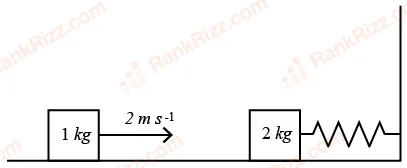
A spring-block system is resting on a friction less floor as shown in the figure. The spring constant is 2.0 Nm−1Nm^{-1} and the mass of the block is 2.0 kg. Ignore the mass of the spring. Initially the spring is in an unstretched condition. Another block of mass 1.0 kg moving with a speed of 2.0 ms−1ms^{-1} collides elastically with the first block. The collision is such that the 2.0 kg block does not hit the wall. The distance, in metres, between the two blocks when the spring returns to its unstretched position for the first time after the collision is _________.

Figure for JEE Advanced 2018 Physics question on Spring-block oscillations
JEE ADVANCED 2016 · PAPER 2Spring-block oscillations

A block with mass M is connected by a massless spring with stiffness constant k to a rigid wall and moves without friction on a horizontal surface. The block oscillates with small amplitude A about an equilibrium position x0x_0. Consider two cases:
(i) when the block is at x0x_0; and
(ii) when the block is at x=x0+Ax = x_0 + A.
In both thecases, a particle with mass m(< M) is softly placed on the block after which they stick to each other. Which of the following statement(s) is(are) true about the motion after the mass mis placed on the mass M ?

  1. A

    The amplitude of oscillation in thefirst case changes by a factor of Mm+M\sqrt{\frac{M}{m + M}}, where as in the secondcase it remains unchanged

  2. B

    The final time period of oscillation in both the cases is same

  3. C

    The total energy decreases in both the cases

  4. D

    The instantaneous speed at x0x_0 of the combined masses decreases in both the cases

JEE ADVANCED 2015 · PAPER 1Spring-block oscillations

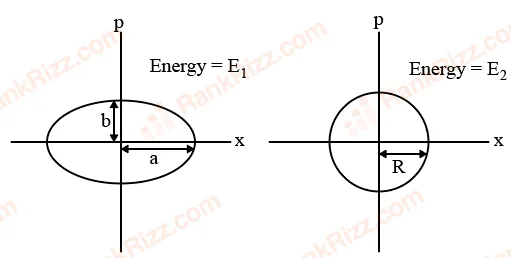
Two independent harmonic oscillators of equal mass are oscillating about the origin with angular frequencies ω1\omega_1 and ω2\omega_2 and have total energies E1E_1 and E2E_2, respectively. The variations of their momenta p with positions x are shown in the figures. If ab=n2\frac{a}{b} = n^2 and aR=n\frac{a}{R} = n, then the correct equation(s) is(are)

Figure for JEE Advanced 2015 Physics question on Spring-block oscillations
  1. A

    E1ω1=E2ω2E_1 \omega_1 = E_2 \omega_2

  2. B

    ω2ω1=n2\frac{\omega_2}{\omega_1} = n^2

  3. C

    ω1ω2=n2\omega_1 \omega_2 = n^2

  4. D

    E1ω1=E2ω2\frac{E_1}{\omega_1} = \frac{E_2}{\omega_2}

JEE ADVANCED 2013 · PAPER 2Spring-block oscillations

A particle of mass mis attached to one end of a mass-less spring of force constant k, lying on a frictionless horizontal plane. The other end of the spring is fixed. The particle starts moving horizontally from its equilibrium position at time t = 0 with an initial velocity u0u_0. When the speed of the particle is 0.5 u0u_0,it collides elastically with a rigid wail. After this collision,

  1. A

    the speed of the particle when it returns to its equilibrium position is u0u_0.

  2. B

    the time at which the particle passes through the equilibrium position for the first time is t=πmkt = \pi \sqrt{\frac{m}{k}}.

  3. C

    the time at which the maximum compression of the spring occurs is t=4π3mkt = \frac{4 \pi}{3} \sqrt{\frac{m}{k}}.

  4. D

    the time at which the particle passes through the equilibrium position for the second time is t=5π3mkt = \frac{5 \pi}{3} \sqrt{\frac{m}{k}}.

JEE ADVANCED 2012 · PAPER 1Spring-block oscillations

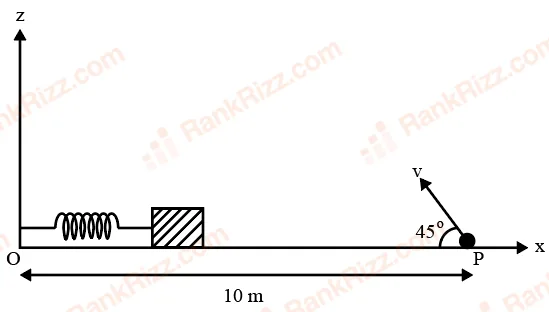
A small block is connected to one end of a massless spring of un-stretched length 4.9 m. The other end of the spring (See thefigure)is fixed. The system lies on a horizontal frictionless surface. The blockis stretched by 0.2 m and released from rest at t= 0. It then executes simple harmonic motion with angular frequency ω=π3\omega = \frac{\pi}{3} rad/s. Simultaneously at t = 0, a small pebble is projected with speed v from point P at an angle of 45∘45^\circ as shownin thefigure. Point P is at a horizontal distance of 10 m from O. If the pebble hits the block at + = 1s, the value of v is (take g = 10 m/s2m/s^2)

Figure for JEE Advanced 2012 Physics question on Spring-block oscillations
  1. A

    50\sqrt{50} m/s

  2. B

    51\sqrt{51} m/s

  3. C

    52\sqrt{52} m/s

  4. D

    53\sqrt{53} m/s

JEE ADVANCED 2011 · PAPER 2Spring-block oscillations

A point mass is subjected to two simultaneous sinusoidal displacements in x-direction, x1(t)=Asin⁡ωtx_1(t) = A \sin \omega t and x2(t)=Asin⁡(ωt+2π3)x_2(t) = A \sin\left(\omega t + \frac{2 \pi}{3}\right). Adding a third sinusoidal displacement x3(t)=Bsin⁡(ωt+ϕ)x_3(t) = B \sin(\omega t + \phi) brings the mass to a complete rest. The value of B and ϕ\phi are

  1. A

    2A,3π4\sqrt{2}A, \frac{3 \pi}{4}

  2. B

    A,4π3A, \frac{4 \pi}{3}

  3. C

    3A,5π6\sqrt{3}A, \frac{5 \pi}{6}

  4. D

    A,π3A, \frac{\pi}{3}

JEE ADVANCED 2011 · PAPER 2Spring-block oscillations

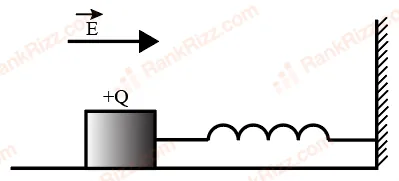
A wooden block performs SHM on a frictionless surface with frequency, v0v_0. The block carries a charge +Q on its surface. If now a uniform electric field E→\overrightarrow{E} is switched-on as shown, then the SHM of the block will be

Figure for JEE Advanced 2011 Physics question on Spring-block oscillations
  1. A

    of the same frequency and with shifted mean position.

  2. B

    of the same frequency and with the same mean position.

  3. C

    of changed frequency and with shifted mean position.

  4. D

    of changed frequency and with the same mean position.

JEE ADVANCED 2011 · PAPER 1Spring-block oscillations

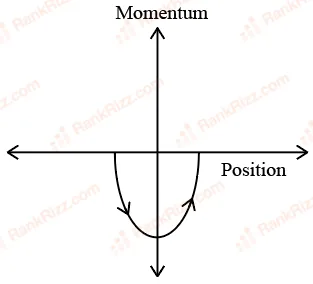
The phase space diagram for a ball thrown vertically up from ground is-

  1. A
    Figure for JEE Advanced 2011 Physics question on Spring-block oscillations
  2. B
    Figure for JEE Advanced 2011 Physics question on Spring-block oscillations
  3. C
    Figure for JEE Advanced 2011 Physics question on Spring-block oscillations
  4. D
    Figure for JEE Advanced 2011 Physics question on Spring-block oscillations
JEE ADVANCED 2011 · PAPER 1Spring-block oscillations

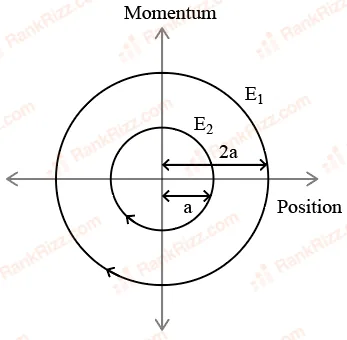
The phase space diagram for simple harmonic motion is a circle centered at the origin. In the figure, the two circles represent the same oscillator but for different initial conditions, and E1E_1 and E2E_2 are the total mechanical energies respectively. Then-

Figure for JEE Advanced 2011 Physics question on Spring-block oscillations
  1. A

    E1=2E2E_1 = \sqrt{2}E_2

  2. B

    E1=2E2E_1 = 2E_2

  3. C

    E1=4E2E_1 = 4E_2

  4. D

    E1=16E2E_1 = 16E_2

JEE ADVANCED 2011 · PAPER 1Spring-block oscillations

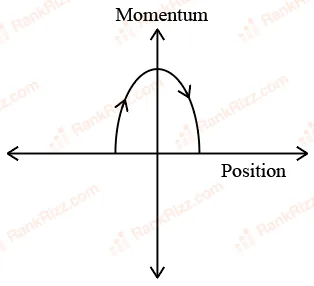
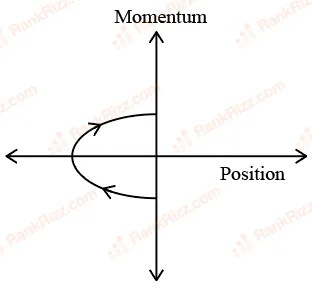
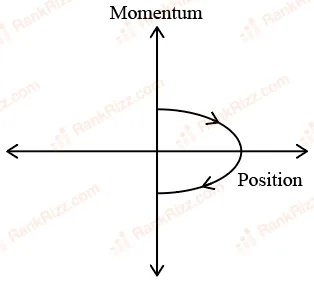
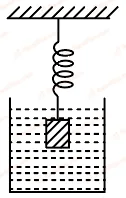
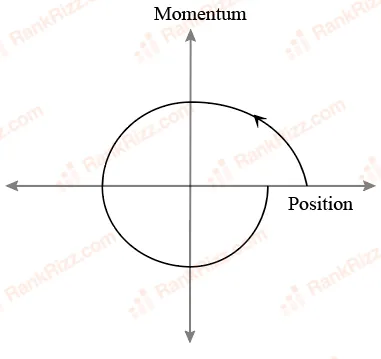
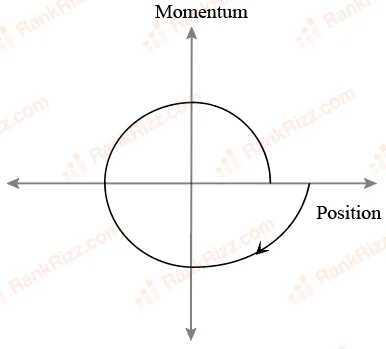
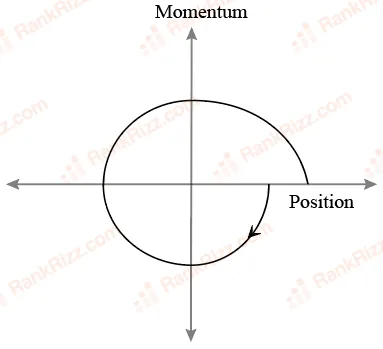
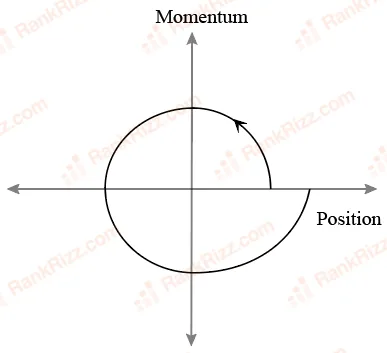
Consider the spring-mass system, with the mass submerged in water, as shown in figure. The phase space diagram for one cycle of this system is-

Figure for JEE Advanced 2011 Physics question on Spring-block oscillations
  1. A
    Figure for JEE Advanced 2011 Physics question on Spring-block oscillations
  2. B
    Figure for JEE Advanced 2011 Physics question on Spring-block oscillations
  3. C
    Figure for JEE Advanced 2011 Physics question on Spring-block oscillations
  4. D
    Figure for JEE Advanced 2011 Physics question on Spring-block oscillations
JEE ADVANCED 2010 · PAPER 1Spring-block oscillations

If the total energy of the particle is E, it will perform periodic motion only if

  1. A

    E < 0

  2. B

    E > 0

  3. C

    V0>E>0V_0 > E > 0

  4. D

    E>V0E > V_0