RankRizz

Oscillations — JEE Main Previous Year Questions

Every Oscillations question JEE Main has set from 2004–2026, grouped by the idea it tests rather than the order of the syllabus. 182 questions across 7 distinct ideas. Free to read, answer key on every one.

DATA UPDATED

Questions

182

Distinct ideas

7

Share of marks

2.8%

Difficulty

MEDIUM

The ideas inside Oscillations

A chapter is not one subject — it is a handful of procedures the examiner reuses. These are the ones Oscillations questions actually test.

Every Oscillations question

101–120 OF 182 · NEWEST FIRST

JEE MAIN 2021 · 16 MAR S2Damped and forced oscillations and resonance

The amplitude of a mass-spring system, which is executing simple harmonic motion decreases with time. If mass = 500 g, Decay constant = 20 g s−1^{-1} then how much time is required for the amplitude of the system to drop to half of its initial value? (ln⁡2=0.693\ln 2 = 0.693)

  1. A

    34.65 s

  2. B

    17.32 s

  3. C

    0.034 s

  4. D

    15.1 s

JEE MAIN 2021 · 26 FEB S2Spring-block oscillations

Given below are two statements:
Statement I: A second's pendulum has a time period of 1 second.
Statement II: It takes precisely one second to move between the two extreme positions.
In the light of the above statements, choose the correct answer from the options given below

  1. A

    Statement I is false but Statement II is true

  2. B

    Both Statement I and Statement II are true

  3. C

    Both Statement I and Statement II are False

  4. D

    Statement I is true but Statement II is false

JEE MAIN 2021 · 26 FEB S2SHM: equation, phase, velocity and acceleration

A particle executes S.H.M., the graph of velocity as a function of displacement is:

  1. A

    a circle

  2. B

    a helix

  3. C

    a parabola

  4. D

    an ellipse

JEE MAIN 2021 · 26 FEB S2SHM: equation, phase, velocity and acceleration

A particle executes S.H.M. with amplitude AA and time period TT. The displacement of the particle when its speed is half of maximum speed is xA2\frac{\sqrt{x}A}{2}. The value of xx is

JEE MAIN 2021 · 26 FEB S2SHM: equation, phase, velocity and acceleration

Time period of a simple pendulum is TT. The time taken to complete 58\frac{5}{8} oscillations starting from mean position is α12T\frac{\alpha}{12}T. The value of α\alpha is ______.

JEE MAIN 2021 · 25 FEB S1Spring-block oscillations

If the time period of a two meter long simple pendulum is 2 s, the acceleration due to gravity at the place where pendulum is executing S.H.M. is:

  1. A

    2π22\pi^2 m s−2^{-2}

  2. B

    16 m s−2^{-2}

  3. C

    π2\pi^2 m s−2^{-2}

  4. D

    9.8 m s−2^{-2}

JEE MAIN 2021 · 25 FEB S2Spring-block oscillations

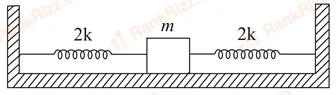
Two identical springs of spring constant 2k2k are attached to a block of mass mm and to fixed support (see figure). When the mass is displaced from equilibrium position on either side, it executes simple harmonic motion. The time period of oscillations of this system is:

Figure for JEE Main 2021 Physics question on Spring-block oscillations
  1. A

    πmk\pi\sqrt{\frac{m}{k}}

  2. B

    2πm2k2\pi\sqrt{\frac{m}{2k}}

  3. C

    πm2k\pi\sqrt{\frac{m}{2k}}

  4. D

    2πmk2\pi\sqrt{\frac{m}{k}}

JEE MAIN 2021 · 25 FEB S2SHM: equation, phase, velocity and acceleration

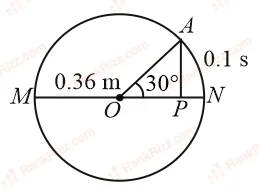
The point AA moves with a uniform speed along the circumference of a circle of radius 0.36 m and covers 30° in 0.1 s. The perpendicular projection PP from AA on the diameter MNMN represents the simple harmonic motion of PP. The restoration force per unit mass when PP touches MM will be:

Figure for JEE Main 2021 Physics question on SHM: equation, phase, velocity and acceleration
  1. A

    0.49 N

  2. B

    9.87 N

  3. C

    50 N

  4. D

    100 N

JEE MAIN 2021 · 25 FEB S2SHM: equation, phase, velocity and acceleration

Y=Asin⁡(ωt+ϕ0)Y = A\sin(\omega t + \phi_0) is the time-displacement equation of a SHM. At t=0t = 0 the displacement of the particle is Y=A2Y = \frac{A}{2} and it is moving along negative xx-direction. Then the initial phase angle ϕ0\phi_0 will be:

  1. A

    2π3\frac{2\pi}{3}

  2. B

    π6\frac{\pi}{6}

  3. C

    5π6\frac{5\pi}{6}

  4. D

    π3\frac{\pi}{3}

JEE MAIN 2021 · 24 FEB S1Spring-block oscillations

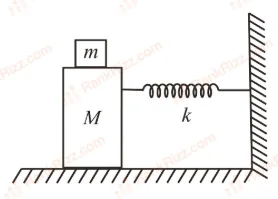
In the given figure, a mass MM is attached to a horizontal spring which is fixed on one side to a rigid support. The spring constant of the spring is kk. The mass oscillates on a frictionless surface with time period TT and amplitude AA. When the mass is in equilibrium position, as shown in the figure, another mass mm is gently fixed upon it. The new amplitude of oscillation will be:

Figure for JEE Main 2021 Physics question on Spring-block oscillations
  1. A

    AM+mMA\sqrt{\frac{M+m}{M}}

  2. B

    AMM−mA\sqrt{\frac{M}{M-m}}

  3. C

    AM−mMA\sqrt{\frac{M-m}{M}}

  4. D

    AMM+mA\sqrt{\frac{M}{M+m}}

JEE MAIN 2021 · 24 FEB S2Spring-block oscillations

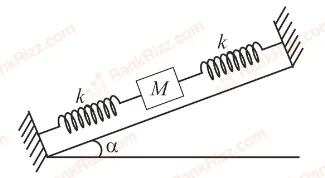
In the given figure, a body of mass MM is held between two massless springs, on a smooth inclined plane. The free ends of the springs are attached to firm supports. If each spring has spring constant kk, the frequency of oscillation of given body is:

Figure for JEE Main 2021 Physics question on Spring-block oscillations
  1. A

    12π2kMgsin⁡α\frac{1}{2\pi}\sqrt{\frac{2k}{Mg\sin\alpha}}

  2. B

    12πkMgsin⁡α\frac{1}{2\pi}\sqrt{\frac{k}{Mg}\sin\alpha}

  3. C

    12πk2M\frac{1}{2\pi}\sqrt{\frac{k}{2M}}

  4. D

    12π2kM\frac{1}{2\pi}\sqrt{\frac{2k}{M}}

JEE MAIN 2021 · 24 FEB S2SHM: equation, phase, velocity and acceleration

When a particle executes SHM, the nature of graphical representation of velocity as a function of displacement is:

  1. A

    straight line

  2. B

    elliptical

  3. C

    circular

  4. D

    parabolic

JEE MAIN 2020 · 06 SEP S2Spring-block oscillations

When a particle of mass mm is attached to a vertical spring of spring constant kk and released, its motion is described by y(t)=y0sin⁡2ωty(t) = y_0\sin^2\omega t, where 'y' is measured from the lower end of unstretched spring. Then ω\omega is:

  1. A

    12gy0\frac{1}{2}\sqrt{\frac{g}{y_0}}

  2. B

    gy0\sqrt{\frac{g}{y_0}}

  3. C

    g2y0\sqrt{\frac{g}{2y_0}}

  4. D

    2gy0\sqrt{\frac{2g}{y_0}}

JEE MAIN 2020 · 05 SEP S2Simple, compound and torsional pendulums

A ring is hung on a nail. It can oscillate, without slipping or sliding (i) in its plane with a time period T1T_1 and (ii) back and forth in a direction perpendicular to its plane, with a period T2T_2. The ratio T1T2\frac{T_1}{T_2} will be:

  1. A

    23\frac{2}{\sqrt{3}}

  2. B

    23\frac{2}{3}

  3. C

    32\frac{3}{\sqrt{2}}

  4. D

    23\frac{\sqrt{2}}{3}

JEE MAIN 2020 · 03 SEP S2Spring-block oscillations

A block of mass m attached to a massless spring is performing oscillatory motion of amplitude 'A' on a frictionless horizontal plane. If half of the mass of the block breaks off when it is passing through its equilibrium point, the amplitude of oscillation for the remaining system become fAfA. The value of ff is:

  1. A

    12\frac{1}{\sqrt{2}}

  2. B

    11

  3. C

    12\frac{1}{2}

  4. D

    2\sqrt{2}

JEE MAIN 2020 · 02 SEP S2Energy in simple harmonic motion

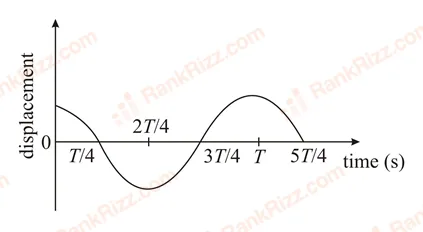
The displacement time graph of a particle executing SHM is given in figure: (sketch is schematic and not to scale)

Figure for JEE Main 2020 Physics question on Energy in simple harmonic motion


Which of the following statements is/are true for this motion?
(A) The force is zero at t=3T4t = \frac{3T}{4}
(B) The magnitude of acceleration is maximum at t=Tt = T
(C) The speed is maximum at t=T4t = \frac{T}{4}
(D) The P.E. is equal to K.E. of the oscillation at t=T2t = \frac{T}{2}

  1. A

    (A), (B) and (C)

  2. B

    (B), (C) and (D)

  3. C

    (A), (B) and (D)

  4. D

    (A) and (D)

JEE MAIN 2019 · 10 APR S1Damped and forced oscillations and resonance

The displacement of a damped harmonic oscillator is given by x(t)=e−0.1tcos⁡(10πt+φ)x(t) = e^{-0.1t}\cos(10\pi t + \varphi). Here t is in seconds. The time taken for its amplitude of vibration to drop to half of its initial value is close to:

  1. A

    27 s

  2. B

    4 s

  3. C

    13 s

  4. D

    7 s

JEE MAIN 2019 · 09 APR S1Simple, compound and torsional pendulums

A simple pendulum oscillating in air has period T. The bob of the pendulum is completely immersed in a non-viscous liquid. The density of the liquid is 116\frac{1}{16}th of the material of the bob. If the bob is inside liquid all the time, its period of oscillation in this liquid is:

  1. A

    2T1102T\sqrt{\frac{1}{10}}

  2. B

    2T1142T\sqrt{\frac{1}{14}}

  3. C

    4T1154T\sqrt{\frac{1}{15}}

  4. D

    4T1144T\sqrt{\frac{1}{14}}

JEE MAIN 2019 · 08 APR S2Damped and forced oscillations and resonance

A damped harmonic oscillator has a frequency of 5 oscillations per second. The amplitude drops to half its value for every 10 oscillations. The time it will take to drop to 11000\frac{1}{1000} of the original amplitude is close to:

  1. A

    50 s

  2. B

    100 s

  3. C

    20 s

  4. D

    10 s

JEE MAIN 2019 · 12 JAN S1Simple, compound and torsional pendulums

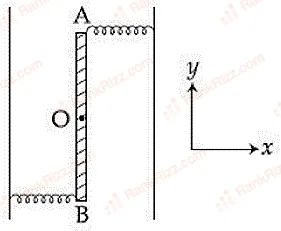
Two light identical springs of spring constant k are attached horizontally at the two ends of a uniform horizontal rod AB of length l and mass m. The rod is pivoted at its center 'O' and can rotate freely in horizontal plane. The other ends of the two springs are fixed to rigid supports as shown in figure. The rod is gently pushed through a small angle and released. The frequency of resulting oscillation is:

Figure for JEE Main 2019 Physics question on Simple, compound and torsional pendulums
  1. A

    12π3km\frac{1}{2\pi}\sqrt{\frac{3k}{m}}

  2. B

    12πkm\frac{1}{2\pi}\sqrt{\frac{k}{m}}

  3. C

    12π6km\frac{1}{2\pi}\sqrt{\frac{6k}{m}}

  4. D

    12π2km\frac{1}{2\pi}\sqrt{\frac{2k}{m}}