JEE MAIN 2026 · 06 APR S1SHM: equation, phase, velocity and acceleration
A particle is executing simple harmonic motion. Its amplitude is and time period is 5 sec. The time required by it to move from to is _______ sec.
- A
1/4
- B
5/4
- C
5/8
- D
3/8
SHM: equation, phase, velocity and acceleration has been asked 78 times in JEE Main, in 18 different years between 2005 and 2026, and in all of the last five exam years (2022–2026), 41 questions in all. That is 43% of Oscillations, its most-asked topic. Last asked in JEE Main 06 Apr 2026, Shift 1. 54 are multiple choice and 24 numerical-value; 35 easy and 32 medium by our difficulty labels. All of them are below, newest first, free to read.
Questions
78
Years asked
18
Since
2005
Of the chapter
43%
Questions on SHM: equation, phase, velocity and acceleration in every year it was asked, newest first.
| Year | Relative frequency | Questions |
|---|---|---|
| 2026 | 5 | |
| 2025 | 4 | |
| 2024 | 8 | |
| 2023 | 17 | |
| 2022 | 7 | |
| 2021 | 13 | |
| 2019 | 1 | |
| 2018 | 3 | |
| 2017 | 2 | |
| 2016 | 3 | |
| 2015 | 1 | |
| 2014 | 4 | |
| 2012 | 1 | |
| 2011 | 1 | |
| 2009 | 1 | |
| 2007 | 2 | |
| 2006 | 2 | |
| 2005 | 3 | |
| Total | 78 |
1–20 OF 78 · NEWEST FIRST
A particle is executing simple harmonic motion. Its amplitude is and time period is 5 sec. The time required by it to move from to is _______ sec.
1/4
5/4
5/8
3/8
Match the List I with List II:
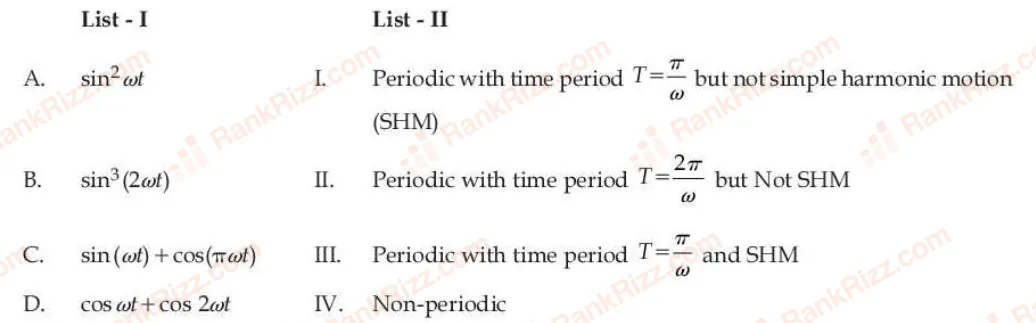
Choose the correct answer from the options given below:
A-III, B-I, C-IV, D-II
A-II, B-I, C-III, D-IV
A-III, B-II, C-IV, D-I
A-II, B-I, C-IV, D-III
The velocity of a particle executing simple harmonic motion along -axis is described as , where represents displacement. If the time period of motion is s, the value of is _____.
The equation of motion of a particle is given by cm. The particle will come to rest at time and it will have zero acceleration at time . The and respectively are _____.
s, s
s, s
s, s
s, s
The displacement of a particle, executing simple harmonic motion with time period T, is expressed as , where A is the amplitude. The maximum value of potential energy of this oscillator is found at . The value of is_____.
A particle is subjected to two simple harmonic motions as:
cm
and cm
where x is displacement and is time in seconds. The maximum acceleration of the particle is ms. The value of x is:
175
125
Given below are two statements : one is labelled as Assertion (A) and the other is labelled as Reason (R). Assertion (A) : Time period of a simple pendulum is longer at the top of a mountain than that at the base of the mountain. Reason (R): Time period of a simple pendulum decreases with increasing value of acceleration due to gravity and vice-versa. In the light of the above statements, choose the most appropriate answer from the options given below :
Both (A) and (R) are true and (R) is the correct explanation of (A)
(A) is true but (R) is false
(A) is false but (R) is true
Both (A) and (R) are true but (R) is not the correct explanation of (A)
Two bodies A and B of equal mass are suspended from two massless springs of spring constant and , respectively. If the bodies oscillate vertically such that their amplitudes are equal, the ratio of the maximum velocity of A to the maximum velocity of B is
A particle is executing simple harmonic motion with time period and amplitude If and are the total distance and displacement covered by the particle in then is:
10
25
The position, velocity and acceleration of a particle executing simple harmonic motion are found to have magnitudes of m, ms and ms at a certain instant. The amplitude of the motion is m, where is ________
A particle of mass executes simple harmonic motion under force . The time period of oscillation is s. The value of is ______ (Given )
A particle is doing simple harmonic motion of amplitude and time period . The maximum velocity of the particle is _______ cm/s.
The displacement of a particle executing SHM is given by m. The time period of motion is s. The velocity of the particle at is _____ m/s.
A mass is suspended from a spring of negligible mass and the system oscillates with a frequency . The frequency of oscillations if a mass is suspended from the same spring is . The value of is ______.
A particle performs simple harmonic motion with amplitude . Its speed is increased to three times at an instant when its displacement is . The new amplitude of motion is . The value of is _____.
A simple harmonic oscillator has an amplitude and time period second. Assuming the oscillation starts from its mean position, the time required by it to travel from to will be s, where ______.
A particle executes simple harmonic motion with an amplitude of cm. At the mean position, velocity of the particle is . The distance of the particle from the mean position when its speed becomes is cm, where ______.
In a linear Simple Harmonic Motion (SHM)
(A) Restoring force is directly proportional to the displacement.
(B) The acceleration and displacement are opposite in direction.
(C) The velocity is maximum at mean position.
(D) The acceleration is minimum at extreme points.
Choose the correct answer from the options given below:
(C) and (D) only
(A), (C) and (D) only
(A), (B) and (C) only
(A), (B) and (D) only
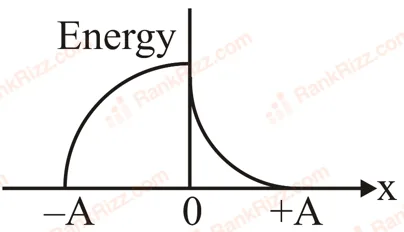
Which graph represents the difference between total energy and potential energy of a particle executing SHM vs its distance from mean position?
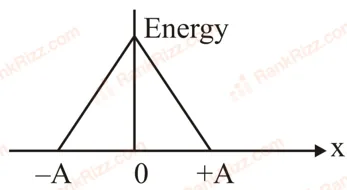
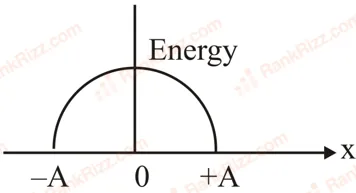
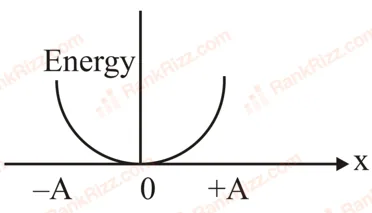
At a given point of time the value of displacement of a simple harmonic oscillator is given as . If amplitude is cm and kinetic energy at that time is J, the value of force constant is N m. The value of is _____.