RankRizz

Gravitation — JEE Main Previous Year Questions

Every Gravitation question JEE Main has set from 2004–2026, grouped by the idea it tests rather than the order of the syllabus. 205 questions across 7 distinct ideas. Free to read, answer key on every one.

DATA UPDATED

Questions

205

Distinct ideas

7

Share of marks

2%

Difficulty

MEDIUM

The ideas inside Gravitation

A chapter is not one subject — it is a handful of procedures the examiner reuses. These are the ones Gravitation questions actually test.

Every Gravitation question

121–140 OF 205 · NEWEST FIRST

JEE MAIN 2021 · 20 JUL S2Newton's law of gravitation and superposition

Consider a binary star system of star A and star B with masses mAm_A and mBm_B revolving in a circular orbit of radii rAr_A and rBr_B, respectively. If TAT_A and TBT_B are the time period of star A and star B, respectively, then:

  1. A

    TATB=(rArB)3/2\frac{T_A}{T_B} = \left(\frac{r_A}{r_B}\right)^{3/2}

  2. B

    TA=TBT_A = T_B

  3. C

    TA>TBT_A > T_B (if mA>mBm_A > m_B)

  4. D

    TA>TBT_A > T_B (if rA>rBr_A > r_B)

JEE MAIN 2021 · 18 MAR S2Acceleration due to gravity and its variation

If the angular velocity of earth's spin is increased such that the bodies at the equator start floating, the duration of the day would be approximately :
(Take : g=10g = 10 ms−2^{-2}, the radius of earth, R=6400×103R = 6400 \times 10^3 m, Take π=3.14\pi = 3.14)

  1. A

    60 minutes

  2. B

    does not change

  3. C

    1200 minutes

  4. D

    84 minutes

JEE MAIN 2021 · 18 MAR S2Kepler's laws and planetary motion

The angular momentum of a planet of mass MM moving around the sun in an elliptical orbit is L⃗\vec{L}. The magnitude of the areal velocity of the planet is :

  1. A

    4LM\frac{4L}{M}

  2. B

    LM\frac{L}{M}

  3. C

    2LM\frac{2L}{M}

  4. D

    L2M\frac{L}{2M}

JEE MAIN 2021 · 17 MAR S1Escape speed

The radius in kilometer to which the present radius of earth (R=6400R = 6400 km) to be compressed so that the escape velocity is increased 10 times is ________.

JEE MAIN 2021 · 17 MAR S2Satellites: orbital speed, period, energy and geostationary orbits

A geostationary satellite is orbiting around an arbitrary planet PP at a height of 11R11R above the surface of PP, RR being the radius of PP. The time period of another satellite in hours at a height of 2R2R from the surface of PP is ________. has the time period of 24 hours.

  1. A

    626\sqrt{2}

  2. B

    62\frac{6}{\sqrt{2}}

  3. C

    3

  4. D

    5

JEE MAIN 2021 · 16 MAR S1Kepler's laws and planetary motion

The maximum and minimum distances of a comet from the Sun are 1.6×10121.6 \times 10^{12} m and 8.0×10108.0 \times 10^{10} m respectively. If the speed of the comet at the nearest point is 6×1046 \times 10^{4} m s−1^{-1}, the speed at the farthest point is:

  1. A

    1.5×1031.5 \times 10^{3} m s−1^{-1}

  2. B

    6.6×1036.6 \times 10^{3} m s−1^{-1}

  3. C

    3.0×1033.0 \times 10^{3} m s−1^{-1}

  4. D

    4.5×1034.5 \times 10^{3} m s−1^{-1}

JEE MAIN 2021 · 16 MAR S2Gravitational potential energy of systems

If one wants to remove all the mass of the earth to infinity in order to break it up completely. The amount of energy that needs to be supplied will be x5GM2R\frac{x}{5}\frac{GM^2}{R} where xx is ________. (Round off to the Nearest Integer)
(MM is the mass of earth, RR is the radius of earth, GG is the gravitational constant)

JEE MAIN 2021 · 26 FEB S2Acceleration due to gravity and its variation

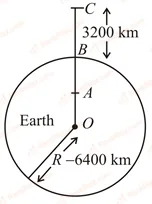
In the reported figure of earth, the value of acceleration due to gravity is same at point A and C but it is smaller than that of its value at point B (surface of the earth). The value of OA:ABOA : AB will be x:5x : 5. The value of xx is ______

Figure for JEE Main 2021 Physics question on Acceleration due to gravity and its variation
JEE MAIN 2021 · 25 FEB S1Kepler's laws and planetary motion

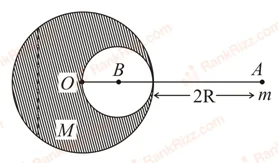
A solid sphere of radius RR gravitationally attracts a particle placed at 3R3R from its centre with a force F1F_1. Now a spherical cavity of radius R2\frac{R}{2} is made in the sphere (as shown in figure) and the force becomes F2F_2. The value of F1:F2F_1 : F_2 is:

Figure for JEE Main 2021 Physics question on Kepler's laws and planetary motion
  1. A

    41 : 50

  2. B

    50 : 41

  3. C

    25 : 36

  4. D

    36 : 25

JEE MAIN 2021 · 25 FEB S1Satellites: orbital speed, period, energy and geostationary orbits

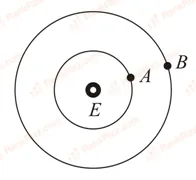
Two satellites AA and BB of masses 200 kg and 400 kg are revolving round the earth at height of 600 km and 1600 km respectively. If TAT_A and TBT_B are the time periods of AA and BB respectively then the value of TB−TAT_B - T_A:

Figure for JEE Main 2021 Physics question on Satellites: orbital speed, period, energy and geostationary orbits


[Given: radius of earth = 6400 km, mass of earth = 6×10246 \times 10^{24} kg]

  1. A

    4.24×1034.24 \times 10^3 s

  2. B

    3.33×1023.33 \times 10^2 s

  3. C

    1.33×1031.33 \times 10^3 s

  4. D

    4.24×1024.24 \times 10^2 s

JEE MAIN 2021 · 25 FEB S1Escape speed

Given below are two statements: one is labelled as Assertion A and the other is labelled as Reason R.
Assertion A: The escape velocities of planet A and B are same. But A and B are of unequal mass.
Reason R: The product of their mass and radius must be same. M1R1=M2R2M_1R_1 = M_2R_2
In the light of the above statements, choose the most appropriate answer from the options given below:

  1. A

    Both A and R are correct and R is the correct explanation of A

  2. B

    Both A and R are correct but R is NOT the correct explanation of A

  3. C

    A is not correct but R is correct

  4. D

    A is correct but R is not correct

JEE MAIN 2021 · 25 FEB S2Satellites: orbital speed, period, energy and geostationary orbits

The initial velocity viv_i required to project a body vertically upward from the surface of the earth to reach a height of 10R10R, where RR is the radius of the earth, may be described in terms of escape velocity vev_e such that vi=xy×vev_i = \sqrt{\frac{x}{y}} \times v_e. The value of xx will be

JEE MAIN 2021 · 24 FEB S1Satellites: orbital speed, period, energy and geostationary orbits

Consider two satellites S1S_1 and S2S_2 with periods of revolution 1hr and 8hr respectively revolving around a planet in circular orbits. The ratio of angular velocity of satellite S1S_1 to the angular velocity of satellite S2S_2 is:

  1. A

    8 : 1

  2. B

    2 : 1

  3. C

    1 : 4

  4. D

    1 : 8

JEE MAIN 2021 · 24 FEB S1Kepler's laws and planetary motion

Four identical particles of equal mass of 1 kg are made to move along the circumference of a circle of radius 1 m under the action of their own mutual gravitational attraction. The speed of each particle will be:

  1. A

    G(1+22)\sqrt{G(1 + 2\sqrt{2})}

  2. B

    12G(1+22)\dfrac{1}{2} \sqrt{G(1 + 2\sqrt{2})}

  3. C

    12G(22−1)\dfrac{1}{2} \sqrt{G(2\sqrt{2} - 1)}

  4. D

    G(1+22)4\sqrt{\dfrac{G(1 + 2\sqrt{2})}{4}}

JEE MAIN 2021 · 24 FEB S1Kepler's laws and planetary motion

Two stars of masses mm and 2m2m at a distance dd rotate about their common centre of mass in free space. The period of revolution is:

  1. A

    2πd33Gm2\pi\sqrt{\frac{d^3}{3Gm}}

  2. B

    2π3Gmd32\pi\sqrt{\frac{3Gm}{d^3}}

  3. C

    12π3Gmd3\frac{1}{2\pi}\sqrt{\frac{3Gm}{d^3}}

  4. D

    12πd33Gm\frac{1}{2\pi}\sqrt{\frac{d^3}{3Gm}}

JEE MAIN 2021 · 24 FEB S2Acceleration due to gravity and its variation

A body weighs 49 N on a spring balance at the north pole. What will be its weight recorded on the same weighing machine, if it is shifted to the equator?
[Use g=GMR2=9.8g = \frac{GM}{R^2} = 9.8 m s−2^{-2} and radius of earth, R=6400R = 6400 km.]

  1. A

    49.17 N

  2. B

    48.83 N

  3. C

    49.83 N

  4. D

    49 N

JEE MAIN 2020 · 06 SEP S1Kepler's laws and planetary motion

A satellite is in an elliptical orbit around a planet PP. It is observed that the velocity of the satellite when it is farthest from the planet is 6 times less than that when it is closest to the planet. The ratio of distances between the satellite and the planet at closest and farthest points is:

  1. A

    1 : 6

  2. B

    1 : 3

  3. C

    1 : 2

  4. D

    3 : 4

JEE MAIN 2020 · 06 SEP S2Gravitational potential energy of systems

Two planets have masses M and 16M and their radii are aa and 2a2a, respectively. The separation between the centres of the planets is 10a10a. A body of mass mm is fired from the surface of the larger planet towards the smaller planet along the line joining their centres. For the body to be able to reach at the surface of smaller planet, the minimum firing speed needed is:

  1. A

    2GMa2\sqrt{\frac{GM}{a}}

  2. B

    4GMa4\sqrt{\frac{GM}{a}}

  3. C

    GM2ma\sqrt{\frac{GM^2}{ma}}

  4. D

    325GMa\frac{3}{2}\sqrt{\frac{5GM}{a}}

JEE MAIN 2020 · 05 SEP S1Acceleration due to gravity and its variation

The value of the acceleration due to gravity is g1g_1 at a height h=R2h = \frac{R}{2} (RR = radius of the earth) from the surface of the earth. It is again equal to g1g_1 at a depth dd below the surface the earth. The ratio (dR)\left(\frac{d}{R}\right) equals:

  1. A

    49\frac{4}{9}

  2. B

    59\frac{5}{9}

  3. C

    13\frac{1}{3}

  4. D

    79\frac{7}{9}

JEE MAIN 2020 · 05 SEP S2Acceleration due to gravity and its variation

The acceleration due to gravity on the earth's surface at the poles is gg and angular velocity of the earth about the axis passing through the pole is ω\omega. An object is weighed at the equator and at a height hh above the poles by using a spring balance. If the weights are found to be same, then hh is: (h≪Rh \ll R, where RR is the radius of the earth)

  1. A

    R2ω22g\dfrac{R^2\omega^2}{2g}

  2. B

    R2ω2g\dfrac{R^2\omega^2}{g}

  3. C

    R2ω24g\dfrac{R^2\omega^2}{4g}

  4. D

    R2ω28g\dfrac{R^2\omega^2}{8g}