JEE Main 2021 Physics question — Kepler's laws and planetary motion
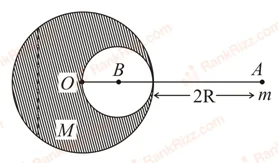
A solid sphere of radius gravitationally attracts a particle placed at from its centre with a force . Now a spherical cavity of radius is made in the sphere (as shown in figure) and the force becomes . The value of is:
SOLUTION
Solution & Explanation
1. Calculate the Initial Gravitational Force ()
Let the total uniform mass of the initial complete, solid sphere of radius be . The particle of mass is placed at a point , which is at a distance of from the center of the sphere.
Using Newton's Law of Universal Gravitation, the initial force exerted by the complete sphere on the particle is:
2. Find the Mass and Position of the Cavity ()
The volume of a sphere is proportional to the cube of its radius (). Since the sphere has a uniform mass density, we can calculate the mass of the removed cavity () of radius as follows:
From the geometry shown in the figure:
- The center of the cavity is shifted to the right from the center by a distance equal to its radius: .
- The particle at is at a distance of from the main center .
- Therefore, the distance from the center of the cavity to the particle is:
3. Calculate the New Gravitational Force ()
Using the principle of superposition, the net gravitational force exerted by the remaining body with the cavity () is equal to the force of the original complete sphere minus the force that would be exerted by the removed cavity mass:
Let's calculate the gravitational pull () of the cavity section independently:
Now, subtract this value from to determine :
4. Compute the Ratio
Divide Equation 1 by Equation 2 to obtain the direct numerical proportion:
Thus, the ratio of the initial force to the final remaining force is exactly .
Correct Option: B ()