Every Gravitation question JEE Main has set from 2004–2026, grouped by the idea it tests rather than the order of the syllabus. 205 questions across 7 distinct ideas. Free to read, answer key on every one.
JEE MAIN 2020 · 04 SEP S1Gravitational field and potential of rings, shells and spheres
On the x-axis and at a distance x from the origin, the gravitational field due to a mass distribution is given by (x2+a2)3/2Ax in the x-direction. The magnitude of the gravitational potential on the x-axis at a distance x, taking its value to be zero at infinity is:
JEE MAIN 2020 · 04 SEP S2Satellites: orbital speed, period, energy and geostationary orbits
A body is moving in a low circular orbit about a planet of mass M and radius R. The radius of the orbit can be taken to be R itself. Then the ratio of the speed of this body in the orbit to the escape velocity from the planet is:
JEE MAIN 2020 · 03 SEP S1Satellites: orbital speed, period, energy and geostationary orbits
A satellite is moving in a low nearly circular orbit around the earth. Its radius is roughly equal to that of the earth's radius Re. By firing rockets attached to it, its speed is instantaneously increased in the direction of its motion so that it becomes 23 times larger. Due to this the farthest distance from the centre of the earth that the satellite reaches is R. Value of R is:
JEE MAIN 2020 · 02 SEP S1Satellites: orbital speed, period, energy and geostationary orbits
The mass density of a spherical galaxy varies as rK over a large distance r from its center. In that region, a small star is in a circular orbit of radius R. Then the period of revolution, T depends on R as:
JEE MAIN 2020 · 02 SEP S2Acceleration due to gravity and its variation
The height 'h' at which the weight of a body will be the same as that at the same depth 'h' from the surface of the earth is (Radius of the earth is R and effect of the rotation of the earth is neglected):
JEE MAIN 2020 · 09 JAN S1Satellites: orbital speed, period, energy and geostationary orbits
A body A of mass m is moving in a circular orbit of radius R about a planet. Another body B of mass 2m collides with A with a velocity which is half (2v) the instantaneous velocity v of A. The collision is completely inelastic. Then, the combined body:
A
continues to move in a circular orbit
B
Escapes from the Planet's Gravitational field
C
Falls vertically downwards towards the planet
D
starts moving in an elliptical orbit around the planet
JEE MAIN 2020 · 09 JAN S2Satellites: orbital speed, period, energy and geostationary orbits
Planet A has mass M and radius R. Planet B has half the mass and half the radius of Planet A. If the escape velocities from the Planets A and B are vA and vB, respectively, then vBvA=4n. The value of n is:
JEE MAIN 2020 · 08 JAN S1Acceleration due to gravity and its variation
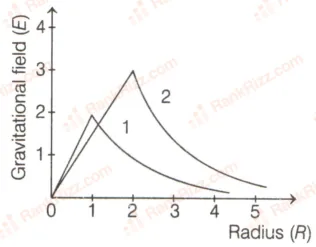
Consider two solid spheres of radii R1=1 m, R2=2 m and masses M1 and M2, respectively. The gravitational field due to sphere (1) and (2) are shown. The value of M2M1 is:
An asteroid is moving directly towards the centre of the earth. When at a distance of 10R (R is the radius of the earth) from the centre of the earth, it has a speed of 12 km s−1. Neglecting the effect of earth's atmosphere, what will be the speed of the asteroid when it hits the surface of the earth (escape velocity from the earth is 11.2 km s−1)? Give your answer to the nearest integer in km s−1
A satellite of mass M is launched vertically upwards with an initial speed u from the surface of the earth. After it reaches height R (R = radius of the earth), it ejects a rocket of mass 10M so that subsequently the satellite moves in a circular orbit. The kinetic energy of the rocket is (G is the gravitational constant; Me is the mass of the earth):
JEE MAIN 2020 · 07 JAN S2Acceleration due to gravity and its variation
A box weighs 196 N on a spring balance at the north pole. Its weight recorded on the same balance if it is shifted to the equator is close to (Take g = 10 ms−2 at the north pole and the radius of the earth = 6400 km):
JEE MAIN 2019 · 12 APR S2Acceleration due to gravity and its variation
The ratio of the weights of a body on Earth's surface to that on the surface of a planet is 9:4. The mass of the planet is 91th of that of the Earth. If R is the radius of the Earth, what is the radius of the planet? (Take the planets to have the same mass density)
JEE MAIN 2019 · 10 APR S1Acceleration due to gravity and its variation
The value of acceleration due to gravity at Earth's surface is 9.8 m s−2. The altitude above its surface at which the acceleration due to gravity decreases to 4.9 m s−2, is close to: (Radius of earth = 6.4×10⁶ m)
JEE MAIN 2019 · 10 APR S2Kepler's laws and planetary motion
A spaceship orbits around a planet at a height of 20 km from its surface. Assuming that only gravitational field of the planet acts on the spaceship, what will be the number of complete revolutions made by the spaceship in 24 hours around the planet? [Given: Mass of planet = 8×10²² kg, Radius of planet = 2×10⁶ m, Gravitational constant G = 6.67×10⁻¹¹ Nm2/kg2]
JEE MAIN 2019 · 09 APR S1Gravitational field and potential of rings, shells and spheres
A solid sphere of mass M and radius a is surrounded by a uniform concentric spherical shell of thickness 2a and mass 2M. The gravitational field at distance 3a from the centre will be:
A test particle is moving in a circular orbit in the gravitational field produced by a mass density ρ(r)=r2K. Identify the current relation between the radius R of the particle's orbit and its period T:
JEE MAIN 2019 · 08 APR S1Kepler's laws and planetary motion
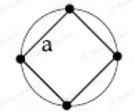
Four identical particles of mass M are located at the corners of a square of side 'a'. What should be their speed if each of them revolves under the influence of other's gravitational field in a circular orbit circumscribing the square?
JEE MAIN 2019 · 08 APR S2Satellites: orbital speed, period, energy and geostationary orbits
A rocket has to be launched from earth in such a way that it never returns. If E is the minimum energy delivered by the rocket launcher, what should be the minimum energy that the launcher should have, if the same rocket is to be launched from the surface of the moon? Assume that the density of the earth and the moon are equal and that the earth's volume is 64 times the volume of the moon.
JEE MAIN 2019 · 12 JAN S1Satellites: orbital speed, period, energy and geostationary orbits
A satellite of mass M is in a circular orbit of radius R about the center of the earth. A meteorite of the same mass, falling towards the earth, collides with the satellite completely inelastic. The speeds of the satellite and the meteorite are the same, just before the collision. The subsequent motion of the combined body will be: