RankRizz

Gravitation — JEE Main Previous Year Questions

Every Gravitation question JEE Main has set from 2004–2026, grouped by the idea it tests rather than the order of the syllabus. 205 questions across 7 distinct ideas. Free to read, answer key on every one.

DATA UPDATED

Questions

205

Distinct ideas

7

Share of marks

2%

Difficulty

MEDIUM

The ideas inside Gravitation

A chapter is not one subject — it is a handful of procedures the examiner reuses. These are the ones Gravitation questions actually test.

Every Gravitation question

101–120 OF 205 · NEWEST FIRST

JEE MAIN 2022 · 26 JUN S2Acceleration due to gravity and its variation

Given below are two statements. One is labelled as Assertion A and the other is labelled as Reason R.
Assertion A: If we move from poles to equator, the direction of acceleration due to gravity of earth always points towards the center of earth without any variation in its magnitude.
Reason R: At equator, the direction of acceleration due to the gravity is towards the center of earth.
In the light of above statements, choose the correct answer from the options given below

  1. A

    Assertion and reason both are correct and reason is correct explanation of assertion.

  2. B

    Assertion and reason both are correct but reason is not correct explanation of assertion.

  3. C

    Assertion is true but reason is false

  4. D

    Assertion is false but reason is true
JEE MAIN 2022 · 25 JUN S1Acceleration due to gravity and its variation

The height of any point PP above the surface of earth is equal to diameter of earth. The value of acceleration due to gravity at point PP will be : (Given gg = acceleration due to gravity at the surface of earth).

  1. A

    g2\frac{g}{2}

  2. B

    g4\frac{g}{4}

  3. C

    g3\frac{g}{3}

  4. D

    g9\frac{g}{9}

JEE MAIN 2022 · 25 JUN S2Satellites: orbital speed, period, energy and geostationary orbits

Two satellites S1S_1 and S2S_2 are revolving in circular orbits around a planet with radius R1=3200R_1 = 3200 km and R2=800R_2 = 800 km respectively. The ratio of speed of satellite S1S_1 to the speed of satellite S2S_2 in their respective orbits would be 1x\frac{1}{x} where x=x = ______.

JEE MAIN 2022 · 24 JUN S1Acceleration due to gravity and its variation

The approximate height from the surface of earth at which the weight of the body becomes 13\frac{1}{3} of its weight on the surface of earth is :
[Radius of earth R=6400R = 6400 km and 3=1.732\sqrt{3} = 1.732]

  1. A

    3840 km

  2. B

    4685 km

  3. C

    2133 km

  4. D

    4267 km

JEE MAIN 2022 · 24 JUN S2Kepler's laws and planetary motion

The distance between Sun and Earth is RR. The duration of year if the distance between Sun and Earth becomes 3R3R will be :

  1. A

    3\sqrt{3} yr

  2. B

    333\sqrt{3} yr

  3. C

    33 yr

  4. D

    99 yr

JEE MAIN 2021 · 01 SEP S2Kepler's laws and planetary motion

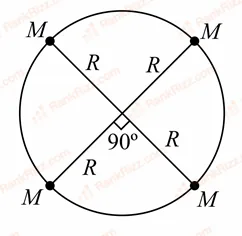
Four particles each of mass MM, move along a circle of radius RR under the action of their mutual gravitational attraction as shown in figure. The speed of each particle is:

Figure for JEE Main 2021 Physics question on Kepler's laws and planetary motion
  1. A

    12GMR(22+1)\frac{1}{2}\sqrt{\frac{GM}{R}(2\sqrt{2}+1)}

  2. B

    12GMR(22+1)\frac{1}{2}\sqrt{\frac{GM}{R(2\sqrt{2}+1)}}

  3. C

    12GMR(22−1)\frac{1}{2}\sqrt{\frac{GM}{R}(2\sqrt{2}-1)}

  4. D

    GMR\sqrt{\frac{GM}{R}}

JEE MAIN 2021 · 01 SEP S2Kepler's laws and planetary motion

Two satellites revolve around a planet in coplanar circular orbits in anticlockwise direction. Their period of revolutions are 1 hour and 8 hours respectively. The radius of the orbit of nearer satellite is 2×1032 \times 10^3 km. The angular speed of the farther satellite as observed from the nearer satellite at the instant when both the satellites are closest is πx\frac{\pi}{x} rad h−1^{-1}, where xx is _________.

JEE MAIN 2021 · 31 AUG S1Escape speed

The masses and radii of the earth and moon are (M1,R1)(M_1, R_1) and (M2,R2)(M_2, R_2) respectively. Their centres are at a distance rr apart. Find the minimum escape velocity for a particle of mass mm to be projected from the middle of these two masses:

  1. A

    ve=4G(M1+M2)rv_e = \sqrt{\frac{4G(M_1+M_2)}{r}}

  2. B

    ve=122G(M1+M2)rv_e = \frac{1}{2}\sqrt{\frac{2G(M_1+M_2)}{r}}

  3. C

    ve=124G(M1+M2)rv_e = \frac{1}{2}\sqrt{\frac{4G(M_1+M_2)}{r}}

  4. D

    ve=2G(M1+M2)rv_e = \frac{\sqrt{2G(M_1+M_2)}}{r}

JEE MAIN 2021 · 31 AUG S2Acceleration due to gravity and its variation

If RER_E be the radius of Earth, then the ratio between the acceleration due to gravity at a depth rr below and a height rr above the earth surface is: (Given: r<REr \lt R_E)

  1. A

    1+rRE−r2RE2−r3RE31 + \frac{r}{R_E} - \frac{r^2}{R_E^2} - \frac{r^3}{R_E^3}

  2. B

    1+rRE+r2RE2+r3RE31 + \frac{r}{R_E} + \frac{r^2}{R_E^2} + \frac{r^3}{R_E^3}

  3. C

    1−rRE−r2RE2−r3RE31 - \frac{r}{R_E} - \frac{r^2}{R_E^2} - \frac{r^3}{R_E^3}

  4. D

    1+rRE−r2RE2+r3RE31 + \frac{r}{R_E} - \frac{r^2}{R_E^2} + \frac{r^3}{R_E^3}

JEE MAIN 2021 · 27 AUG S1Gravitational potential energy of systems

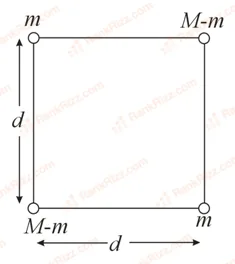
A body of mass (2M)(2M) splits into four masses {m,M−m,m,M−m}\{m, M-m, m, M-m\}, which are rearranged to form a square as shown in the figure. The ratio of Mm\frac{M}{m} for which, the gravitational potential energy of the system becomes maximum is x:1x : 1. The value of xx is _________.

Figure for JEE Main 2021 Physics question on Gravitational potential energy of systems
JEE MAIN 2021 · 27 AUG S2Gravitational potential energy of systems

A mass of 50 kg is placed at the center of a uniform spherical shell of mass 100 kg and radius 50 m. If the gravitational potential at a point, 25 m from the center is VV kg m−1^{-1}. The value of VV is:

  1. A

    +2GG

  2. B

    -20GG

  3. C

    -4GG

  4. D

    -60GG

JEE MAIN 2021 · 26 AUG S1Gravitational potential energy of systems

Inside a uniform spherical shell:
(a) The gravitational field is zero.
(b) The gravitational potential is zero.
(c) The gravitational field is the same everywhere.
(d) The gravitation potential is the same everywhere.
(e) All the above.
Choose the most appropriate answer from the options given below:

  1. A

    (a), (c) and (d) only

  2. B

    (a), (b) and (c) only

  3. C

    (b), (c) and (d) only

  4. D

    (e) only

JEE MAIN 2021 · 27 JUL S1Gravitational potential energy of systems

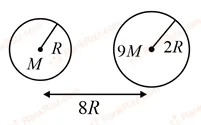
Suppose two planets (spherical in shape) of radii RR and 2R2R, but mass MM and 9M9M respectively have a centre to centre separation 8R8R as shown in the figure. A satellite of mass mm is projected from the surface of the planet of mass MM directly towards the centre of the second planet. The minimum speed vv required for the satellite to reach the surface of the second planet is a7GMR\sqrt{\frac{a}{7} \frac{GM}{R}}, then the value of aa is
[Given: The two planets are fixed in their position]

Figure for JEE Main 2021 Physics question on Gravitational potential energy of systems
JEE MAIN 2021 · 27 JUL S2Kepler's laws and planetary motion

Two identical particles of mass 1 kg each go round a circle of radius RR, under the action of their mutual gravitational attraction. The angular speed of each particle is:

  1. A

    G2R3\sqrt{\frac{G}{2R^3}}

  2. B

    12GR3\frac{1}{2}\sqrt{\frac{G}{R^3}}

  3. C

    12R1G\frac{1}{2R}\sqrt{\frac{1}{G}}

  4. D

    2GR3\sqrt{\frac{2G}{R^3}}

JEE MAIN 2021 · 27 JUL S2Escape speed

The planet Mars has two moons, if one of them has a period 7 hours, 30 minutes and an orbital radius of 9.0×1039.0 \times 10^3 km. Find the mass of Mars.
{Given 4π2G=6×10¹¹ N−1 m−2 kg2}\left\{\text{Given } \frac{4\pi^2}{G} = 6 \times 10^{11} \text{ N}^{-1} \text{ m}^{-2} \text{ kg}^2\right\}

  1. A

    5.96×10195.96 \times 10^{19} kg

  2. B

    3.25×10213.25 \times 10^{21} kg

  3. C

    7.02×10257.02 \times 10^{25} kg

  4. D

    6.00×10236.00 \times 10^{23} kg

JEE MAIN 2021 · 25 JUL S1Kepler's laws and planetary motion

The minimum and maximum distances of a planet revolving around the Sun are x1x_1 and x2x_2. If the minimum speed of the planet on its trajectory is v0v_0, then its maximum speed will be:

  1. A

    v0x12x22\frac{v_0 x_1^2}{x_2^2}

  2. B

    v0x22x12\frac{v_0 x_2^2}{x_1^2}

  3. C

    v0x1x2\frac{v_0 x_1}{x_2}

  4. D

    v0x2x1\frac{v_0 x_2}{x_1}

JEE MAIN 2021 · 25 JUL S2Acceleration due to gravity and its variation

Consider a planet in some solar system that has a mass double the mass of earth and density equal to the average density of the earth. If the weight of an object on earth is WW, the weight of the same object on that planet will be:

  1. A

    2W2W

  2. B

    WW

  3. C

    213W2^{\frac{1}{3}}W

  4. D

    2 W\sqrt{2} \, W

JEE MAIN 2021 · 22 JUL S1Gravitational potential energy of systems

A body is projected vertically upwards from the surface of earth with a velocity sufficient enough to carry it to infinity. The time taken by it to reach height hh is ___ s.

  1. A

    Re2g[(1+hRe)3/2−1]\sqrt{\frac{R_e}{2g}}\left[\left(1 + \frac{h}{R_e}\right)^{3/2} - 1\right]

  2. B

    2Reg[(1+hRe)3/2−1]\sqrt{\frac{2R_e}{g}}\left[\left(1 + \frac{h}{R_e}\right)^{3/2} - 1\right]

  3. C

    13Re2g[(1+hRe)3/2−1]\frac{1}{3}\sqrt{\frac{R_e}{2g}}\left[\left(1 + \frac{h}{R_e}\right)^{3/2} - 1\right]

  4. D

    132Reg[(1+hRe)3/2−1]\frac{1}{3}\sqrt{\frac{2R_e}{g}}\left[\left(1 + \frac{h}{R_e}\right)^{3/2} - 1\right]

JEE MAIN 2021 · 20 JUL S1Acceleration due to gravity and its variation

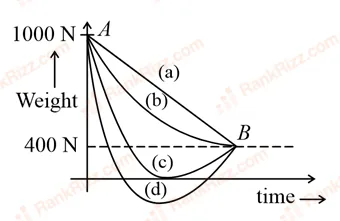
A person whose mass is 100 kg travels from Earth to Mars in a spaceship. Neglect all other objects in sky and take acceleration due to gravity on the surface of the Earth and Mars as 10 m s−2^{-2} and 4 m s−2^{-2}, respectively. Identify from the below figures, the curve that fits best for the weight of the passenger as a function of time.

Figure for JEE Main 2021 Physics question on Acceleration due to gravity and its variation
  1. A

    (c)

  2. B

    (a)

  3. C

    (d)

  4. D

    (b)

JEE MAIN 2021 · 20 JUL S2Satellites: orbital speed, period, energy and geostationary orbits

A satellite is launched into a circular orbit of radius RR around earth, while a second satellite is launched into a circular orbit of radius 1.02 RR. The percentage difference in the time periods of the two satellites is:

  1. A

    1.5

  2. B

    2.0

  3. C

    0.7

  4. D

    3.0