JEE MAIN 2019 · 12 JAN S1Kepler's laws and planetary motion
A straight rod of length L extends from to . The gravitational force it exerts on a point mass 'm' at , if the mass per unit length of the rod is , is given by:
- A
- B
- C
- D
Every Gravitation question JEE Main has set from 2004–2026, grouped by the idea it tests rather than the order of the syllabus. 205 questions across 7 distinct ideas. Free to read, answer key on every one.
DATA UPDATED
Questions
205
Distinct ideas
7
Share of marks
2%
Difficulty
MEDIUM
A chapter is not one subject — it is a handful of procedures the examiner reuses. These are the ones Gravitation questions actually test.
161–180 OF 205 · NEWEST FIRST
A straight rod of length L extends from to . The gravitational force it exerts on a point mass 'm' at , if the mass per unit length of the rod is , is given by:
Two satellites, A and B, have masses m and 2m respectively. A is in a circular orbit of radius R and B is in a circular orbit of radius 2R around the earth. The ratio of their kinetic energies, is:
2
1
A satellite is revolving in a circular orbit at a height h from the earth surface, such that where R is the radius of the earth. Assuming that the effect of earth's atmosphere can be neglected the minimum increase in the speed required so that the satellite could escape from the gravitational field of earth is
A satellite is moving with a constant speed in circular orbit around the earth. An object of mass '' is ejected from the satellite such that it just escapes from the gravitational pull of the earth. At the time of ejection, the kinetic energy of the object is:
Two stars of masses kg each, and at distance m rotate in a plane about their common centre of mass O. A meteorite passes through O moving perpendicular to the star's rotation plane. In order to escape from the gravitational field of this double star, the minimum speed that meteorite should have at O is: (Take Gravitational constant N m kg)
m s
m s
m s
m s
If the angular momentum of a planet of mass , moving around the Sun in a circular orbit is , about the center of the Sun, its areal velocity is:
The energy required to take a satellite to a height above the Earth surface (radius of Earth km) is , and the kinetic energy required for the satellite to be in a circular orbit at this height is . The value of for which and are equal, is:
km
km
km
km
Suppose that the angular velocity of rotation of the Earth is increased. Then, as a consequence:
weight of the object, everywhere on the earth, will decrease.
weight of the object, everywhere on the earth, will increase.
except at poles, weight of the object on the earth, will decrease.
there will be no change in weight anywhere on the earth.
A body of mass m is moving in a circular orbit of radius R about a planet of mass M. At some instant, it splits into two equal masses. The first mass moves in a circular orbit of radius , and the other mass, in a circular orbit of radius . The difference between the final and initial total energies is:
Take the mean distance of the moon and the sun from the earth to be km and km respectively. Their masses are kg and kg respectively. The radius of the earth is 6400 km. Let be the difference in the forces exerted by the moon at the nearest and farthest points on the earth and be the difference in the force exerted by the sun at the nearest and farthest points on the earth. Then, the number closest to is:
2
6
0.6
A particle is moving with a uniform speed in a circular orbit of radius R in a central force inversely proportional to the power of R. If the period of rotation of the particle is T, then:
for any n
The mass density of a spherical body is given by for and for , where is the distance from the center. The correct graph that describes qualitatively the acceleration, of a test particle as a function of is:
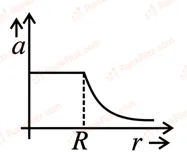
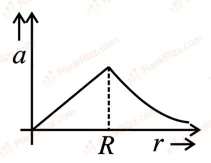
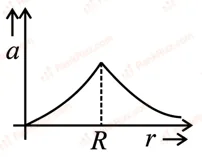
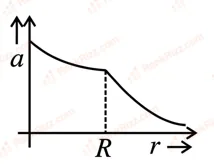
If the Earth has no rotational motion, the weight of a person on the equator is . Determine the speed with which the earth would have to rotate about its axis so that the person at the equator will weigh . The radius of the Earth is 6400 km and m s.
rad s
rad s
rad s
rad s
The variation of acceleration due to gravity with distance from the centre of the earth is best represented by ( = Earth's radius):
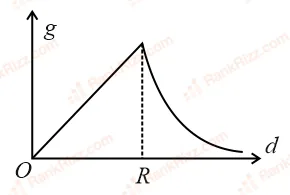
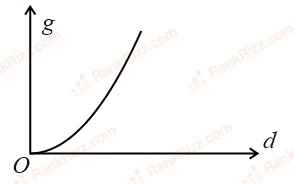
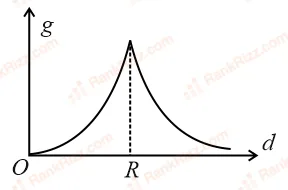
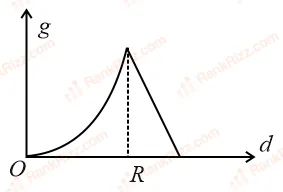
An astronaut of mass is working on a satellite orbiting the earth at a distance from the earth's surface. The radius of the earth is , while its mass is . The gravitational pull on the astronaut is
Zero since astronaut feels weightless
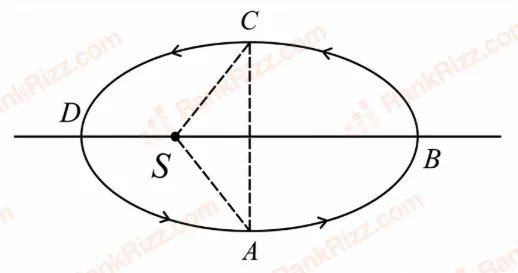
The figure shows an elliptical path of a planet around the sun such that the area of triangle is the area of the ellipse (see the figure below) with as the major axis, and as the minor axis. If is the time taken for the planet to go over the path and for the path taken over then:
A satellite is revolving in a circular orbit at a height from the earth's surface (radius of earth ; ). The minimum increase in its orbital velocity required, so that the satellite could escape from the earth's gravitational field, is close to (Neglect the effect of atmosphere.)
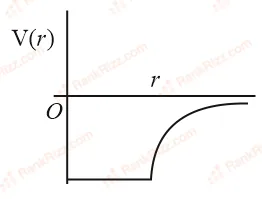
Which of the following most closely depicts the correct variation of the gravitation potential, with distance due to a large planet of radius and uniform mass density? (figures are not drawn to scale)
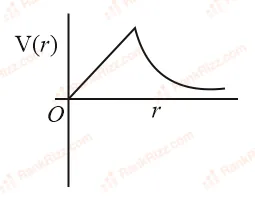
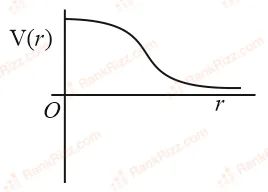
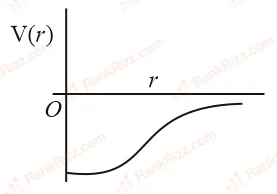
A very long (length ) cylindrical galaxy is made of uniformly distributed mass and has radius . A star outside the galaxy is orbiting the galaxy in a plane perpendicular to the galaxy and passing through its centre. If the time period of the star is and its distance from the galaxy's axis is , then
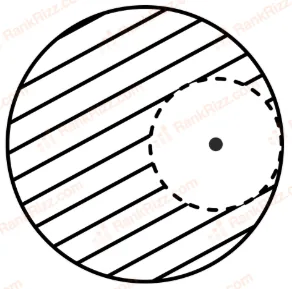
From a solid sphere of mass and radius , a spherical portion of radius is removed as shown in the figure. Taking gravitational potential at , the potential at the centre of the cavity thus formed is ( = gravitational constant)
JEE Advanced has set 21 Gravitation questions too. Gravitation JEE Advanced PYQs →
OTHER PHYSICS CHAPTERS