A planet (P) is moving around the star of mass 2M in the orbit of radius R. Another planet (P) is moving around another star of mass 4M in a orbit of radius 2R. Ratio of time periods of revolution of P and P is __________.
- A
- B
- C
- D
Kepler's laws and planetary motion has been asked 45 times in JEE Main, in 13 different years between 2004 and 2026, and in all of the last five exam years (2022–2026), 21 questions in all. That is 22% of Gravitation, one of its three most-asked topics. Last asked in JEE Main 02 Apr 2026, Shift 1. 43 are multiple choice and 2 numerical-value; 18 easy, 23 medium and 2 hard by our difficulty labels. All of them are below, newest first, free to read.
Questions
45
Years asked
13
Since
2004
Of the chapter
22%
Questions on Kepler's laws and planetary motion in every year it was asked, newest first.
| Year | Relative frequency | Questions |
|---|---|---|
| 2026 | 2 | |
| 2025 | 4 | |
| 2024 | 4 | |
| 2023 | 6 | |
| 2022 | 5 | |
| 2021 | 9 | |
| 2020 | 1 | |
| 2019 | 4 | |
| 2018 | 3 | |
| 2016 | 2 | |
| 2014 | 3 | |
| 2013 | 1 | |
| 2004 | 1 | |
| Total | 45 |
1–20 OF 45 · NEWEST FIRST
A planet (P) is moving around the star of mass 2M in the orbit of radius R. Another planet (P) is moving around another star of mass 4M in a orbit of radius 2R. Ratio of time periods of revolution of P and P is __________.
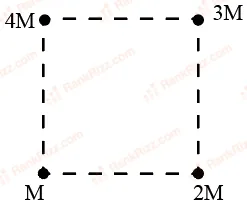
Net gravitational force at the center of a square is found to be when four particles having mass and are placed at the four corners of the square as shown in the figure and it is when the positions of and are interchanged. The ratio is The value of is _________.

1
2
3
Given below are two statements : one is labelled as Assertion (A) and the other is labelled as Reason (R).
Assertion (A) : The radius vector from the Sun to a planet sweeps out equal areas in equal intervals of time and thus areal velocity of planet is constant.
Reason (R) : For a central force field the angular momentum is a constant.
In the light of about statement, Choose the most appropriate answer from the option given below :
Both (A) and (R) are correct and (R) is the correct explanation of (A)
Both (A) and (R) are correct but (R) is not the correct explanation of (A)
(A) is correct but (R) is not correct
(A) is not correct but (R) is correct
Three identical spheres of mass m, are placed at the vertices of an equilateral triangle of length a. When released, they interact only through gravitational force and collide after a time seconds. If the sides of the triangle are increased to length 2a and also the masses of the spheres are made 2m, then they will collide after _________ seconds.
A satellite is launched into a circular orbit of radius around the earth. A second satellite is launched into an orbit of radius The time period of revolution of the second satellite is larger than the first one approximately by:
9%
3%
4.5%
2.5%
If a satellite orbiting the Earth is 9 times closer to the Earth than the Moon, what is the time period of rotation of the satellite? Given rotational time period of Moon =27 days and gravitational attraction between the satellite and the moon is neglected.
27 days
1 days
81 days
3 days
Two planets and having masses and move around the sun in circular orbits of and radii respectively. If angular momentum of is and that of is , the ratio of time period is:
A light planet is revolving around a massive star in a circular orbit of radius with a period of revolution . If the force of attraction between planet and star is proportional to then choose the correct option:
Four identical particles of mass are kept at the four corners of a square. If the gravitational force exerted on one of the masses by the other masses is , the length of the sides of the square is
A planet takes days to complete one revolution around the Sun. If the distance of the planet from Sun is reduced to one fourth of the original distance, how many days will it take to complete one revolution?
Two identical particles each of mass go round a circle of radius under the action of their mutual gravitational attraction. The angular speed of each particle will be :
A planet has double the mass of the earth. Its average density is equal to that of the earth. An object weighing on earth will weigh on that planet:
Two particles of equal mass move in a circle of radius under the action of their mutual gravitational attraction. The speed of each particle will be:
The time period of a satellite of earth is hours. If the separation between the earth and the satellite is decreased to one fourth of the previous value, then its new time period will become.
hours
hours
hours
hours
Every planet revolves around the sun in an elliptical orbit:
A. The force acting on a planet is inversely proportional to square of distance from sun.
B. Force acting on planet is inversely proportional to product of the masses of the planet and the sun.
C. The centripetal force acting on the planet is directed away from the sun.
D. The square of time period of revolution of planet around sun is directly proportional to cube of semi-major axis of elliptical orbit.
Choose the correct answer from the options below:
A and D only
C and D only
B and C only
A and C only
If the distance of the earth from Sun is km, then the distance of an imaginary planet from Sun, if its period of revolution is 2.83 years is:
km
km
km
km
Three identical particles , and of mass each are placed in a straight line with . The gravitational force on a fourth particle of the same mass is , when placed at a distance from the particle on the perpendicular bisector of the line . The value of will be approximately
The time period of a satellite revolving around earth in a given orbit is 7 hours. If the radius of orbit is increased to three times its previous value, then approximate new time period of the satellite will be
36 hours
40 hours
30 hours
25 hours
Two planets and of equal mass are having their period of revolutions and such that . These planets are revolving in the circular orbits of radii and respectively. Which out of the following would be the correct relationship of their orbits?
Two objects of equal masses placed at certain distance from each other attracts each other with a force of . If one-third mass of one object is transferred to the other object, then the new force will be