RankRizz

Gravitation — JEE Main Previous Year Questions

Every Gravitation question JEE Main has set from 2004–2026, grouped by the idea it tests rather than the order of the syllabus. 205 questions across 7 distinct ideas. Free to read, answer key on every one.

DATA UPDATED

Questions

205

Distinct ideas

7

Share of marks

2%

Difficulty

MEDIUM

The ideas inside Gravitation

A chapter is not one subject — it is a handful of procedures the examiner reuses. These are the ones Gravitation questions actually test.

Every Gravitation question

181–200 OF 205 · NEWEST FIRST

JEE MAIN 2014 · 19 APR ONLINEGravitational field and potential of rings, shells and spheres

The gravitational field in a region is given by g⃗=(5i^+12j^)\vec{g} = (5\hat{i} + 12\hat{j}) N kg−1^{-1}. The change in the gravitational potential energy of a particle of mass 2 kg when it is taken from the origin to a point (7 m, −3-3 m) is:

  1. A

    71 J

  2. B

    135813\sqrt{58} J

  3. C

    2 J

  4. D

    1 J

JEE MAIN 2014 · 12 APR ONLINEGravitational potential energy of systems

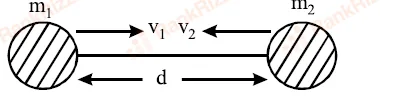
Two hypothetical planets of masses m1_1 and m2_2 are at rest when they are infinite distance apart. Because of the gravitational force they move towards each other along the line joining their centres. What is their speed when their separation is 'd'? (Speed of m1_1 is v1_1 and that of m2_2 is v2_2)

Figure for JEE Main 2014 Physics question on Gravitational potential energy of systems
  1. A

    v1=v2v_1 = v_2

  2. B

    v1=m22Gd(m1+m2)v_1 = m_2\sqrt{\frac{2G}{d(m_1+m_2)}}, v2=m12Gd(m1+m2)v_2 = m_1\sqrt{\frac{2G}{d(m_1+m_2)}}

  3. C

    v1=m12Gd(m1+m2)v_1 = m_1\sqrt{\frac{2G}{d(m_1+m_2)}}, v2=m22Gd(m1+m2)v_2 = m_2\sqrt{\frac{2G}{d(m_1+m_2)}}

  4. D

    v1=m22Gm1v_1 = m_2\sqrt{\frac{2G}{m_1}}, v2=m22Gm2v_2 = m_2\sqrt{\frac{2G}{m_2}}

JEE MAIN 2014 · 11 APR ONLINEKepler's laws and planetary motion

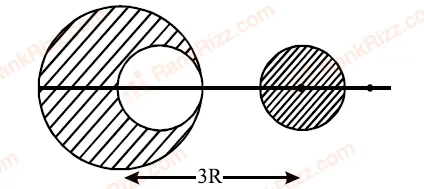
From a sphere of mass M and radius R, a smaller sphere of radius R2\frac{R}{2} is carved out such that the cavity made in the original sphere is between its centre and the periphery (see the figure). For the configuration in the figure where the distance between the centre of the original sphere and the removed sphere is 3R, the gravitational force between the two spheres is:

Figure for JEE Main 2014 Physics question on Kepler's laws and planetary motion
  1. A

    41GM23600R2\frac{41GM^2}{3600R^2}

  2. B

    41GM2450R2\frac{41GM^2}{450R^2}

  3. C

    59GM2450R2\frac{59GM^2}{450R^2}

  4. D

    GM2225R2\frac{GM^2}{225R^2}

JEE MAIN 2014 · 09 APR ONLINEKepler's laws and planetary motion

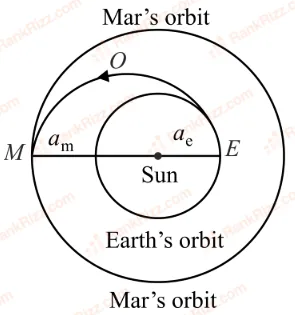
India's Mangalyan was sent to the Mars by launching it into a transfer orbit EOM around the sun. It leaves the earth at E and meets Mars at M. If the semi-major axis of Earth's orbit is ae=1.5×10¹¹a_e = 1.5 \times 10^{11} m, that of Mar's orbit am=2.28×10¹¹a_m = 2.28 \times 10^{11} m, taking Kepler's laws, give the estimate of time for Mangalyan to reach Mars from Earth.

Figure for JEE Main 2014 Physics question on Kepler's laws and planetary motion
  1. A

    220 days

  2. B

    500 days

  3. C

    260 days

  4. D

    320 days

JEE MAIN 2014 · 06 APR OFFLINEKepler's laws and planetary motion

Four particles, each of mass MM and equidistant from each other, move along a circle of radius RR under the action of their mutual gravitational attraction. The speed of each particle is:

  1. A

    GMR\sqrt{\frac{GM}{R}}

  2. B

    22GMR\sqrt{2\sqrt{2}\frac{GM}{R}}

  3. C

    GMR(1+22)\sqrt{\frac{GM}{R}\left(1 + 2\sqrt{2}\right)}

  4. D

    12GMR(1+22)\frac{1}{2}\sqrt{\frac{GM}{R}\left(1 + 2\sqrt{2}\right)}

JEE MAIN 2013 · 25 APR ONLINEGravitational field and potential of rings, shells and spheres

The gravitational field in a region is given by: E⃗=(5N/kg)i^+(12N/kg)j^\vec{E} = (5N/kg)\hat{i} + (12N/kg)\hat{j}. If the potential at the origin is taken to be zero, then the ratio of the potential at the points (12 m, 0) and (0, 5 m) is :

  1. A

    Zero

  2. B

    1

  3. C

    14425\frac{144}{25}

  4. D

    25144\frac{25}{144}

JEE MAIN 2013 · 22 APR ONLINEKepler's laws and planetary motion

The change in the value of acceleration of earth towards sun, when the moon comes from the position of solar eclipse to the position on the other side of earth in line with sun is: (mass of the moon = 7.36×10227.36 \times 10^{22} kg, radius of the moon's orbit = 3.8×1083.8 \times 10^8 m).

  1. A

    6.73×10−56.73 \times 10^{-5} m/s2^2

  2. B

    6.73×10−36.73 \times 10^{-3} m/s2^2

  3. C

    6.73×10−26.73 \times 10^{-2} m/s2^2

  4. D

    6.73×10−46.73 \times 10^{-4} m/s2^2

JEE MAIN 2013 · 09 APR ONLINEGravitational field and potential of rings, shells and spheres

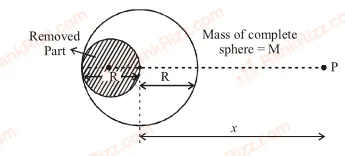
The gravitational field, due to the 'left over part' of a uniform sphere (from which a part as shown, has been 'removed out'), at a very far off point, P, located as shown, would be (nearly) :

Figure for JEE Main 2013 Physics question on Gravitational field and potential of rings, shells and spheres
  1. A

    56GMx2\frac{5}{6}\frac{GM}{x^2}

  2. B

    89GMx2\frac{8}{9}\frac{GM}{x^2}

  3. C

    78GMx2\frac{7}{8}\frac{GM}{x^2}

  4. D

    67GMx2\frac{6}{7}\frac{GM}{x^2}

JEE MAIN 2013 · 07 APR ONLINEEscape speed

What is the minimum energy required to launch a satellite of mass m from the surface of a planet of mass M and radius R in a circular orbit at an altitude of 2R?

  1. A

    GmM2R\frac{GmM}{2R}

  2. B

    GmM3R\frac{GmM}{3R}

  3. C

    5GmM6R\frac{5GmM}{6R}

  4. D

    2GmM3R\frac{2GmM}{3R}

JEE MAIN 2012Escape speed

The mass of a spaceship is 10001000 kg. It is to be launched from the earth's surface out into free space. The value of ′g′'g' and ′R′'R' (radius of earth) are 10 m/s210\ m/s^2 and 64006400 km respectively. The required energy for this work will be:

  1. A

    6.4×10116.4 \times 10^{11} Joules

  2. B

    6.4×1086.4 \times 10^{8} Joules

  3. C

    6.4×1096.4 \times 10^{9} Joules

  4. D

    6.4×10106.4 \times 10^{10} Joules

JEE MAIN 2012Acceleration due to gravity and its variation

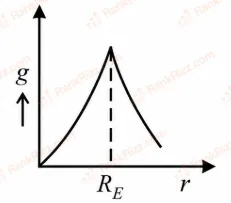
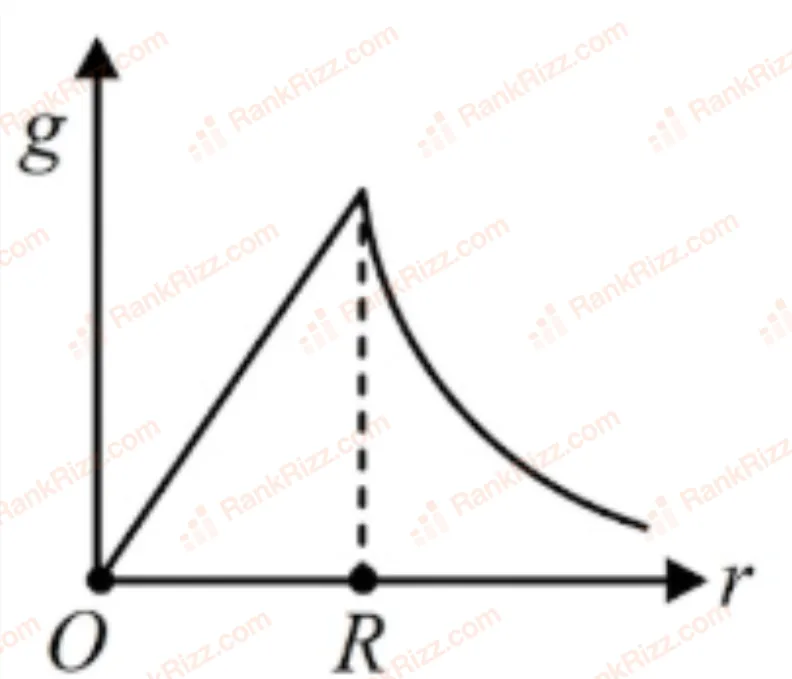
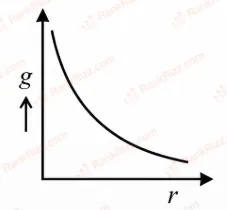
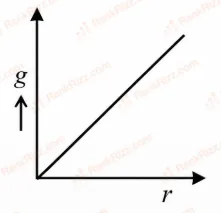
Which graph correctly presents the variation of acceleration due to gravity with the distance from the centre of the earth (radius of the earth = RER_E)?

  1. A
    Figure for JEE Main 2012 Physics question on Acceleration due to gravity and its variation
  2. B
    Figure for JEE Main 2012 Physics question on Acceleration due to gravity and its variation
  3. C
    Figure for JEE Main 2012 Physics question on Acceleration due to gravity and its variation
  4. D
    Figure for JEE Main 2012 Physics question on Acceleration due to gravity and its variation
JEE MAIN 2012Gravitational field and potential of rings, shells and spheres

A point particle is held on the axis of a ring of mass mm and radius rr at a distance rr from its centre CC. When released, it reaches CC under the gravitational attraction of the ring. Its speed at CC will be

  1. A

    2Gmr(2−1)\sqrt{\frac{2Gm}{r}(\sqrt{2}-1)}

  2. B

    Gmr\sqrt{\frac{Gm}{r}}

  3. C

    2Gmr(1−12)\sqrt{\frac{2Gm}{r}\left(1 - \frac{1}{\sqrt{2}}\right)}

  4. D

    2Gmr\sqrt{\frac{2Gm}{r}}

JEE MAIN 2012Satellites: orbital speed, period, energy and geostationary orbits

Two point masses of mass m1=fMm_1 = fM and m2=(1−f)M (f<1)m_2 = (1-f)M\ (f<1) are in outer space (far from gravitational influence of other objects) at a distance RR from each other. They move in circular orbits about their centre of mass with angular velocities ω1\omega_1 for m1m_1 and ω2\omega_2 for m2m_2. In that case

  1. A

    (1−f)ω1=fω(1-f)\omega_1 = f\omega

  2. B

    ω1=ω2\omega_1 = \omega_2 and independent of ff

  3. C

    fω1=(1−f)ω2f\omega_1 = (1-f)\omega_2

  4. D

    ω1=ω2\omega_1 = \omega_2 and depend on ff

JEE MAIN 2012Acceleration due to gravity and its variation

Assuming the earth to be a sphere of uniform density, the acceleration due to gravity inside the earth at a distance of rr from the centre is proportional to

  1. A

    rr

  2. B

    r−1r^{-1}

  3. C

    r2r^2

  4. D

    r−2r^{-2}

JEE MAIN 2011Gravitational field and potential of rings, shells and spheres

Two bodies of masses mm and 4m4m are placed at a distance rr. The gravitational potential at a point on the line joining them where the gravitational field is zero is:

  1. A

    −4Gmr-\dfrac{4Gm}{r}

  2. B

    −6Gmr-\dfrac{6Gm}{r}

  3. C

    −9Gmr-\dfrac{9Gm}{r}

  4. D

    zero

JEE MAIN 2009Acceleration due to gravity and its variation

The height at which the acceleration due to gravity becomes g9\frac{g}{9} (where g == the acceleration due to gravity on the surface of the earth) in terms of RR, the radius of the earth is

  1. A

    2R2R

  2. B

    R2\frac{R}{\sqrt{2}}

  3. C

    R2\frac{R}{2}

  4. D

    2R\sqrt{2}R

JEE MAIN 2008Escape speed

A planet in a distant solar system is 10 times more massive than the earth and its radius is 10 times smaller. Given that the escape velocity from the earth is 11 kms−111\ kms^{-1}, the escape velocity from the surface of the planet would be

  1. A

    1.1 kms−11.1\ kms^{-1}

  2. B

    11 kms−111\ kms^{-1}

  3. C

    110 kms−1110\ kms^{-1}

  4. D

    0.11 kms−10.11\ kms^{-1}

JEE MAIN 2008Gravitational field and potential of rings, shells and spheres

This question contains Statement-1 and Statement-2. Of the four choices given after the statements, choose the one that best describes the two statements. Statement - I: For a mass MM kept at the centre of a cube of side 'aa', the flux of gravitational field passing through its sides is 4πGM4\pi GM. Statement - II: If the direction of a field due to a point source is radial and its dependence on the distance 'rr' for the source is given as 1/r21/r^2, its flux through a closed surface depends only on the strength of the source enclosed by the surface and not on the size or shape of the surface.

  1. A

    Statement-1 is false, Statement-2 is true.

  2. B

    Statement-1 is true, Statement-2 is true; Statement-2 is correct explanation for Statement-1.

  3. C

    Statement-1 is true, Statement-2 is true; Statement-2 is not a correct explanation for Statement-1.

  4. D

    Statement-1 is true, Statement-2 is False.

JEE MAIN 2005Acceleration due to gravity and its variation

Average density of the earth

  1. A

    does not depend on gg

  2. B

    is a complex function of gg

  3. C

    is directly proportional to gg

  4. D

    is inversely proportional to gg

JEE MAIN 2005Acceleration due to gravity and its variation

The change in the value of gg at a height 'hh' above the surface of the earth is the same as at a depth 'dd' below the surface of earth. When both 'dd' and 'hh' are much smaller than the radius of earth, then which one of the following is correct?

  1. A

    d=h2d = \frac{h}{2}

  2. B

    d=3h2d = \frac{3h}{2}

  3. C

    d=2hd = 2h

  4. D

    d=hd = h