Motion in a Straight Line — JEE Main Previous Year Questions
Every Motion in a Straight Line question JEE Main has set from 2004–2026, grouped by the idea it tests rather than the order of the syllabus. 134 questions across 6 distinct ideas. Free to read, answer key on every one.
A chapter is not one subject — it is a handful of procedures the examiner reuses. These are the ones Motion in a Straight Line questions actually test.
JEE MAIN 2021 · 25 JUL S2Distance, displacement, speed, velocity and acceleration (average vs instantaneous)
The instantaneous velocity of a particle moving in a straight line is given as v=αt+βt2, where α and β are constants. The distance travelled by the particle between 1 s and 2 s is:
JEE MAIN 2021 · 20 JUL S2Relative motion in one dimension
A boy reaches the airport and finds that the escalator is not working. He walks up the stationary escalator in time t1. If he remains stationary on a moving escalator then the escalator takes him up in time t2. The time taken by him to walk up on the moving escalator will be:
JEE MAIN 2021 · 17 MAR S1Equations of motion for uniform acceleration
A car accelerates from rest at a constant rate α for some time after which it decelerates at a constant rate β to come to rest. If the total time elapsed is t seconds, the total distance travelled is:
JEE MAIN 2021 · 17 MAR S2Vertical motion under gravity
A rubber ball is released from a height of 5 m above the floor. It bounces back repeatedly, always rising to 10081 of the height through which it falls. Find the average speed of the ball. (Take g=10 m s−2)
JEE MAIN 2021 · 26 FEB S2Equations of motion for uniform acceleration
A scooter accelerates from rest for time t1 at constant rate a1 and then retards at constant rate a2 for time t2 and comes to rest. The correct value of t2t1 will be:
JEE MAIN 2021 · 25 FEB S1Equations of motion for uniform acceleration
An engine of a train, moving with uniform acceleration, passes the signal-post with velocity u and the last compartment with velocity v. The velocity with which middle point of the train passes the signal post is:
JEE MAIN 2021 · 25 FEB S2Vertical motion under gravity
A stone is dropped from the top of a building. When it crosses a point 5 m below the top, another stone starts to fall from a point 25 m below the top. Both stones reach the bottom of building simultaneously. The height of the building is:
JEE MAIN 2020 · 05 SEP S1Vertical motion under gravity
A helicopter rises from rest on the ground vertically upwards with a constant acceleration g. A food packet is dropped from the helicopter when it is at a height h. The time taken by the packet to reach the ground is close to [g is the acceleration due to gravity]:
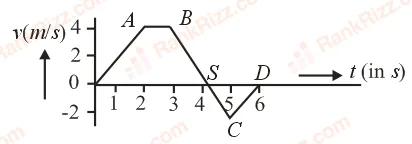
JEE MAIN 2020 · 05 SEP S2Motion graphs: x-t, v-t and a-t
The velocity (v) and time (t) graph of a body in a straight line motion is shown in the figure. The point S is at 4.333 seconds. The total distance covered by the body in 6 s is:
JEE MAIN 2020 · 04 SEP S1Motion graphs: x-t, v-t and a-t
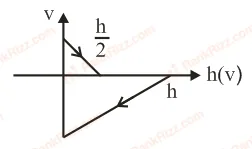
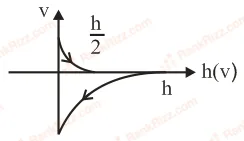
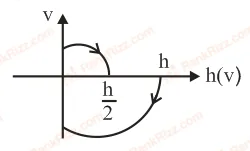
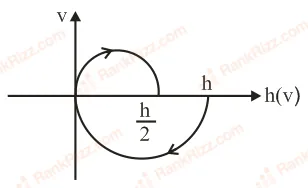
A tennis ball is released from a height h and after freely falling on a wooden floor it rebounds and reaches height h/2. The velocity versus height of the ball during its motion may be represented graphically by: (graphs are drawn schematically and on not to scale)
JEE MAIN 2020 · 04 SEP S2Motion graphs: x-t, v-t and a-t
The speed versus time graph for a particle is shown in the figure. The distance travelled (in m) by the particle during the time interval t = 0 to t = 5 s will be __________
JEE MAIN 2020 · 02 SEP S1Relative motion in one dimension
Train A and train B are running on parallel tracks in the opposite directions with speed of 36 km hour−1 and 72 km hour−1, respectively. A person is walking in train A in the direction opposite to its motion with a speed of 1.8 km hour−1. Speed (in m s−1) of this person as observed from train B will be close to: (take the distance between the tracks as negligible)
JEE MAIN 2020 · 09 JAN S1Non-uniform acceleration using calculus
The distance x covered by a particle in one dimensional motion varies with time t as x2=at2+2bt+c. If the acceleration of the particle depends on x as x−n, where n is an integer, the value of n is ___________.
JEE MAIN 2020 · 08 JAN S2Vertical motion under gravity
A ball is dropped from the top of a 100 m high tower on a planet. In the last 21 s before hitting the ground, it covers a distance of 19 m. Acceleration due to gravity (in m s−2) near the surface on that planet is
JEE MAIN 2019 · 12 APR S2Non-uniform acceleration using calculus
A particle is moving with speed v=bx along positive x-axis. Calculate the speed of the particle at time t=τ (assume that the particle is at origin at t = 0)
JEE MAIN 2019 · 09 APR S2Non-uniform acceleration using calculus
The position of a particle as a function of time t, is given by x(t)=at+bt2−ct3 where a, b and c are constants. When the particles zero acceleration, then its velocity will be: