RankRizz

Equations of motion for uniform acceleration — JEE Main Previous Year Questions

Equations of motion for uniform acceleration has been asked 25 times in JEE Main, in 11 different years between 2004 and 2026, and in 4 of the last five exam years (2022–2026), 13 questions in all. That is 19% of Motion in a Straight Line, one of its three most-asked topics. Last asked in JEE Main 08 Apr 2026, Shift 2. 19 are multiple choice and 6 numerical-value; 10 easy and 8 medium by our difficulty labels. All of them are below, newest first, free to read.

Questions

25

Years asked

11

Since

2004

Of the chapter

19%

When JEE Main asked it

Questions on Equations of motion for uniform acceleration in every year it was asked, newest first.

JEE Main questions on Equations of motion for uniform acceleration by year, 2004–2026
YearRelative frequencyQuestions
20261
20246
20233
20223
20213
20192
20182
20151
20121
20052
20041
Total25

Every Equations of motion for uniform acceleration question

1–20 OF 25 · NEWEST FIRST

JEE MAIN 2026 · 08 APR S2Equations of motion for uniform acceleration

Two masses of 3.4 kg and 2.5 kg are accelerated from an initial speed of 5 m/s and 12 m/s, respectively. The distances traversed by the masses in the 5th^{\text{th}} second are 104 m and 129 m, respectively. The ratio of their momenta after 10 s is x8\frac{x}{8}. The value of xx is __________.

JEE MAIN 2024 · 09 APR S2Equations of motion for uniform acceleration

Two cars are travelling towards each other at speed of 20 m s−120 \text{ m s}^{-1} each. When the cars are 300 m300 \text{ m} apart, both the drivers apply brakes and the cars retard at the rate of 2 m s−22 \text{ m s}^{-2}. The distance between them when they come to rest is :

  1. A

    200 m200 \text{ m}

  2. B

    100 m100 \text{ m}

  3. C

    50 m50 \text{ m}

  4. D

    25 m25 \text{ m}

JEE MAIN 2024 · 05 APR S1Equations of motion for uniform acceleration

A body moves on a frictionless plane starting from rest. If SnS_n is distance moved between t=n−1t = n - 1 and t=nt = n and Sn−1S_{n-1} is distance moved between t=n−2t = n - 2 and t=n−1t = n - 1, then the ratio Sn−1Sn\frac{S_{n-1}}{S_n} is (1−2x)\left(1 - \frac{2}{x}\right) for n=10n = 10. The value of xx is ______.

JEE MAIN 2024 · 04 APR S1Equations of motion for uniform acceleration

A body travels 102.5 m in the nthn^{th} second and 115.0 m in the (n+2)th(n+2)^{th} second. The acceleration is:

  1. A

    6.25 m/s26.25\ m/s^2

  2. B

    12.5 m/s212.5\ m/s^2

  3. C

    9 m/s29\ m/s^2

  4. D

    5 m/s25\ m/s^2

JEE MAIN 2024 · 04 APR S2Equations of motion for uniform acceleration

A bus moving along a straight highway with speed of 7272 km/h is brought to halt within 44 s after applying the brakes. The distance travelled by the bus during this time (Assume the retardation is uniform) is _____ m.

JEE MAIN 2024 · 30 JAN S1Equations of motion for uniform acceleration

The displacement and the increase in the velocity of a moving particle in the time interval of tt to (t+1)(t + 1) s are 125 m125 \text{ m} and 50 m s−150 \text{ m s}^{-1}, respectively. The distance travelled by the particle in (t+2)th(t + 2)^{th} s is __________ m.

JEE MAIN 2024 · 29 JAN S1Equations of motion for uniform acceleration

A body starts moving from rest with constant acceleration covers displacement S1S_1 in first (p−1)(p - 1) seconds and S2S_2 in first pp seconds. The displacement S1+S2S_1 + S_2 will be made in time :

  1. A

    (2p+1)(2p + 1) s

  2. B

    (2p2−2p+1)\sqrt{(2p^2 - 2p + 1)} s

  3. C

    (2p−1)(2p - 1) s

  4. D

    (2p2−2p+1)(2p^2 - 2p + 1) s

JEE MAIN 2023 · 06 APR S2Equations of motion for uniform acceleration

A particle starts with an initial velocity of 10.0 ms−1^{-1} along x-direction and accelerates uniformly at the rate of 2.0 m s−2^{-2}. The time taken by the particle to reach the velocity of 60.0 m s−1^{-1} is ______.

  1. A

    25 s

  2. B

    3 s

  3. C

    6 s

  4. D

    30 s

JEE MAIN 2023 · 01 FEB S2Equations of motion for uniform acceleration

For a train engine moving with speed of 2020 ms−1^{-1}, the driver must apply brakes at a distance of 500500 m before the station for the train to come to rest at the station. If the brakes were applied at half of this distance, the train engine would cross the station with speed x\sqrt{x} ms−1^{-1}. The value of xx is ______. (Assuming same retardation is produced by brakes)

JEE MAIN 2023 · 24 JAN S1Equations of motion for uniform acceleration

hello dummy text

  1. A

    A - III, B - I, C - II, D - IV

  2. B

    A - III, B - IV, C - I, D - II

  3. C

    A - II, B - IV, C - III, D - I

  4. D

    A - I, B - III, C - IV, D - II

JEE MAIN 2022 · 27 JUL S2Equations of motion for uniform acceleration

The velocity of the bullet becomes one third after it penetrates 4 cm in a wooden block. Assuming that bullet is facing a constant resistance during its motion in the block. The bullet stops completely after travelling at (4+x)(4 + x) cm inside the block. The value of xx is

  1. A

    2.0

  2. B

    1.0

  3. C

    0.5

  4. D

    1.5

JEE MAIN 2022 · 25 JUL S1Equations of motion for uniform acceleration

A car is moving with speed of 150 km h−1150 \text{ km h}^{-1} and after applying the brake it will move 27 m27 \text{ m} before it stops. If the same car is moving with a speed of one third the reported speed then it will stop after travelling ______ m distance.

JEE MAIN 2022 · 29 JUN S2Equations of motion for uniform acceleration

A small toy starts moving from the position of rest under a constant acceleration. If it travels a distance of 10 m in tt s, the distance travelled by the toy in the next tt s will be:

  1. A

    10 m

  2. B

    20 m

  3. C

    30 m

  4. D

    40 m

JEE MAIN 2021 · 17 MAR S1Equations of motion for uniform acceleration

A car accelerates from rest at a constant rate α\alpha for some time after which it decelerates at a constant rate β\beta to come to rest. If the total time elapsed is tt seconds, the total distance travelled is:

  1. A

    4αβ(α+β)t2\frac{4\alpha\beta}{(\alpha+\beta)}t^2

  2. B

    2αβ(α+β)t2\frac{2\alpha\beta}{(\alpha+\beta)}t^2

  3. C

    αβ2(α+β)t2\frac{\alpha\beta}{2(\alpha+\beta)}t^2

  4. D

    αβ4(α+β)t2\frac{\alpha\beta}{4(\alpha+\beta)}t^2

JEE MAIN 2021 · 26 FEB S2Equations of motion for uniform acceleration

A scooter accelerates from rest for time t1t_1 at constant rate a1a_1 and then retards at constant rate a2a_2 for time t2t_2 and comes to rest. The correct value of t1t2\frac{t_1}{t_2} will be:

  1. A

    a2a1\frac{a_2}{a_1}

  2. B

    a1a2\frac{a_1}{a_2}

  3. C

    a1+a2a1\frac{a_1 + a_2}{a_1}

  4. D

    a1+a2a2\frac{a_1 + a_2}{a_2}

JEE MAIN 2021 · 25 FEB S1Equations of motion for uniform acceleration

An engine of a train, moving with uniform acceleration, passes the signal-post with velocity uu and the last compartment with velocity vv. The velocity with which middle point of the train passes the signal post is:

  1. A

    u+v2\frac{u+v}{2}

  2. B

    v2+u22\sqrt{\frac{v^2 + u^2}{2}}

  3. C

    v−u2\frac{v-u}{2}

  4. D

    v2−u22\sqrt{\frac{v^2 - u^2}{2}}

JEE MAIN 2019 · 11 JAN S2Equations of motion for uniform acceleration

A particle moves from the point (2.0i^+4.0j^)(2.0\hat{i} + 4.0\hat{j}) m, at t=0t = 0, with an initial velocity (5.0i^+4.0j^)(5.0\hat{i} + 4.0\hat{j}) ms−1^{-1}. It is acted upon by a constant force which produces a constant acceleration (4.0i^+4.0j^)(4.0\hat{i} + 4.0\hat{j}) ms−2^{-2}. What is the distance of the particle from the origin at time 2 s?

  1. A

    15 m

  2. B

    20220\sqrt{2} m

  3. C

    5 m

  4. D

    10210\sqrt{2} m

JEE MAIN 2019 · 09 JAN S2Equations of motion for uniform acceleration

In a car race on straight road, car A takes a time tt less than car BB at the finish and passes finishing point with a speed vv more than that of car BB. Both the cars start from rest and travel with constant acceleration a1a_1 and a2a_2 respectively. Then vv is equal to:

  1. A

    2a1a2a1+a2t\frac{2a_1 a_2}{a_1 + a_2} t

  2. B

    a1+a22t\frac{a_1 + a_2}{2} t

  3. C

    a1a2  t\sqrt{a_1 a_2} \; t

  4. D

    2a1a2  t\sqrt{2a_1 a_2} \; t

JEE MAIN 2018 · 15 APR S1Equations of motion for uniform acceleration

An automobile, travelling at 40 km/h, can be stopped at a distance of 40 m by applying brakes. If the same automobile is travelling at 80 km/h, the minimum stopping distance, in metres, is (assume no skidding):

  1. A

    75 m

  2. B

    160 m

  3. C

    100 m

  4. D

    150 m

JEE MAIN 2018 · 08 APR OFFLINEEquations of motion for uniform acceleration

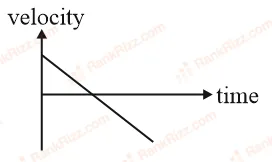
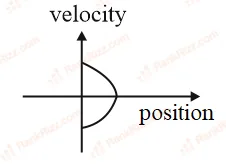
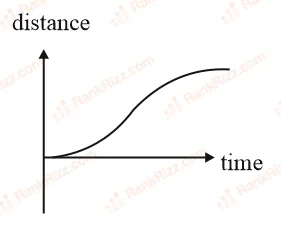
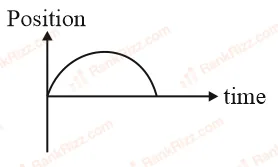
All the graphs below are intended to represent the same motion. One of them does it incorrectly. Pick it up.

  1. A
    Figure for JEE Main 2018 Physics question on Equations of motion for uniform acceleration
  2. B
    Figure for JEE Main 2018 Physics question on Equations of motion for uniform acceleration
  3. C
    Figure for JEE Main 2018 Physics question on Equations of motion for uniform acceleration
  4. D
    Figure for JEE Main 2018 Physics question on Equations of motion for uniform acceleration

Equations of motion for uniform acceleration: common questions

How many Equations of motion for uniform acceleration questions have come in JEE Main?
Equations of motion for uniform acceleration has been asked 25 times in JEE Main, in 11 different years between 2004 and 2026. It came up in 4 of the last five exam years (2022–2026), 13 questions in all.
Is Equations of motion for uniform acceleration important for JEE Main?
It is one of the three most-asked topics in Motion in a Straight Line: 25 of the chapter's 134 JEE Main questions (19%). It came up in 4 of the last five exam years (2022–2026), 13 questions in all.
When was Equations of motion for uniform acceleration last asked in JEE Main?
Most recently in JEE Main 08 Apr 2026, Shift 2. Questions on this page are newest first, so the latest ones are at the top.
What kind of Equations of motion for uniform acceleration questions does JEE Main ask?
19 are multiple choice and 6 numerical-value; 10 easy and 8 medium by our difficulty labels. Each question shows its answer key and worked solution where we have them.