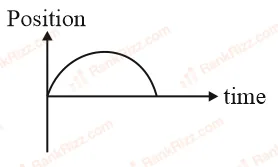
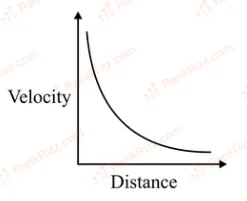
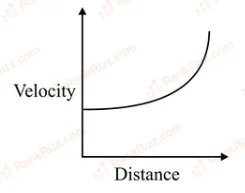
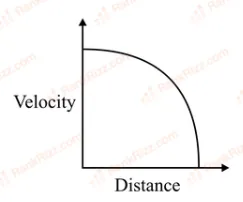
The position vector of a particle changes with time according to the relation . What is the magnitude of the acceleration at ?
- A
40
- B
25
- C
100
- D
50
Every Motion in a Straight Line question JEE Main has set from 2004–2026, grouped by the idea it tests rather than the order of the syllabus. 134 questions across 6 distinct ideas. Free to read, answer key on every one.
DATA UPDATED
Questions
134
Distinct ideas
6
Share of marks
1.8%
Difficulty
EASY
A chapter is not one subject — it is a handful of procedures the examiner reuses. These are the ones Motion in a Straight Line questions actually test.
101–120 OF 134 · NEWEST FIRST
The position vector of a particle changes with time according to the relation . What is the magnitude of the acceleration at ?
40
25
100
50
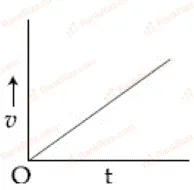
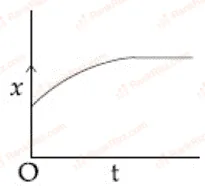
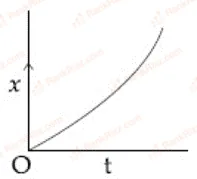
A particle starts from origin O from rest and moves with a uniform acceleration along the positive -axis. Identify all figures that correctly represent the motion qualitatively. (a = acceleration, v = velocity, x = displacement, t = time)

A, B, D
A, B, C
B, C
A
A passenger train of length 60 m travels at a speed of 80 km/hr. Another freight train of length 120 m travels at a speed of 30 km/hr. The ratio of times taken by the passenger train to completely cross the freight train when: (i) they are moving in the same direction, and (ii) in the opposite directions is:
A particle moves from the point m, at , with an initial velocity ms. It is acted upon by a constant force which produces a constant acceleration ms. What is the distance of the particle from the origin at time 2 s?
15 m
m
5 m
m
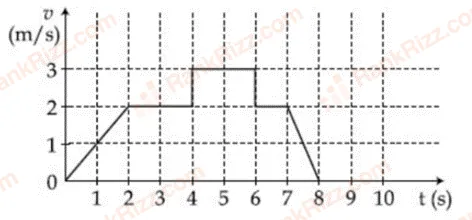
A particle starts from the origin at time and moves along the positive -axis. The graph of velocity with respect to time is shown in figure. What is the position of the particle at time ?

10 m
9 m
6 m
3 m
In a car race on straight road, car A takes a time less than car at the finish and passes finishing point with a speed more than that of car . Both the cars start from rest and travel with constant acceleration and respectively. Then is equal to:
An automobile, travelling at 40 km/h, can be stopped at a distance of 40 m by applying brakes. If the same automobile is travelling at 80 km/h, the minimum stopping distance, in metres, is (assume no skidding):
75 m
160 m
100 m
150 m
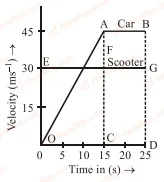
The velocity-time graphs of a car and a scooter are shown in the figure. (i) the difference between the distance travelled by the car and the scooter in 15 s and (ii) the time at which the car will catch up with the scooter are, respectively.

337.5 m and 25 s
225.5 m and 10 s
112.5 m and 22.5 s
112.5 m and 15 s
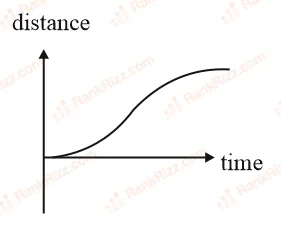
All the graphs below are intended to represent the same motion. One of them does it incorrectly. Pick it up.


A car is standing 200 m behind a bus, which is also at rest. The two start moving at the same instant but with different forward accelerations. The bus has acceleration 2 m s and the car has acceleration 4 m s. The car will catch up with the bus after time:
s
15 s
s
s
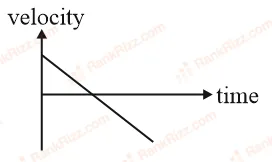
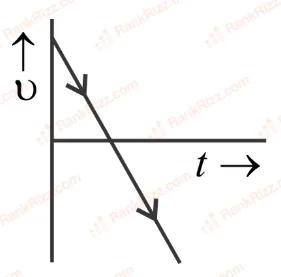
Which graph corresponds to an object moving with a constant negative acceleration and a positive velocity?


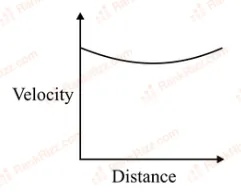
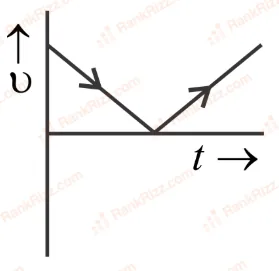
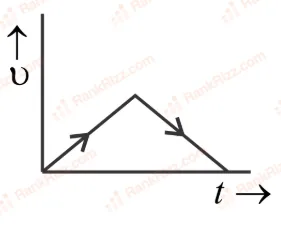
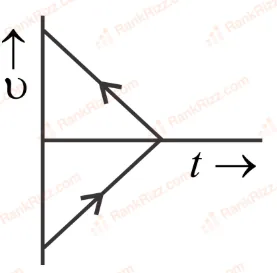
A body is thrown vertically upwards. Which one of the following graphs correctly represents the velocity vs time ?


From the top of a 64 metres high tower, a stone is thrown upwards vertically with the velocity of 48 m/s. The greatest height (in metres) attained by the stone, assuming the value of the gravitational acceleration m/s, is:
112
88
128
100
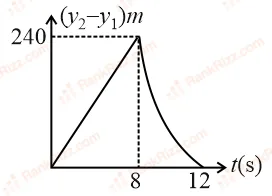
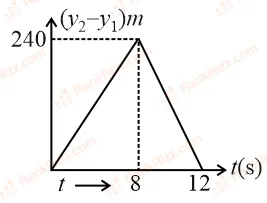
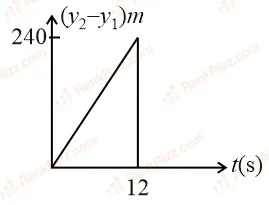
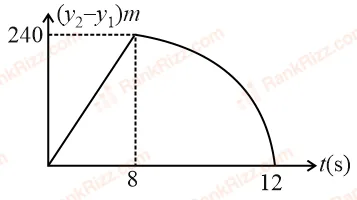
Two stones are thrown up simultaneously from the edge of a cliff 240 m high with an initial speed of 10 m s and 40 m s respectively. Which of the following graph best represents the time variation of the relative position of the second stone with respect to the first? (Assume stones do not rebound after hitting the ground and neglect air resistance, take ms)(the figures are schematic and not drawn to scale)


A person climbs up a stalled escalator in 60 s. If standing on the same but escalator running with constant velocity he takes 40 s. How much time is taken by the person to walk up the moving escalator?
37 s
27 s
24 s
45 s
From a tower of height H, a particle is thrown vertically upwards with a speed u. The time taken by the particle, to hit the ground, is n times that taken by it to reach the highest point of its path. The relation between H, u and n is:
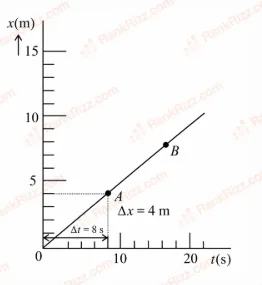
The graph of an object's motion (along the -axis) is shown in the figure. The instantaneous velocity of the object at points and are and respectively. Then

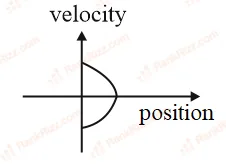
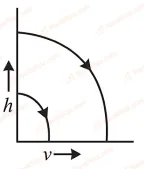
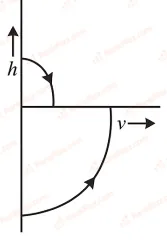
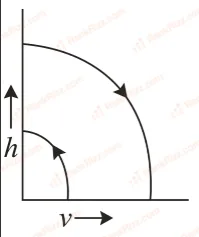
A ball is dropped vertically downwards from a height above the ground. It hits the ground inelastically and bounces up vertically. Neglecting subsequent motion and air resistance, which of the following graph represents variation between speed () and height () correctly?


A goods train accelerating uniformly on a straight railway track, approaches an electric pole standing on the side of track. Its engine passes the pole with velocity and the guard's room passes with velocity . The middle wagon of the train passes the pole with a velocity.
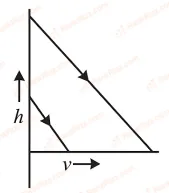
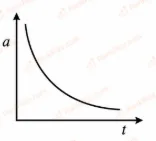
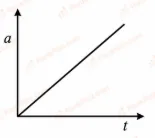
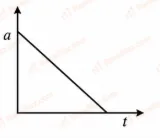
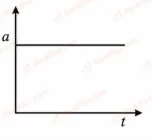
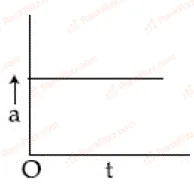
The distance travelled by a body moving along a line in time is proportional to . The acceleration-time graph for the motion of the body will be


OTHER PHYSICS CHAPTERS