JEE Main 2021 Physics question — Motion graphs: x-t, v-t and a-t
The velocity-displacement graph of a particle is shown in the figure.
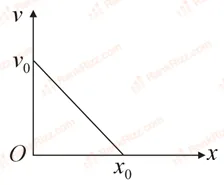
The acceleration-displacement graph of the same particle is represented by :
SOLUTION
We need to find the correct acceleration-displacement () graph corresponding to the given velocity-displacement () graph of a particle.
1. Analyze the Velocity-Displacement () Graph
From the problem statement, the velocity decreases linearly with displacement . This straight line has a positive vertical intercept and a negative slope.
We can write the equation of this line using the slope-intercept form ():
Where:
- is the negative slope of the line ().
- is the initial velocity at (the positive vertical intercept).
2. Derive the Acceleration Expression
Acceleration is defined as the rate of change of velocity with respect to time (). Using the chain rule, we can express it in terms of displacement :
Since , the relationship simplifies to:
Now, let's find the components from Equation 1:
- The derivative of velocity with respect to displacement is the constant slope:
- Substitute and into the acceleration formula:
3. Determine the Features of the Graph
Equation 2 () is also a linear equation representing a straight line on an coordinate plane:
- Slope: The coefficient of is . Since any real squared number is positive, the line has a positive slope (it slants upwards from left to right).
- Vertical Intercept: At , the acceleration is . Since both and are positive constants, the vertical intercept is negative (it starts below the horizontal origin axis).
Looking at the options, the graph that features a straight line starting from a negative vertical intercept and sloping upwards to cross the -axis is Option C.
Conclusion
The correct acceleration-displacement graph is represented by Option C.