RankRizz

Mechanical Properties of Fluids — JEE Main Previous Year Questions

Every Mechanical Properties of Fluids question JEE Main has set from 2004–2026, grouped by the idea it tests rather than the order of the syllabus. 193 questions across 9 distinct ideas. Free to read, answer key on every one.

DATA UPDATED

Questions

193

Distinct ideas

9

Share of marks

4.2%

Difficulty

MEDIUM

The ideas inside Mechanical Properties of Fluids

A chapter is not one subject — it is a handful of procedures the examiner reuses. These are the ones Mechanical Properties of Fluids questions actually test.

Every Mechanical Properties of Fluids question

101–120 OF 193 · NEWEST FIRST

JEE MAIN 2022 · 29 JUN S2Stokes' law and terminal velocity

A small spherical ball of radius 0.1 mm and density 10410^4 kg m−3^{-3} falls freely under gravity through a distance hh before entering a tank of water. If, after entering the water the velocity of ball does not change and it continue to fall with same constant velocity inside water, then the value of hh will be ______ m. (Given g=10g = 10 m s−2^{-2}, viscosity of water =1.0×10−5= 1.0 \times 10^{-5} N-s m−2^{-2}).

JEE MAIN 2022 · 28 JUN S1Viscosity, Poiseuille's equation and Reynolds number

Assertion A: Product of Pressure (PP) and time (tt) has the same dimension as that of coefficient of viscosity.
Reason: Coefficient of viscosity = ForceVelocity gradient\frac{\text{Force}}{\text{Velocity gradient}}

  1. A

    Both A and R true, and R is correct explanation of A.

  2. B

    Both A and R are true but R is NOT the correct explanation of A.

  3. C

    A is true but R is false.

  4. D

    A is false but R is true.

JEE MAIN 2022 · 28 JUN S1Surface tension and surface energy

A water drop of diameter 22 cm is broken into 6464 equal droplets. The surface tension of water is 0.0750.075 N m−1^{-1}. In this process the gain in surface energy will be

  1. A

    2.8×10−42.8 \times 10^{-4} J

  2. B

    1.5×10−31.5 \times 10^{-3} J

  3. C

    1.9×10−41.9 \times 10^{-4} J

  4. D

    9.4×10−59.4 \times 10^{-5} J

JEE MAIN 2022 · 28 JUN S2Stokes' law and terminal velocity

A water drop of radius 1μ1 \mum falls in a situation where the effect of buoyant force is negligible. Co-efficient of viscosity of air is 1.8×10−51.8 \times 10^{-5} N s m−2^{-2} and its density is negligible as compared to that of water 10610^6 g m−3^{-3}. Terminal velocity of the water drop is
(Take acceleration due to gravity =10= 10 m s−2^{-2})

  1. A

    145.4×10−6145.4 \times 10^{-6} m s−1^{-1}

  2. B

    123.4×10−6123.4 \times 10^{-6} m s−1^{-1}

  3. C

    118.0×10−6118.0 \times 10^{-6} m s−1^{-1}

  4. D

    132.6×10−6132.6 \times 10^{-6} m s−1^{-1}

JEE MAIN 2022 · 28 JUN S2Equation of continuity and Bernoulli's theorem

A liquid of density 750 kg m−3^{-3} flows smoothly through a horizontal pipe that tapers in cross-sectional area from A1=1.2×10⁻²A_1 = 1.2 \times 10^{-2} m2^2 to A2=A12A_2 = \frac{A_1}{2}. The pressure difference between the wide and narrow sections of the pipe is 4500 Pa. The rate of flow of liquid is ______ ×10−3\times 10^{-3} m3^3 s−1^{-1}.

JEE MAIN 2022 · 27 JUN S1Stokes' law and terminal velocity

The velocity of a small ball of mass mm and density d1d_1, when dropped in a container filled with glycerine, becomes constant after some time. If the density of glycerine is d2d_2, then the viscous force acting on the ball will be

  1. A

    mg(1−d1d2)mg\left(1 - \frac{d_1}{d_2}\right)

  2. B

    mg(1−d2d1)mg\left(1 - \frac{d_2}{d_1}\right)

  3. C

    mg(d1d2−1)mg\left(\frac{d_1}{d_2} - 1\right)

  4. D

    mg(d2d1−1)mg\left(\frac{d_2}{d_1} - 1\right)

JEE MAIN 2022 · 27 JUN S1Speed of efflux and applications of Bernoulli's theorem

The area of cross-section of a large tank is 0.50.5 m2^2. It has a narrow opening near the bottom having area of cross-section 11 cm2^2. A load of 2525 kg is applied on the water at the top in the tank. Neglecting the speed of water in the tank, the velocity of the water, coming out of the opening at the time when the height of water level in the tank is 4040 cm above the bottom, will be ______ cm s−1^{-1}.
[Take g=10g = 10 m s−2^{-2}]

JEE MAIN 2022 · 26 JUN S1Equation of continuity and Bernoulli's theorem

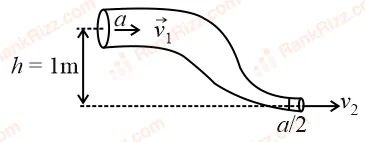
An ideal fluid of density 800800 kg m−3^{-3}, flows smoothly through a bent pipe (as shown in the figure) that tapers in cross-sectional area from aa to a2\frac{a}{2}. The pressure difference between the wide and narrow sections of pipe is 41004100 Pa. At the wider section, the velocity of the fluid is x6\frac{\sqrt{x}}{6} m s−1^{-1} for x=x = ______. (Given g=10g = 10 m s−2^{-2})

Figure for JEE Main 2022 Physics question on Equation of continuity and Bernoulli's theorem
JEE MAIN 2022 · 26 JUN S2Viscosity, Poiseuille's equation and Reynolds number

If pp is the density and η\eta is coefficient of viscosity of fluid which flows with a speed vv in the pipe of diameter dd, the correct formula for Reynolds number ReR_e is

  1. A

    Re=πdρvR_e = \frac{\pi d}{\rho v}

  2. B

    Re=ρvηdR_e = \frac{\rho v}{\eta d}

  3. C

    Re=ρvdηR_e = \frac{\rho v d}{\eta}

  4. D

    Re=ηρvdR_e = \frac{\eta}{\rho v d}

JEE MAIN 2022 · 25 JUN S1Stokes' law and terminal velocity

The terminal velocity vtv_t of the spherical rain drop depends on the radius rr of the spherical rain drop as

  1. A

    rr

  2. B

    r2r^2

  3. C

    1r\frac{1}{r}

  4. D

    1r2\frac{1}{r^2}

JEE MAIN 2022 · 25 JUN S1Viscosity, Poiseuille's equation and Reynolds number

The velocity of upper layer of water in a river is 3636 km h−1^{-1}. Shearing stress between horizontal layers of water is 10−310^{-3} N m−2^{-2}. Depth of the river is ______ m. (Co-efficient of viscosity of water is 10−210^{-2} Pa s)

JEE MAIN 2021 · 27 AUG S1Stokes' law and terminal velocity

In Millikan's oil drop experiment, what is viscous force acting on an uncharged drop of radius 2.0×10−52.0 \times 10^{-5} m and density 1.2×1031.2 \times 10^3 kg m−3^{-3}? Take viscosity of liquid = 1.8×10−51.8 \times 10^{-5} N s m−2^{-2}. (Neglect buoyancy due to air).

  1. A

    5.8×10−105.8 \times 10^{-10} N

  2. B

    3.9×10−103.9 \times 10^{-10} N

  3. C

    1.8×10−101.8 \times 10^{-10} N

  4. D

    3.8×10−113.8 \times 10^{-11} N

JEE MAIN 2021 · 26 AUG S1Angle of contact and capillary rise

Two narrow bores of diameter 5.0 mm and 8.0 mm are joined together to form a U-shaped tube open at both ends. If this U-tube contains water, what is the difference in the level of two limbs of the tube.
[Take surface tension of water T=7.3×10⁻²T = 7.3 \times 10^{-2} N m−1^{-1}, angle of contact = 0, g=10g = 10 m s−2^{-2} and density of water = 1.0×1031.0 \times 10^3 kg m−3^{-3}]

  1. A

    5.34 mm

  2. B

    3.62 mm

  3. C

    2.19 mm

  4. D

    4.97 mm

JEE MAIN 2021 · 26 AUG S1Excess pressure in drops and bubbles

A soap bubble of the radius 3 cm is formed inside another soap bubble of radius 6 cm. The radius of an equivalent soap bubble that has the same excess pressure as inside the smaller bubble with respect to the atmospheric pressure is _________ cm.

JEE MAIN 2021 · 27 JUL S1Speed of efflux and applications of Bernoulli's theorem

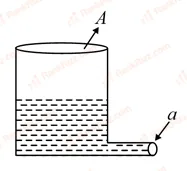
A light cylindrical vessel is kept on a horizontal surface. Area of the base is AA. A hole of cross-sectional area aa is made just at its bottom side. The minimum coefficient of friction necessary to prevent sliding the vessel due to the impact force of the emerging liquid is

Figure for JEE Main 2021 Physics question on Speed of efflux and applications of Bernoulli's theorem
  1. A

    A2a\frac{A}{2a}

  2. B

    None of these

  3. C

    2aA\frac{2a}{A}

  4. D

    aA\frac{a}{A}

JEE MAIN 2021 · 27 JUL S2Stokes' law and terminal velocity

A raindrop with radius R = 0.2 mm falls from a cloud at a height h = 2000 m above the ground. Assume that the drop is spherical throughout its fall and the force of buoyancy may be neglected, then the terminal speed attained by the raindrop is: [Density of water fw=1000f_w = 1000 kg m−3^{-3} and Density of air fa=1.2f_a = 1.2 kg m−3^{-3}, g = 10 m/s2^2, Coefficient of viscosity of air = 1.8×10−51.8 \times 10^{-5} N s m−2^{-2}]

  1. A

    250.6 m s−1^{-1}

  2. B

    43.56 m s−1^{-1}

  3. C

    4.94 m s−1^{-1}

  4. D

    14.4 m s−1^{-1}

JEE MAIN 2021 · 27 JUL S2Speed of efflux and applications of Bernoulli's theorem

The water is filled up to a height of 12 m in a tank having vertical sidewalls. A hole is made in one of the walls at a depth hh below the water level. The value of hh for which the emerging stream of water strikes the ground at the maximum range is _________ m.

JEE MAIN 2021 · 25 JUL S2Excess pressure in drops and bubbles

Two spherical soap bubbles of radii r1r_1 and r2r_2 in vacuum combine under isothermal conditions. The resulting bubble has a radius equal to:

  1. A

    r1r2r1+r2\frac{r_1 r_2}{r_1 + r_2}

  2. B

    r1r2\sqrt{r_1 r_2}

  3. C

    r12+r22\sqrt{r_1^2 + r_2^2}

  4. D

    r1+r22\frac{r_1 + r_2}{2}

JEE MAIN 2021 · 20 JUL S2Surface tension and surface energy

Two small drops of mercury each of radius RR coalesce to form a single large drop. The ratio of total surface energy before and after the change is:

  1. A

    21/3:12^{1/3} : 1

  2. B

    1:21/31 : 2^{1/3}

  3. C

    2:12 : 1

  4. D

    1:21 : 2

JEE MAIN 2021 · 18 MAR S2Speed of efflux and applications of Bernoulli's theorem

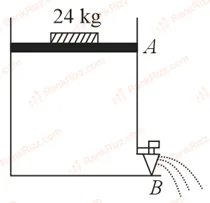
Consider a water tank as shown in the figure. It's cross-sectional area is 0.4 m2^2. The tank has an opening B near the bottom whose cross-section area is 1 cm2^2. A load of 24 kg is applied on the water at the top when the height of the water level is 40 cm above the bottom, the velocity of water coming out the opening B is v m s−1^{-1}. The value of vv, to the nearest integer, is ___. [Take the value of gg to be 10 m s−2^{-2}]

Figure for JEE Main 2021 Physics question on Speed of efflux and applications of Bernoulli's theorem