JEE Main 2021 Physics question — Speed of efflux and applications of Bernoulli's theorem
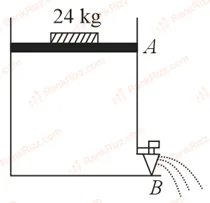
Consider a water tank as shown in the figure. It's cross-sectional area is 0.4 m. The tank has an opening B near the bottom whose cross-section area is 1 cm. A load of 24 kg is applied on the water at the top when the height of the water level is 40 cm above the bottom, the velocity of water coming out the opening B is v m s. The value of , to the nearest integer, is ___. [Take the value of to be 10 m s]
SOLUTION
We need to find the velocity of water coming out of the opening near the bottom of the tank.
1. Identify the Circuit Parameters
From the problem statement, we have the following parameters:
- Cross-sectional area of the tank at the top () =
- Cross-sectional area of the opening at the bottom () =
- Mass of the load applied at the top () =
- Height of the water level () =
- Acceleration due to gravity () =
- Density of water () =
2. Apply Bernoulli's Principle
Since the top cross-sectional area () is vastly larger than the opening area (), the velocity of the water level dropping at the top is negligibly close to zero ().
Let's set our reference level at the bottom opening (). Applying Bernoulli's equation between the top surface () and the bottom opening ():
Where:
- (Atmospheric pressure plus the pressure due to the external load)
- (Exposed directly to atmospheric pressure)
Substituting these pressure values and setting into the equation gives:
3. Solve for Velocity ()
Cancel out the atmospheric pressure () from both sides:
Isolate by multiplying the entire equation by :
Now, plug in the given numerical values:
Taking the square root to find :
Conclusion
The value of to the nearest integer is 3.
Topic: Speed of efflux and applications of Bernoulli's theorem